293 posters, 56 videos, 24 topics, 13 sessions, 658 authors, 215 institutions
ePostersLive by SciGen Technologies S.A. All rights reserved.
ISMICS 2025 Annual Meeting
28 - 31 May, 2025 | Istanbul, Turkey

D147
Should Transaxillary Minithoracotomy Be The Standard Approach For Minimally Invasive Surgical Treatment Of Multiple Valve Pathologies?
Poster Presenter
Authors
Part of Topic
Valve – Surgical Valves
Should Transaxillary Minithoracotomy Be The Standard Approach For Minimally Invasive Surgical Treatment of Multiple Valve Pathologies?
Introduction
Minimally invasive cardiac surgery is increasingly encompassing the majority of cardiac operations. While almost all aorticand mitral valve pathologies can be treatedusing minimally invasive methods withvarious approaches, such methods are not yet as widely applied for pathologies involvingboth valves. Through a vertical thoracotomyincision made in the axillary region, simultaneous interventions can be performedon the aortic, mitral and tricuspid valves. Considering this technique suitable for youngcardiac surgeons interested in minimally invasive surgery, we aim to present the casesof eight patients treated by a young cardiac surgeon.
Patients
All eight patients who underwent minimally invasive surgery on the aortic, mitral and tricuspid valves at Kosuyolu Heart Surgery Center between January 2023 and December 2024 were included in this study. Three of the patients were female. The mean age was 55 years (range: 47–67).
Surgical Technique
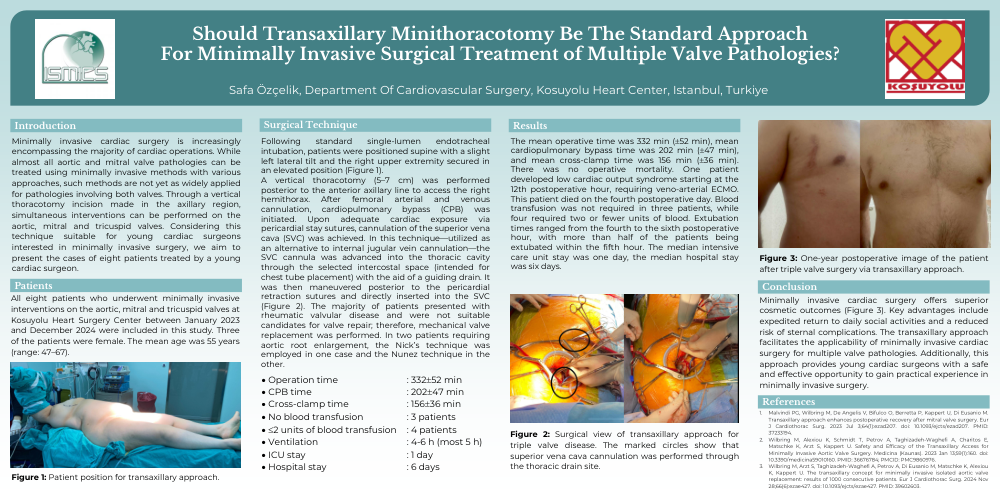
Following standard single-lumen endotracheal intubation, patients were positioned supine with a slight left lateral tiltand the right upper extremity secured in an elevated position. A vertical thoracotomy (5–7 cm) was performed posterior to the anterior axillaryline to access the right hemithorax. After femoral arterial and venous cannulation, cardiopulmonary bypass (CPB) was initiated. Upon adequate cardiac exposure via pericardial stay sutures, cannulation of the superior vena cava (SVC) was achieved. In this technique—utilized as an alternative to internal jugular vein cannulation—the SVC cannula was advanced into the thoracic cavity through the selected intercostal space (intended for chest tube placement) with the aid of a guiding drain. It was then maneuvered posterior to the pericardial retraction sutures and directly inserted into the SVC. The majority of patients presented with rheumatic valvular disease and were not suitable candidates for valve repair; therefore, mechanical valve replacement was performed. In two patients requiring aortic root enlargement, the Nick’s technique was employed in one case and the Nunez technique in the other.
Results
The mean operative time was 332 min (±52min), mean cardiopulmonary bypass time was 202 min (±47 min), and mean cross-clamp time was 156 min (±36 min). There was no operative mortality. One patient developed low cardiac output syndrome starting at the 12th postoperative hour, requiring veno-arterial ECMO. This patient died on the fourth postoperative day. Blood transfusion was not required in three patients, while four required two or fewer units of blood. Extubation times ranged from the fourth to the sixth postoperative hour, with more than half of the patients being extubated within the fifth hour. The median intensive care unit stay was one day, the median hospital stay was six days.
Conclusion
Minimally invasive cardiac surgery offers superior cosmetic outcomes (Figure 3). Key advantages include expedited return to daily social activities and a reduced risk of sternal complications. The transaxillary approach facilitates the applicability of minimally invasive cardiac surgery for multiple valve pathologies. Additionally, this approach provides young cardiac surgeons with a safe and effective opportunity to gain practical experience in minimally invasive surgery.