293 posters, 56 videos, 24 topics, 13 sessions, 658 authors, 215 institutions
ePostersLive by SciGen Technologies S.A. All rights reserved.
ISMICS 2025 Annual Meeting
28 - 31 May, 2025 | Istanbul, Turkey

D146
Minimally Invasive Approach For Accute Endocarditis In A Hypertrophic Cardiomyopathy Patient
Poster Presenter
Authors
Affiliations
Part of Topic
Valve – Surgical Valves
MINIMALLY INVASIVE APPROACH FOR ACCUTE ENDOCARDITIS IN A HYPERTROPHIC CARDIOMYOPATHY (HOCM) PATIENT
Alexandra Andronache MD(1), Dr. Andreea Costache MD. Phd.(2), Ema Pantiru MD(3), Dr. Cristina Pitiş MD(4), Prof. Victor CostacheMD Phd(5)
SUMMARY:
Infective endocarditis (IE) involves a broad range of systemic signs and symptoms, presenting a significant risk of mortality and morbidity in individuals with heart valve abnormalities. We present a novel minimally invasive approach that allows us to perform an effective endoscopic septal myomectomy for hypertrophic obstructive cardiomyopathy (HOCM) and simultaneously allow mitral valve replacement for infective endocarditis. In this case report, we emphasize the importance of determining an early diagnosis of IE introducing appropriate antibiotic therapy, and initiating emergency minimally invasive surgical treatment, which will enhance the patient’s clinical status and decrease both mortality and morbidity rates.
BACKGROUND:
Infective endocarditis (IE) is an uncommon complication associated with hypertrophic cardiomyopathy (HOCM), resulting from bacterial, viral, or fungal infections. Over the last thirty years, there has been a notable increase in both the occurrence and death rates associated with infective endocarditis (IE) (1) with an estimated occurrence of 161 cases per million individuals annually (2). Despite the elevated mortality associated with IE, which surpasses that of acute coronary syndromes, it remains frequently underdiagnosed and inadequately treated in patients with HOCM (3).
Typically, IE affects heart valves, but it can also manifest on the endocardium or within intracardiac devices, particularly in patients experiencing basal outflow tract obstruction (4). Consequently, the overall risk of developing endocarditis in individuals with HOCM is not well defined, leading to challenges in management, especially given the broad clinical presentations of HOCM. Current guidelines advocate for early surgical intervention in cases of IE, even for those patients deemed to be at high risk (5).
We present a case of mitral valve (MV) endocarditis in a previously healthy but symptomatic hypertrophic obstructive cardiomyopathy (HOCM) patient, who presented initially with recurrent bacteremia, having repeated admission to our hospital over a period of 3 weeks for shortness of breath at small efforts with repeated fever episodes, the diagnosis being of acute pulmonary edema. We performed a total endoscopic correction of the HOCM associated with mitral valve replacement with percutaneous cardiopulmonary bypass.
CASE REPORT
A 42-year-old male patient, with a medical history limited to hypertrophic obstructive cardiomyopathy (HOCM), was admitted to a peripheral hospital multiple times over a two-month period due to heart failure symptoms, which included fatigue, reduced physical endurance, dyspnea, and recurrent fever. His symptoms began acutely with a fever following a dental abscess six months prior, which was treated with antibiotics, leading to temporary symptom relief. However, in the last three weeks, he experienced persistent fever and shortness of breath with minimal exertion. Two weeks after being discharged from the hospital, the patient returned to the emergency department (ED) presenting with a high-grade fever, chills, and a significantly deteriorated general condition.
Upon physical examination, a vesicular murmur was noted to be absent at the base of the right lung, and the patient exhibited hypoxemia (SaO2 94% on room air) attributed to acute pulmonary edema. His blood pressure was recorded at 138/86 mmHg, and his heart rate was 80 bpm, with a calculated Euroscore II of 28.34%. An electrocardiogram (ECG) indicated sinus tachycardia, left atrial enlargement, and signs of left ventricular hypertrophy accompanied by ST-T changes. A chest X-ray revealed cardiomegaly and pulmonary congestion, primarily characterized by vascular components, with more pronounced effects on the right side.
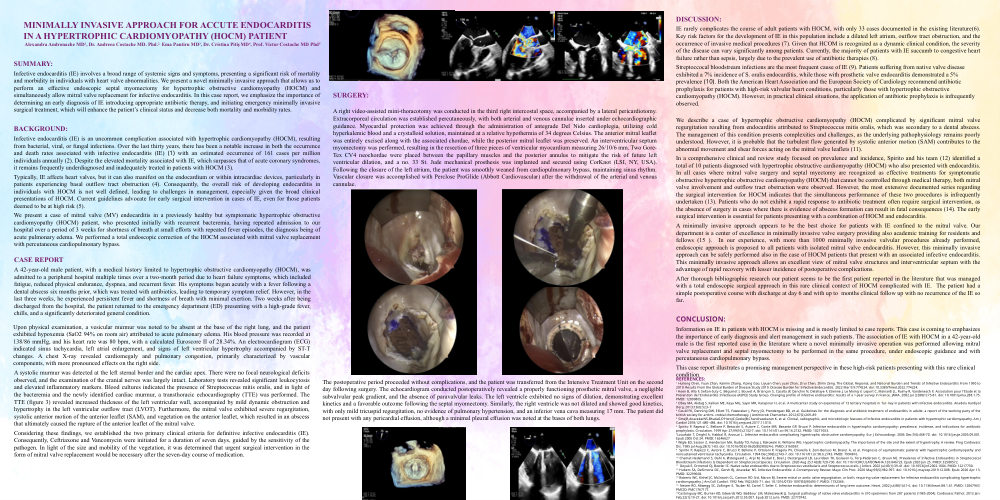
A systolic murmur was detected at the left sternal border and the cardiac apex. There were no focal neurological deficits observed, and the examination of the cranial nerves was largely intact. Laboratory tests revealed significant leukocytosis and elevated inflammatory markers. Blood cultures indicated the presence of Streptococcus mitis oralis, and in light of the bacteremia and the newly identified cardiac murmur, a transthoracic echocardiography (TTE) was performed. The TTE (figure 3) revealed increased thickness of the left ventricular wall, accompanied by mild dynamic obstruction and hypertrophy in the left ventricular outflow tract (LVOT). Furthermore, the mitral valve exhibited severe regurgitation, systolic anterior motion of the anterior leaflet (SAM), and vegetation on the anterior leaflet, which resulted in an abscess that ultimately caused the rupture of the anterior leaflet of the mitral valve.
Considering these findings, we established the two primary clinical criteria for definitive infective endocarditis (IE). Consequently, Ceftriaxone and Vancomycin were initiated for a duration of seven days, guided by the sensitivity of the pathogen. In light of the size and mobility of the vegetation, it was determined that urgent surgical intervention in the form of mitral valve replacement would be necessary after the seven-day course of medication.
SURGERY:
A right video-assisted mini-thoracotomy was conducted in the third right intercostal space, accompanied by a lateral pericardiotomy. Extracorporeal circulation was established percutaneously, with both arterial and venous cannulaeinserted under echocardiographic guidance. Myocardial protection was achieved through the administration of antegrade Del Nido cardioplegia, utilizing cold hyperkalemic blood and a crystalloid solution, maintained at a relative hypothermia of 34 degrees Celsius. The anterior mitral leaflet was entirely excised along with the associated chordae, while the posterior mitral leaflet was preserved. An interventricular septum myomectomy was performed, resulting in the resection of three pieces of ventricular myocardium measuring 26/10/6 mm. Two Gore-Tex CV4 neochordae were placed between the papillary muscles and the posterior annulus to mitigate the risk of future left ventricular dilation, and a no. 33 St. Jude mechanical prosthesis was implanted and secured using CorKnot (LSI, NY, USA). Following the closure of the left atrium, the patient was smoothly weaned from cardiopulmonary bypass, maintaining sinus rhythm. Vascular closure was accomplished with Perclose ProGlide (Abbott Cardiovascular) after the withdrawal of the arterial and venous cannulae.
The postoperative period proceeded without complications, and the patient was transferred from the Intensive Treatment Unit on the second day following surgery. The echocardiogram conducted postoperatively revealed a properly functioning prosthetic mitral valve, a negligible subvalvular peak gradient, and the absence of paravalvular leaks. The left ventricle exhibited no signs of dilation, demonstrating excellent kinetics and a favorable outcome following the septal myomectomy. Similarly, the right ventricle was not dilated and showed good kinetics, with only mild tricuspid regurgitation, no evidence of pulmonary hypertension, and an inferior vena cava measuring 17 mm. The patient did not present with any pericardial effusion, although a minimal pleural effusion was noted at the bases of both lungs.
DISCUSSION:
IE rarely complicates the course of adult patients with HOCM, with only 33 cases documented in the existing literature(6). Key risk factors for the development of IE in this population include a dilated left atrium, outflow tract obstruction, and the occurrence of invasive medical procedures (7). Given that HCOM is recognized as a dynamic clinical condition, the severity of the disease can vary significantly among patients. Currently, the majority ofpatients with IE succumb to congestive heart failure rather than sepsis, largely due to the prevalent use of antibiotic therapies (8).
Streptoccocal bloodstream infections are the most frequent cause of IE (9). Patients suffering from native valve disease exhibited a 7% incidence of S. oralis endocarditis, while those with prosthetic valve endocarditis demonstrated a 5% prevalence (10). Both the American Heart Association and the European Society of Cardiology recommend antibiotic prophylaxis for patients with high-risk valvular heart conditions, particularly those with hypertrophic obstructive cardiomyopathy (HOCM). However, in practical clinical situations, the application of antibiotic prophylaxis is infrequently observed.
We describe a case of hypertrophic obstructive cardiomyopathy (HOCM) complicated by significant mitral valve regurgitation resulting from endocarditis attributed to Streptococcus mitis oralis, which was secondary to a dental abscess. The management of this condition presents complexities and challenges, as the underlying pathophysiology remains poorly understood. However, it is probable that the turbulent flow generated by systolic anterior motion (SAM) contributes to the abnormal movement and shear forces acting on the mitral valve leaflets (11).
In a comprehensive clinical and review study focused on prevalence and incidence, Spirito and his team (12) identified a total of 10 patients diagnosed with hypertrophic obstructive cardiomyopathy (HOCM) who also presented with endocarditis. In all cases where mitral valve surgery and septal myectomy are recognized as effective treatments for symptomatic obstructive hypertrophic obstructive cardiomyopathy (HOCM) that cannot be controlled through medical therapy, both mitral valve involvement and outflow tract obstruction were observed. However, the most extensive documented series regarding the surgical intervention for HOCM indicates that the simultaneous performance of these two procedures is infrequently undertaken (13). Patients who do not exhibit a rapid response to antibiotic treatment often require surgical intervention, as the absence of surgery in cases where there is evidence of abscess formation can result in fatal consequences (14). The early surgical intervention is essential for patients presenting with a combination of HOCM and endocarditis.
A minimally invasive approach appears to be the best choice for patients with IE confined to the mitral valve. Our department is a center of excellence in minimally invasive valve surgery providing also academic training for residents and fellows (15 ). In our experience, with more than 1000 minimally invasive valvular procedures already performed, endoscopic approach is proposed to all patients with isolated mitral valve endocarditis. However, this minimally invasive approach can be safely performed also in the case of HOCM patients that present with an associated infective endocarditis. This minimally invasive approach allows an excellent view of mitral valve structures and interventricular septum with the advantage of rapid recovery with lesser incidence of postoperative complications.
After thorough bibliographic research our patient seems to be the first patient reported in the literature that was managed with a total endoscopic surgical approach in this rare clinical context of HOCM complicated with IE. The patient had a simple postoperative course with discharge at day 6 and with up to months clinical follow up with no recurrence of the IE so far.
CONCLUSION:
Information on IE in patients with HOCM is missing and is mostly limited to case reports. This case is coming to emphasizes the importance of early diagnosis and alert management in such patients. The association of IE with HOCM in a 42-year-old male is the first reported case in the literature where a novel minimally invasive operation was performed allowing mitral valve replacement and septal myomectomy to be performed in the same procedure, under endoscopic guidance and with percutaneous cardiopulmonary bypass.
This case report illustrates a promising management perspective in these high-risk patients presenting with this rare clinical condition.
REFERENCES:
1 Huilong Chen, Yuan Zhan, Kaimin Zhang, Yiping Gao, Liyuan Chen, juan Zhan, Zirui Chen, Zhilin Zeng. The Global, Regional, and National Burden and Trends of Infective Endocarditis From 1990 to 2019: Results From the Global Burden of Disease Study 2019. Disease Burden for Infective Endocarditis. 2022 Mar 9:9:774224. doi: 10.3389/fmed.2022.774224.
2 Hoen B, Alla F, Selton-Suty C, Béguinot I, Bouvet A, Briançon S, Casalta JP, Danchin N, Delahaye F, Etienne J, Le Moing V, Leport C, Mainardi JL, Ruimy R, Vandenesch F; Association pour l'Etude et la Prévention de l'Endocardite Infectieuse (AEPEI) Study Group. Changing profile of infective endocarditis: results of a 1-year survey in France. JAMA. 2002 Jul 3;288(1):75-81. doi: 10.1001/jama.288.1.75. PMID: 12090865.
3 Elbey MA, Akdağ S, Kalkan ME, Kaya MG, Sayın MR, Karapınar H, et al. A multicenter study on experience of 13 tertiary hospitals in Tur‐ key in patients with infective endocarditis. Anadolu KardiyolDerg. 2013;13(6):523–7
4 Gould FK, Denning DW, Elliott TS, Foweraker J, Perry JD, Prendergast BD, et al. Guidelines for the diagnosis and antibiotic treatment of endocarditis in adults: a report of the working party of the british society for antimi‐ crobial chemotherapy. J Antimicrob Chemother. 2012;67(2):269–89
5 SimsJR,AnavekarNS,BhatiaS,O’HoroJC,GeskeJB,Chandrasekaran K, et al. Clinical, radiographic, and microbiologic features of infective endocarditis in patients with hypertrophic cardiomyopathy. Am J Cardiol 2018;121:480–484. doi: 10.1016/j.amjcard.2017.11.010.
6 Spirito P, Rapezzi C, Bellone P, Betocchi S, Autore C, Conte MR, Bezante GP, Bruzzi P. Infective endocarditis in hypertrophic cardiomyopathy: prevalence, incidence, and indications for antibiotic prophylaxis. Circulation. 1999 Apr 27;99(16):2132-7. doi: 10.1161/01.cir.99.16.2132. PMID: 10217653.
7Louahabi T, Drighil A, Habbal R, Azzouzi L. Infective endocarditis complicating hypertrophic obstructive cardiomyopathy. Eur J Echocardiogr. 2006 Dec;7(6):468-70. doi: 10.1016/j.euje.2005.09.001. Epub 2005 Oct 24. PMID: 16246627
8 Wigle ED, Sasson Z, Henderson MA, Ruddy TD, Fulop J, Rakowski H, Williams WG. Hypertrophic cardiomyopathy. The importance of the site and the extent of hypertrophy. A review. Prog Cardiovasc Dis. 1985 Jul-Aug;28(1):1-83. doi: 10.1016/0033-0620(85)90024-6. PMID: 3160067.
9 Spirito P, Rapezzi C, Autore C, Bruzzi P, Bellone P, Ortolani P, Fragola PV, Chiarella F, Zoni-BerissoM, Branzi A, et al. Prognosis of asymptomatic patients with hypertrophic cardiomyopathy and nonsustained ventricular tachycardia. Circulation. 1994 Dec;90(6):2743-7. doi: 10.1161/01.cir.90.6.2743. PMID: 7994816.
10 Chamat-Hedemand S, Dahl A, Østergaard L, Arpi M, Fosbøl E, Boel J, Oestergaard LB, LauridsenTK, Gislason G, Torp-Pedersen C, Bruun NE. Prevalence of Infective Endocarditis in Streptococcal Bloodstream Infections Is Dependent on Streptococcal Species. Circulation. 2020 Aug 25;142(8):720-730. doi: 10.1161/CIRCULATIONAHA.120.046723. Epub 2020 Jun 25. PMID: 32580572.
11 Doyuk E, Ormerod OJ, Bowler IC. Native valve endocarditis due to Streptococcus vestibularisand Streptococcus oralis. J Infect. 2002 Jul;45(1):39-41. doi: 10.1053/jinf.2002.1004. PMID: 12217730.
12 Hubers SA, DeSimone DC, Gersh BJ, Anavekar NS. Infective Endocarditis: A Contemporary Review. Mayo Clin Proc. 2020 May;95(5):982-997. doi: 10.1016/j.mayocp.2019.12.008. Epub 2020 Apr 13. PMID: 32299668.
13 Roberts WC, Kishel JC, McIntosh CL, Cannon RO 3rd, Maron BJ. Severe mitral or aortic valve regurgitation, or both, requiring valve replacement for infective endocarditis complicating hypertrophic cardiomyopathy. J Am Coll Cardiol. 1992 Feb;19(2):365-71. doi: 10.1016/0735-1097(92)90493-7. PMID: 1732366.
14 Netzer RO, Altwegg SC, Zollinger E, Täuber M, Carrel T, Seiler C. Infective endocarditis: determinants of long term outcome. Heart. 2002 Jul;88(1):61-6. doi: 10.1136/heart.88.1.61. PMID: 12067947; PMCID: PMC1767177.
15Castonguay MC, Burner KD, Edwards WD, Baddour LM, Maleszewski JJ. Surgical pathology of native valve endocarditis in 310 specimens from 287 patients (1985-2004). Cardiovasc Pathol. 2013 Jan-Feb;22(1):19-27. doi: 10.1016/j.carpath.2012.05.007. Epub 2012 Jul 6. PMID: 22770742.