293 posters, 56 videos, 24 topics, 13 sessions, 658 authors, 215 institutions
ePostersLive by SciGen Technologies S.A. All rights reserved.
ISMICS 2025 Annual Meeting
28 - 31 May, 2025 | Istanbul, Turkey

D138
Robotic Mitral Valve Surgery - A Practical, Reproducible, Day-to-day Curative Option Beyond Cosmetic Appeal
Poster Presenter
Part of Topic
Valve – Surgical Valves
Robotic Mitral Valve Surgery: A practical, Reproducible, Day-to-Day Curative Option Beyond Cosmetic Appeal
Objective:
The objective of this study is to highlight the advantages of robotic mitral valve surgery as a practical and effective treatment option. The motto is to establish its possibility as a daily procedure thereby improving patient outcomes, and to highlight its role in day-to-day clinical practise. Beyond its cosmetic appeal, this approach offers benefits like enhanced surgical precision thereby minimising complications, less blood loss, quick recovery and reduced hospital stay.
Methods:
We retrospectively analysed the data of patients who underwent robotic mitral valve surgery between August 2019 and October 2024. The patient details, echocardiography parameters, perfusion data, blood loss, ventilator support time, ICU stay and mortality were analysed.
Results:
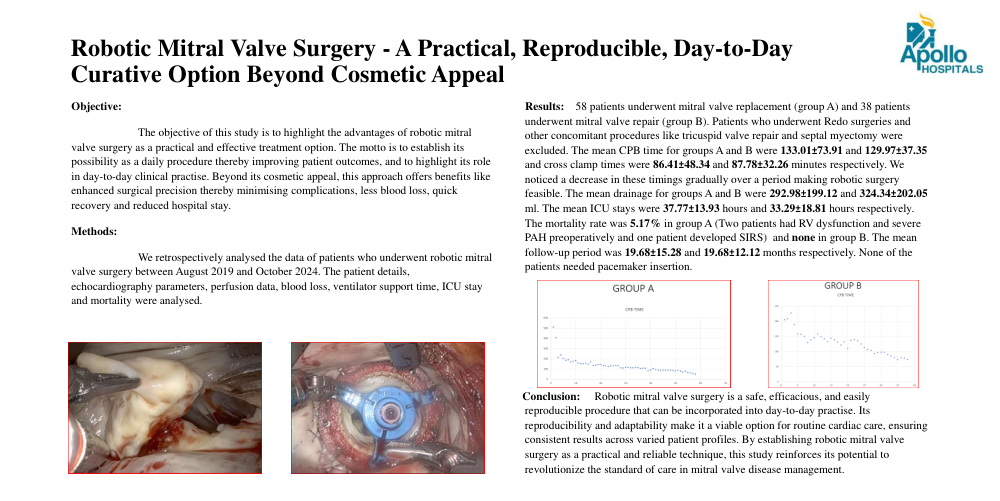
58 patients underwent mitral valve replacement (group A) and 38 patients underwent mitral valve repair (group B). Patients who underwent Redo surgeries and other concomitant procedures like tricuspid valve repair and septal myectomy were excluded. The mean CPB time for groups A and B were 133.01±73.91 and 129.97±37.35 and cross clamp times were 86.41±48.34 and 87.78±32.26 minutes respectively. We noticed a decrease in these timings gradually over a period making robotic surgery feasible. The mean drainage for groups A and B were 292.98±199.12 and 324.34±202.05 ml. The mean ICU stays were 37.77±13.93 hours and 33.29±18.81 hours respectively. The mortality rate was 5.17% in group A (Two patients had RV dysfunction and severe PAH preoperatively and one patient developed SIRS) and none in group B. The mean follow-up period was 19.68±15.28 and 19.68±12.12 months respectively. None of the patients needed pacemaker insertion.
Conclusion:
Robotic mitral valve surgery is a safe, efficacious, and easily reproducible procedure that can be incorporated into day-to-day practise. Its reproducibility and adaptability make it a viable option for routine cardiac care, ensuring consistent results across varied patient profiles. By establishing robotic mitral valve surgery as a practical and reliable technique, this study reinforces its potential to revolutionize the standard of care in mitral valve disease management.