293 posters, 56 videos, 24 topics, 13 sessions, 658 authors, 215 institutions
ePostersLive by SciGen Technologies S.A. All rights reserved.
ISMICS 2025 Annual Meeting
28 - 31 May, 2025 | Istanbul, Turkey

D135
Efficiency Of Folding Mitral Valve Repair Technique For Degenerative Mitral Valve Regurgitation In Robotic Mitral Valve Repair
Poster Presenter
Authors
Affiliations
Part of Topic
Valve – Surgical Valves
Video
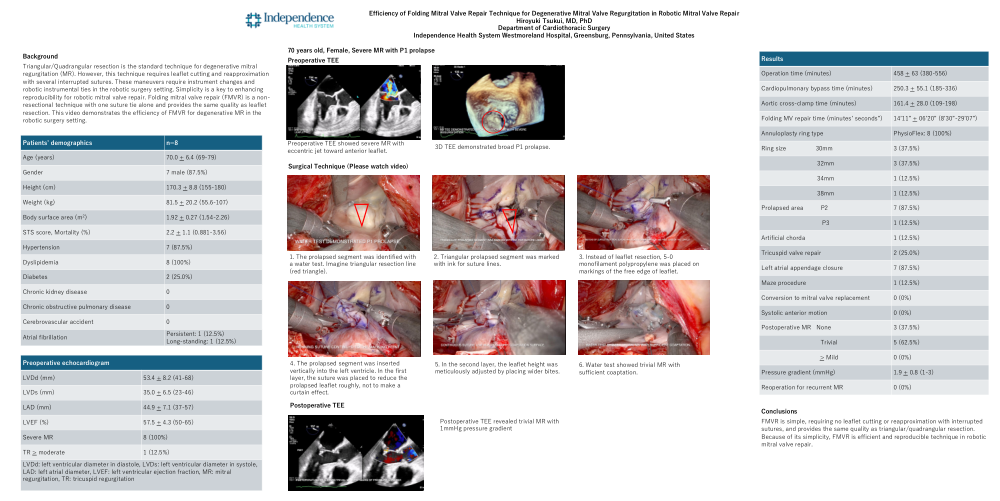
Efficiency of Folding Mitral Valve Repair Technique for Degenerative Mitral Valve Regurgitation in Robotic Mitral Valve Repair
Hiroyuki Tsukui, MD, PhD
Department of Cardiothoracic Surgery
Background
Triangular/Quadrangular resection is the standard technique for degenerative mitral regurgitation (MR). However, this technique requires leaflet cutting and reapproximation with several interrupted sutures. These maneuvers require instrument changes and robotic instrumental ties in the robotic surgery setting. Simplicity is a key to enhancing reproducibility for robotic mitral valve repair. Folding mitral valve repair (FMVR) is a non-resectional technique with one suture tie alone and provides the same quality as leaflet resection. This study demonstrates the efficiency of FMVR for degenerative MR in the robotic surgery setting.
Methods
The prolapsed segment was identified with a water test and marked with ink. The prolapsed segment was inserted vertically into the left ventricle from the free edge of the leaflet to the mitral annulus with a running suture of 5-0 monofilament polypropylene in two layers. In the first layer, the suture was placed to reduce the prolapsed leaflet roughly, not to make a curtain effect. In the second layer, the leaflet height was meticulously adjusted by placing wider bites.
Results
From August 2023 to December 2024, 10 patients (8 male, 68.3 + 6.7 years old) had FMVR for severe degenerative MR. The prolapsed segment was P2 in 8 patients, posterolateral commissure in 1, and P1 in 1. Concomitant procedure included left atrial appendage closure in 9, tricuspid valve repair in 2, and Maze procedure in 1. All patients received ring annuloplasty. One patient required an artificial chord to P2. Aortic cross-clamp time was 157.8 + 21.6 (111-187) minutes. No patient converted to replacement. Postoperative transesophageal echocardiogram showed no MR in 3, trivial MR in 5, and mild MR in 2. All the patients had no anterior leaflet motion. The mean pressure gradient was 2.4 + 1.3 (1-5.2) mmHg. No patient required reoperation for recurrent MR.
Conclusions
FMVR is simple, requiring no leaflet cutting or reapproximation with interrupted sutures, and provides the same quality as triangular/quadrangular resection. Because of its simplicity, FMVR is efficient and reproducible technique in robotic mitral valve repair.