293 posters, 56 videos, 24 topics, 13 sessions, 658 authors, 215 institutions
ePostersLive by SciGen Technologies S.A. All rights reserved.
ISMICS 2025 Annual Meeting
28 - 31 May, 2025 | Istanbul, Turkey

D131
A Comparison Of Endoscopic Versus Median Sternotomy Approach For Myxoma Excision: A Single-center Experience
Poster Presenter
Authors
Bassem Gadallah, Khalid Ajbna, Mohamed Mashat, Joseph Zacharias
Affiliations
Part of Topic
Valve – Surgical Valves
OBJECTIVE:
• Cardiac myxomas are the most common benign tumour of the heart, typically found in the left atrium, and require timely surgical removal to prevent complications such as embolism and obstruction.
• While median sternotomy has traditionally been the preferred approach due to its direct cardiac access, endoscopic-assisted surgery are becoming popular for their less surgical trauma and quicker recovery.
• This study examines the outcomes of endoscopic surgery in comparison to median sternotomy for cardiac myxoma excision.
METHODS:
• This a retrospective study , Between January 2009 and August 2024, a total of 89 patients (27 males, 62 females; age range from 43 to 82 years (mean age: 68) had a confirmed diagnosis of isolated cardiac myxoma were included in the study. The patients were divided into two groups as those underwent endoscopic
myxoma excision (n=24) and those underwent conventional median sternotomy (n=65). Clinical characteristics, operative, and postoperative outcomes were compared.
RESULTS:
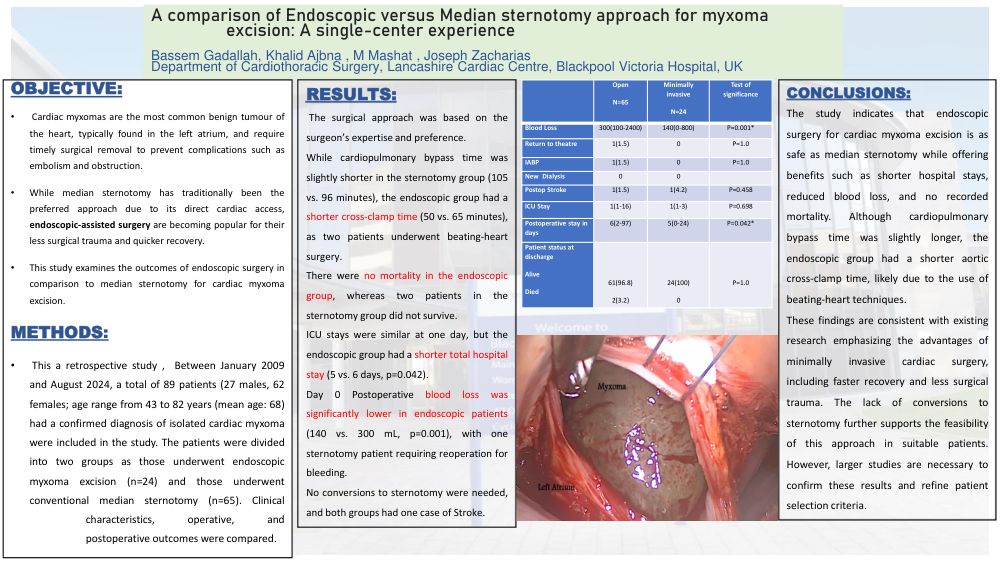
The surgical approach was based on the surgeon’s expertise and preference.
While cardiopulmonary bypass time was slightly shorter in the sternotomy group (105 vs. 96 minutes), the endoscopic group had a shorter cross-clamp time (50 vs. 65 minutes), as two patients underwent beating-heart surgery.
There were no mortality in the endoscopic group, whereas two patients in the sternotomy group did not survive.
ICU stays were similar at one day, but the endoscopic group had a shorter total hospital stay (5 vs. 6 days, p=0.042).
Day 0 Postoperative blood loss was significantly lower in endoscopic patients (140 vs. 300 mL, p=0.001), with one sternotomy patient requiring reoperation for
bleeding.
No conversions to sternotomy were needed, and both groups had one case of Stroke.
CONCLUSIONS:
The study indicates that endoscopic surgery for cardiac myxoma excision is as safe as median sternotomy while offering benefits such as shorter hospital stays,
reduced blood loss, and no recorded mortality. Although cardiopulmonary bypass time was slightly longer, the endoscopic group had a shorter aortic cross-clamp time, likely due to the use of beating-heart techniques.
These findings are consistent with existing research emphasizing the advantages of minimally invasive cardiac surgery, including faster recovery and less surgical trauma. The lack of conversions to sternotomy further supports the feasibility of this approach in suitable patients.
However, larger studies are necessary to confirm these results and refine patient selection criteria.