293 posters, 56 videos, 24 topics, 13 sessions, 658 authors, 215 institutions
ePostersLive by SciGen Technologies S.A. All rights reserved.
ISMICS 2025 Annual Meeting
28 - 31 May, 2025 | Istanbul, Turkey

D113
SEVEN-YEAR EXPERIENCE WITH NOVEL AORTIC BIOPROSTHESIS
Poster Presenter
Part of Topic
Valve – Surgical Valves
Seven-year experience with novel aortic bioprosthesis
Objectives: Bioprostheses are increasingly used in young patients to avoid anticoagulation. The
Inspiris Resilia aortic bioprosthesis (INSPIRIS) (Edwards Lifesciences LLC, Irvine, USA) has
shown to be extremely promising in this population, thanks to a reduced calcification of the
prosthetic leaflets in preclinical and early clinical studies. However, there is paucity of data on
patients younger than 65 years. This study investigates the hemodynamic performance and clinical
outcome of the Inspiris Resilia bioprosthesis in a group of young patients at increased risk of early
structural valve degeneration (SVD).
Methods: All the consecutive patients who received the study prosthesis from January 2018 to
October 2024 were counted: 708 patients aged 61 ± 10.9 years underwent aortic valve
replacement with the Inspiris bioprosthesis at our institution. Follow-up consisted of telephonic
interviews and in-person visits for patients with doubtful findings. The mean follow-up was 27.5 ±
21.2 months (range 1-79.9 months).
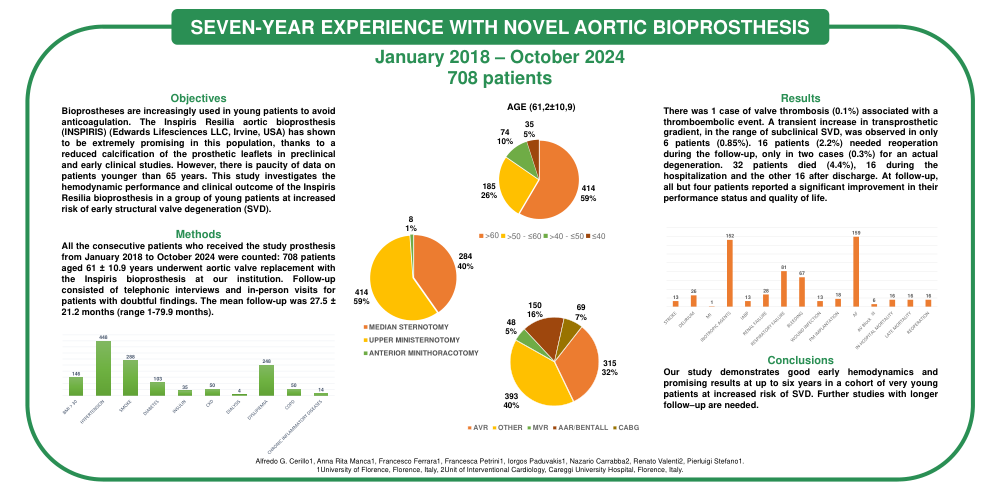
Results: 32 patients died (4.4%), 16 during the hospitalization and the other 16 after discharge.
Sixteen patients (2.2%) needed reoperation during the follow-up, only in two cases (0.3%) for an
actual degeneration. There was one case of valve thrombosis (0.1%) associated with a
thromboembolic event. A transient increase in transprosthetic gradient, in the range of subclinical
SVD, was observed in only 6 patients (0.85%). At follow-up, all but four patients reported a
significant improvement in their symptomatic status and quality of life.
Conclusions: Our study demonstrates good early hemodynamics and promising results at up to six
years in a cohort of very young patients at increased risk of SVD. Further studies with longer
follow–up are needed.