293 posters, 56 videos, 24 topics, 13 sessions, 658 authors, 215 institutions
ePostersLive by SciGen Technologies S.A. All rights reserved.
ISMICS 2025 Annual Meeting
28 - 31 May, 2025 | Istanbul, Turkey

D111
Gender- And Pathology-based Approach In Minimal Invasive Video-assisted Valve Surgery. Does One Access Fit All Patients?
Poster Presenter
Part of Topic
Valve – Surgical Valves
Objective: The aim of our study was to present our strategy and clinical results of minimal invasive video-assisted valve surgery in the department cardiac surgery of general clinical hospital.
Methods: The study included 78 patients operated on between December 2020 and November 2024. Mean age was 69,5±7,6 y. Female patients were 34(43%), male - 44(57%). Mean EF was 59±7,3%. Median of EuroScore II was 3 [1,5-5]. Patients were scheduled for isolated mitral valve replacement (MVR) in 9(11,5%), mitral valve repair (MR) - 21(26,9%), MVR+tricuspid repair 4(5,1%), MR+TR - 15(19,2%), isolated aortic valve replacement (AVR) - 13(16,6%), cardiac myxoma - 15(19,2%), giant right atrium dialysis-associated thrombus - 1(1,2%). Concomitant biatrial cryomaze procedure was applied in 15(19,2%) cases. Preoperative CT-scan was performed in all patients in order to check femoral vessels and aortic anatomy. Early safety and clinical efficacy were estimated in accordance with VARC-3 criteria.
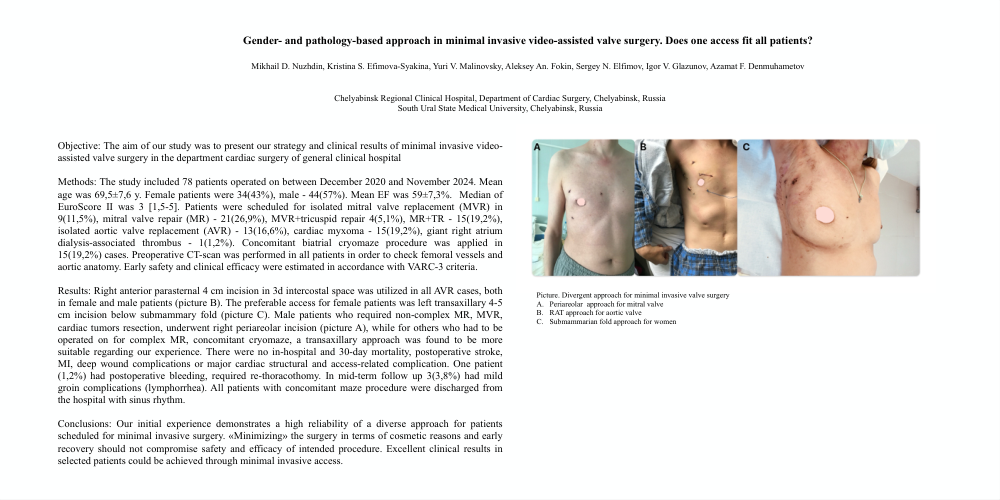
Results: Right anterior parasternal 4 cm incision in 3d intercostal space was utilized in all AVR cases, both in female and male patients (picture B). The preferable access for female patients was left transaxillary 4-5 cm incision below submammary fold (picture C). Male patients who required non-complex MR, MVR, cardiac tumors resection, underwent right periareolar incision (picture A), while for others who had to be operated on for complex MR, concomitant cryomaze, a transaxillary approach was found to be more suitable regarding our experience. There were no in-hospital and 30-day mortality, postoperative stroke, MI, deep wound complications or major cardiac structural and access-related complication. One patient (1,2%) had postoperative bleeding, required re-thoracothomy. In mid-term follow up 3(3,8%) had mild groin complications (lymphorrhea). All patients with concomitant maze procedure were discharged from the hospital with sinus rhythm.
Conclusions: Our initial experience demonstrates a high reliability of a diverse approach for patients scheduled for minimal invasive surgery. «Minimizing» the surgery in terms of cosmetic reasons and early recovery should not compromise safety and efficacy of intended procedure. Excellent clinical results in selected patients could be achieved through minimal invasive access.