293 posters, 56 videos, 24 topics, 13 sessions, 658 authors, 215 institutions
ePostersLive by SciGen Technologies S.A. All rights reserved.
ISMICS 2025 Annual Meeting
28 - 31 May, 2025 | Istanbul, Turkey

D99
Minimal Invasive Rheumatic Mitral Valve Repair: A Single Center Experience.
Poster Presenter
Part of Topic
Valve – Surgical Valves
Video
Minimal Invasive Rheumatic Mitral Valve Repair: A Single Center Experience.
Author Block: Peng Teng, Chen Hu, Liang Ma.
The First Aflliated Hospital, College of Medicine, Zhejiang University, Hangzhou, China.
Abstract:
BACKGROUND: China has the second largest estimated numbers of cases of rheumatic heart disease in the world. Evidence-based medicine
has also confirmed mitral valve repair has shown superior results, which is currently not commonly performed in China. Enhanced recovery
after surgery (ERAS) set a higher demand on minimally invasive surgery, due to the increasing age of the patient of rheumatic mitral valve
malfunction. The objective is to present a single center’s experience in minimal invasive rheumatic mitral valve repair. METHODS: The clinical
data of patients diagnosed with rheumatic mitral valve malfunction and undergoing mitral valve repair in our department from 2021 to
October 2024 were retrospectively analyzed.
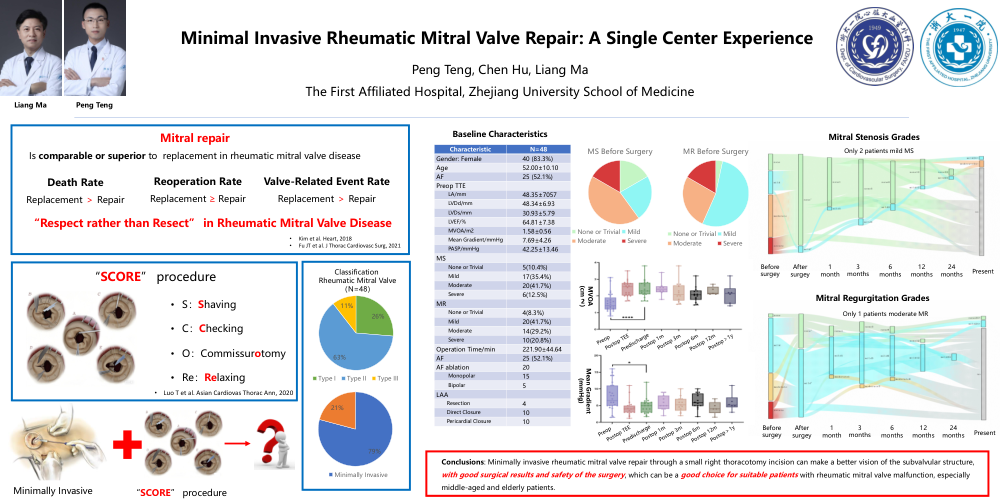
RESULTS: Among all 48 patients with rheumatic mitral valve malfunction who underwent mitral valve repair, 38 patients (79.2%) underwent
minimally invasive mitral valve repair through a small right thoracotomy, including 30 females and 8 males, with a median age of 56.5 years
and median hospital stay of 12 days. Before surgery: mitral stenosis was absent or mild in 5 cases, mild in 17 cases, moderate in 20 cases,
and severe in 6 cases; mitral regurgitation was absent or trivial in 4 cases, mild in 20 cases, moderate in 14 cases, and severe in 10 cases.
After surgery: mitral stenosis was absent or mild in 45 cases, mild in 3 cases, mitral regurgitation was absent or mild in 16 cases, mild in 28
cases, and moderate in 4 cases. The di#erences in mitral stenosis grades, mitral regurgitation grades, LA, LVDd, mitral PTH functional area,
and mitral transvalvular mean pressure gradient before and after surgery were statistically significant (P<0.05). Eight patients underwent
tricuspid valvuloplasty during the same period. There were 24 patients with atrial fibrillation, 18 of whom underwent radiofrequency ablation
during surgery, and 12 underwent continuous closure of the left atrial appendage. Fourteen patients recovered sinus rhythm after surgery or
during follow-up after discharge. No patient died or underwent secondary surgery. Only 2 patients developed moderate mitral stenosis and 2
patients developed moderate mitral regurgitation. CONCLUSIONS:Minimally invasive rheumatic mitral valve repair through a small right
thoracotomy incision can make a better vision of the sub valvular structure, with good surgical results and safety of the surgery, which can be
a good choice for suitable patients with rheumatic mitral valve malfunction, especially middle-aged and elderly patients.