293 posters, 56 videos, 24 topics, 13 sessions, 658 authors, 215 institutions
ePostersLive by SciGen Technologies S.A. All rights reserved.
ISMICS 2025 Annual Meeting
28 - 31 May, 2025 | Istanbul, Turkey

D92
Mini Left Anterior Thoracotomy To Pulmonic Homograft Replacement In Extensive Active Pulmonic Valve Endocarditis
Poster Presenter
Authors
Noppon Taksaudom, Jakaparn Horsatidkul, Amarit Phothikun, Thitipong Thepsuwan
Affiliations
null,
Part of Topic
Valve – Surgical Valves
Video
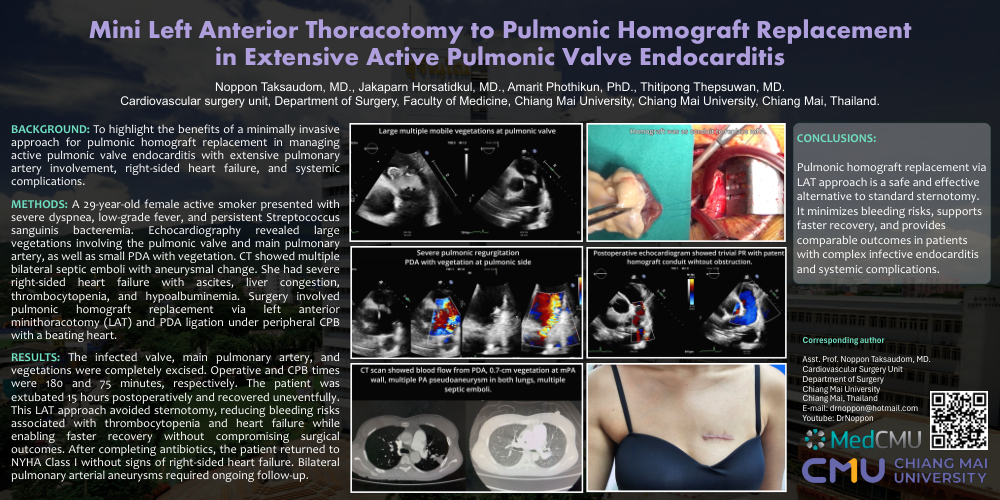
Mini Left Anterior Thoracotomy to Pulmonic Homograft Replacement in Extensive Active Pulmonic Valve Endocarditis
Noppon Taksaudom, MD., Jakaparn Horsatidkul, MD., Amarit Phothikun, PhD., Thitipong Thepsuwan, MD.
Cardiovascular surgery unit, Department of Surgery, Faculty of Medicine, Chiang Mai University, Chiang Mai University, Chiang Mai, Thailand.
BACKGROUND:To highlight the benefits of a minimally invasive approach for pulmonic homograft replacement in managing active pulmonic valve endocarditis with extensive pulmonary artery involvement, right-sided heart failure, and systemic complications.
METHODS:A 29-year-old female active smoker presented with severe dyspnea, low-grade fever, and persistent Streptococcus sanguinis bacteremia. Echocardiography revealed large vegetations involving the pulmonic valve and main pulmonary artery, as well as small PDA with vegetation. CT showed multiple bilateral septic emboli with aneurysmal change. She had severe right-sided heart failure with ascites, liver congestion, thrombocytopenia, and hypoalbuminemia. Surgery involved pulmonic homograft replacement via left anterior minithoracotomy(LAT) and PDA ligation under peripheral CPB with a beating heart.
RESULTS:The infected valve, main pulmonary artery, and vegetations were completely excised. Operative and CPB times were 180 and 75 minutes, respectively. The patient was extubated 15 hours postoperatively and recovered uneventfully. This LAT approach avoided sternotomy, reducing bleeding risks associated with thrombocytopenia and heart failure while enabling faster recovery without compromising surgical outcomes. After completing antibiotics, the patient returned to NYHA Class I without signs of right-sided heart failure. Bilateral pulmonary arterial aneurysms required ongoing follow-up.
CONCLUSIONS:Pulmonic homograft replacement via LAT approach is a safe and effective alternative to standard sternotomy. It minimizes bleeding risks, supports faster recovery, and provides comparable outcomes in patients with complex infective endocarditis and systemic complications.