293 posters, 56 videos, 24 topics, 13 sessions, 658 authors, 215 institutions
ePostersLive by SciGen Technologies S.A. All rights reserved.
ISMICS 2025 Annual Meeting
28 - 31 May, 2025 | Istanbul, Turkey

D85
Preliminary Outcomes Of A Standardized, Non-resectional Technique For Mitral Valve Repair
Poster Presenter
Authors
Beatrice Bacchi, Yasuhiko Kawaguchi, Nicolas Mourad, Bhavendra Singh, Rim Abdelli, Ahmad Alli, Kendra Derry, Daniel J. P. Burns, Gianluigi Bisleri
Affiliations
Division of Cardiac Surgery, St. Michael’s Hospital, University of Toronto, Toronto, ON, Canada, Department of Anesthesiology & Pain Medicine, St. Michael's Hospital, University of Toronto, Toronto, ON, Canada
Part of Topic
Valve – Surgical Valves
Preliminary Outcomes of a Standardized, Non-ResectionalTechnique for Mitral Valve Repair
Beatrice Bacchi1, Yasuhiko Kawaguchi1, Nicolas Mourad1, Bhavendra Singh1, Rim Abdelli1, Ahmad Alli2, Kendra Derry2, Daniel J. P. Burns1, Gianluigi Bisleri1
1Division of Cardiac Surgery, St. Michael’s Hospital, University of Toronto, Toronto, ON, Canada
2Department of Anesthesiology & Pain Medicine, St. Michael's Hospital, University of Toronto, Toronto, ON, Canada
Objectives
Different strategies for mitral valve (MV) repair in treating mitral regurgitation (MR), including both resectional and non-resectional approaches, have demonstrated effectiveness and durability in clinical practice. This study aims to evaluate the preliminary outcomes of a standardized, non-resectionalrepair technique that combines fixed-length chordae implantation with edge-to-edge repair, applied across a broad spectrum of patients undergoing MV repair.
Methods
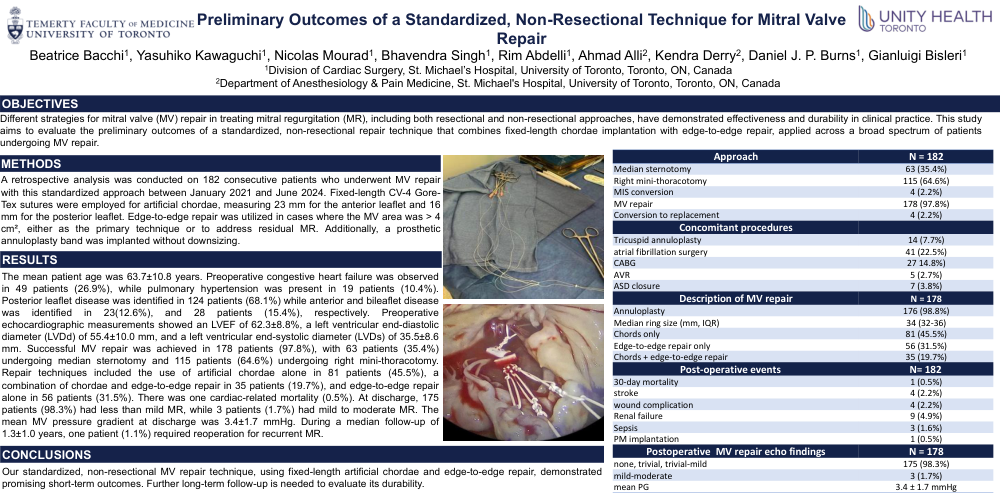
A retrospective analysis was conducted on 182 consecutive patients who underwent MV repair with this standardized approach between January 2021 and June 2024. Fixed-length CV-4 Gore-Tex sutures were employed for artificial chordae, measuring 23 mm for the anterior leaflet and 16 mm for the posterior leaflet. Edge-to-edge repair was utilized in cases where the MV area was > 4 cm², either as the primary technique or to address residual MR. Additionally, a prosthetic annuloplasty band was implanted without downsizing.
Results
The mean patient age was 63.7±10.8 years. Preoperative congestive heart failure was observed in 49 patients (26.9%), while pulmonary hypertension was present in 19 patients (10.4%). Posterior leaflet disease was identified in 124 patients (68.1%) while anterior and bileaflet disease was identified in 23(12.6%), and 28 patients (15.4%), respectively. Preoperative echocardiographic measurements showed an LVEF of 62.3±8.8%, a left ventricular end-diastolic diameter (LVDd) of 55.4±10.0 mm, and a left ventricular end-systolic diameter (LVDs) of 35.5±8.6 mm. Successful MV repair was achieved in 178 patients (97.8%), with 63 patients (35.4%) undergoing median sternotomy and 115 patients (64.6%) undergoing right mini-thoracotomy. Repair techniques included the use of artificial chordae alone in 81 patients (45.5%), a combination of chordae and edge-to-edge repair in 35 patients (19.7%), and edge-to-edge repair alone in 56 patients (31.5%). There was one cardiac-related mortality (0.5%). At discharge, 175 patients (98.3%) had less than mild MR, while 3 patients (1.7%) had mild to moderate MR. The mean MV pressure gradient at discharge was 3.4±1.7 mmHg. During a median follow-up of 1.3±1.0 years, one patient (1.1%) required reoperation for recurrent MR.
Conclusions
Our standardized, non-resectional MV repair technique, using fixed-length artificial chordae and edge-to-edge repair, demonstrated promising short-term outcomes. Further long-term follow-up is needed to evaluate its durability.