293 posters, 56 videos, 24 topics, 13 sessions, 658 authors, 215 institutions
ePostersLive by SciGen Technologies S.A. All rights reserved.
ISMICS 2025 Annual Meeting
28 - 31 May, 2025 | Istanbul, Turkey

D81
Robotic Redo Isolated Tricuspid Surgery: Safety And Outcomes
Poster Presenter
Authors
Gökhan Arslanhan, Murat Baştopçu, Zeynep Sıla Özcan, Anıl Karaağaç, Muharrem Koçyiğit, Halim Ulugöl, Aleks Değirmencioğlu, Şahin Şenay, Cem Alhan
Affiliations
Part of Topic
Valve – Surgical Valves
Robotic Redo Isolated Tricuspid Surgery: Safety And Outcomes
Objective
To evaluate early outcomes and long-term survival of robotic redo isolated tricuspid surgery.
Methods
A retrospective analysis was conducted on patients who underwent robotic redo isolated tricuspid valve surgery between 2016 and 2024 using the Da Vinci Xi surgical system. Patients with previous cardiac surgeries requiring tricuspid valve intervention were included. Patients who required combined coronary or valve surgery were excluded. Patients with depressed ventricular functions received preoperative levosimendan infusion. Data on early and late outcomes were collected and analysed.
Surgical Technique
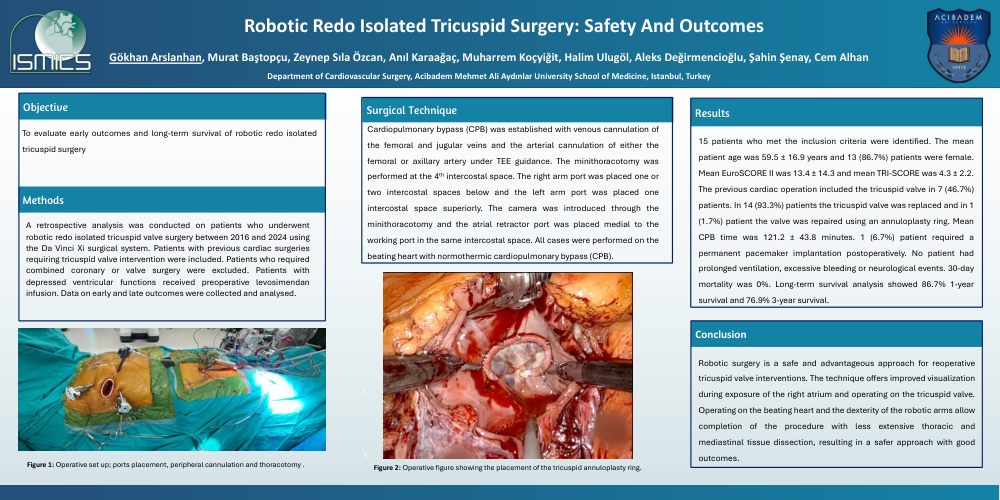
Cardiopulmonary bypass (CPB) was established with venous cannulation of the femoral and jugular veins and the arterial cannulation of either the femoral or axillary artery under TEE guidance. The minithoracotomy was performed at the 4th intercostal space. The right arm port was placed one or two intercostal spaces below and the left arm port was placed one intercostal space superiorly. The camera was introduced through the minithoracotomy and the atrial retractor port was placed medial to the working port in the same intercostal space. All cases were performed on the beating heart with normothermic cardiopulmonary bypass (CPB).
Results
15 patients who met the inclusion criteria were identified. The mean patient age was 59.5 ± 16.9 years and 13 (86.7%) patients were female. Mean EuroSCORE II was 13.4 ± 14.3 and mean TRI-SCORE was 4.3 ± 2.2. The previous cardiac operation included the tricuspid valve in 7 (46.7%) patients. In 14 (93.3%) patients the tricuspid valve was replaced and in 1 (1.7%) patient the valve was repaired using an annuloplasty ring. Mean CPB time was 121.2 ± 43.8 minutes. 1 (6.7%) patient required a permanent pacemaker implantation postoperatively. No patient had prolonged ventilation, excessive bleeding or neurological events. 30-day mortality was 0%. Long-term survival analysis showed 86.7% 1-year survival and 76.9% 3-year survival.
Conclusion
Robotic surgery is a safe and advantageous approach for reoperative tricuspid valve interventions. The technique offers improved visualization during exposure of the right atrium and operating on the tricuspid valve. Operating on the beating heart and the dexterity of the robotic arms allow completion of the procedure with less extensive thoracic and mediastinal tissue dissection, resulting in a safer approach with good outcomes.