293 posters, 56 videos, 24 topics, 13 sessions, 658 authors, 215 institutions
ePostersLive by SciGen Technologies S.A. All rights reserved.
ISMICS 2025 Annual Meeting
28 - 31 May, 2025 | Istanbul, Turkey

D74
Peri Areolar Minimally Invasive Approach For Cardiac Surgery: Single Centre Experience With Literature Review
Poster Presenter
Authors
Part of Topic
Valve – Surgical Valves
PERIAREOLAR MINIMALLY INVASIVE APPROACH FOR CARDIAC SURGERY: SINGLE-CENTER EXPERIENCE WITH LITERATURE REVIEW
OBJECTIVE
The periareolar minimally invasive approach is a novel technique in cardiac surgery that emphasizes minimal disruption of anatomical structures while achieving optimal surgical outcomes. The objective of the study is to evaluate the aesthetic, functional, and quality of life outcomes achieved through the use of the periareolar incision approach in female patients undergoing cardiac surgery.
METHODS
The periareolar MICS technique was employed, involving a left or right thoracotomy and a periareolar incision extending from the 3 to 9 o’clock positions. The present study comprised 24 female patients who underwent various surgical interventions, including valve surgery, coronary revascularization, intracardiac mass excision, or antiarrhythmic surgery. In 23 surgeries, cardiopulmonary bypass was achieved by central arterial cannulation, whereas in one operation, peripheral arterial cannulation via the femoral artery was the preferred approach.
RESULTS
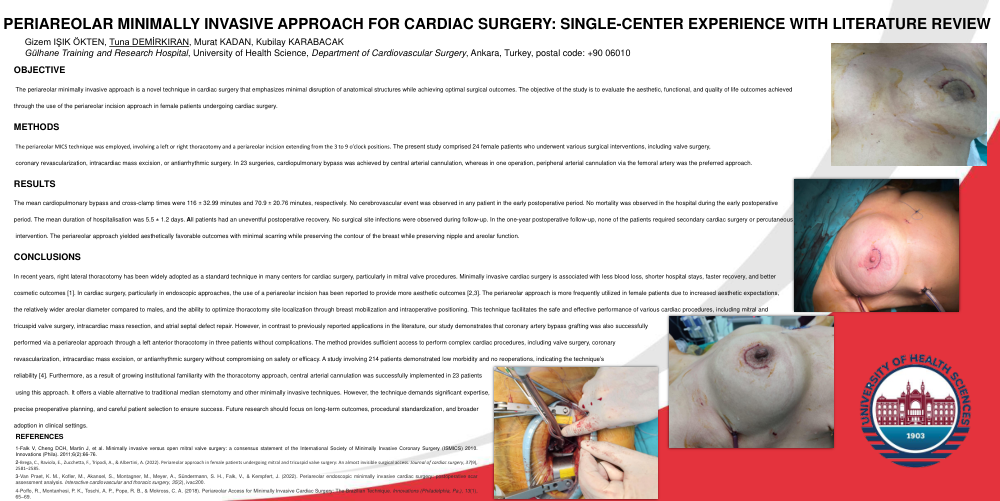
The mean cardiopulmonary bypass and cross-clamp times were 116 ± 32.99 minutes and 70.9 ± 20.76 minutes, respectively. No cerebrovascular event was observed in any patient in the early postoperative period. No mortality was observed in the hospital during the early postoperative period. The mean duration of hospitalisation was 5.5 ± 1.2 days. All patients had an uneventful postoperative recovery. No surgical site infections were observed during follow-up. In the one-year postoperative follow-up, none of the patients required secondary cardiac surgery or percutaneous intervention. The periareolar approach yielded aesthetically favorable outcomes with minimal scarring while preserving the contour of the breast while preserving nipple and areolar function.
CONCLUSIONS
In recent years, right lateral thoracotomy has been widely adopted as a standard technique in many centers for cardiac surgery, particularly in mitral valve procedures. Minimally invasive cardiac surgery is associated with less blood loss, shorter hospital stays, faster recovery, and better cosmetic outcomes [1]. In cardiac surgery, particularly in endoscopic approaches, the use of a periareolar incision has been reported to provide more aesthetic outcomes [2,3]. The periareolar approach is more frequently utilized in female patients due to increased aesthetic expectations, the relatively wider areolar diameter compared to males, and the ability to optimize thoracotomy site localization through breast mobilization and intraoperative positioning. This technique facilitates the safe and effective performance of various cardiac procedures, including mitral and tricuspid valve surgery, intracardiac mass resection, and atrial septal defect repair. However, in contrast to previously reported applications in the literature, our study demonstrates that coronary artery bypass grafting was also successfully performed via a periareolar approach through a left anterior thoracotomy in three patients without complications. The method provides sufficient access to perform complex cardiac procedures, including valve surgery, coronary revascularization, intracardiac mass excision, or antiarrhythmic surgery without compromising on safety or efficacy. A study involving 214 patients demonstrated low morbidity and no reoperations, indicating the technique’s reliability [4]. Furthermore, as a result of growing institutional familiarity with the thoracotomy approach, central arterial cannulation was successfully implemented in 23 patients using this approach. It offers a viable alternative to traditional median sternotomy and other minimally invasive techniques. However, the technique demands significant expertise, precise preoperative planning, and careful patient selection to ensure success. Future research should focus on long-term outcomes, procedural standardization, and broader adoption in clinical settings.