293 posters, 56 videos, 24 topics, 13 sessions, 658 authors, 215 institutions
ePostersLive by SciGen Technologies S.A. All rights reserved.
ISMICS 2025 Annual Meeting
28 - 31 May, 2025 | Istanbul, Turkey

D73
Miclats With Sutured Valve
Poster Presenter
Part of Topic
Valve – Surgical Valves
Video
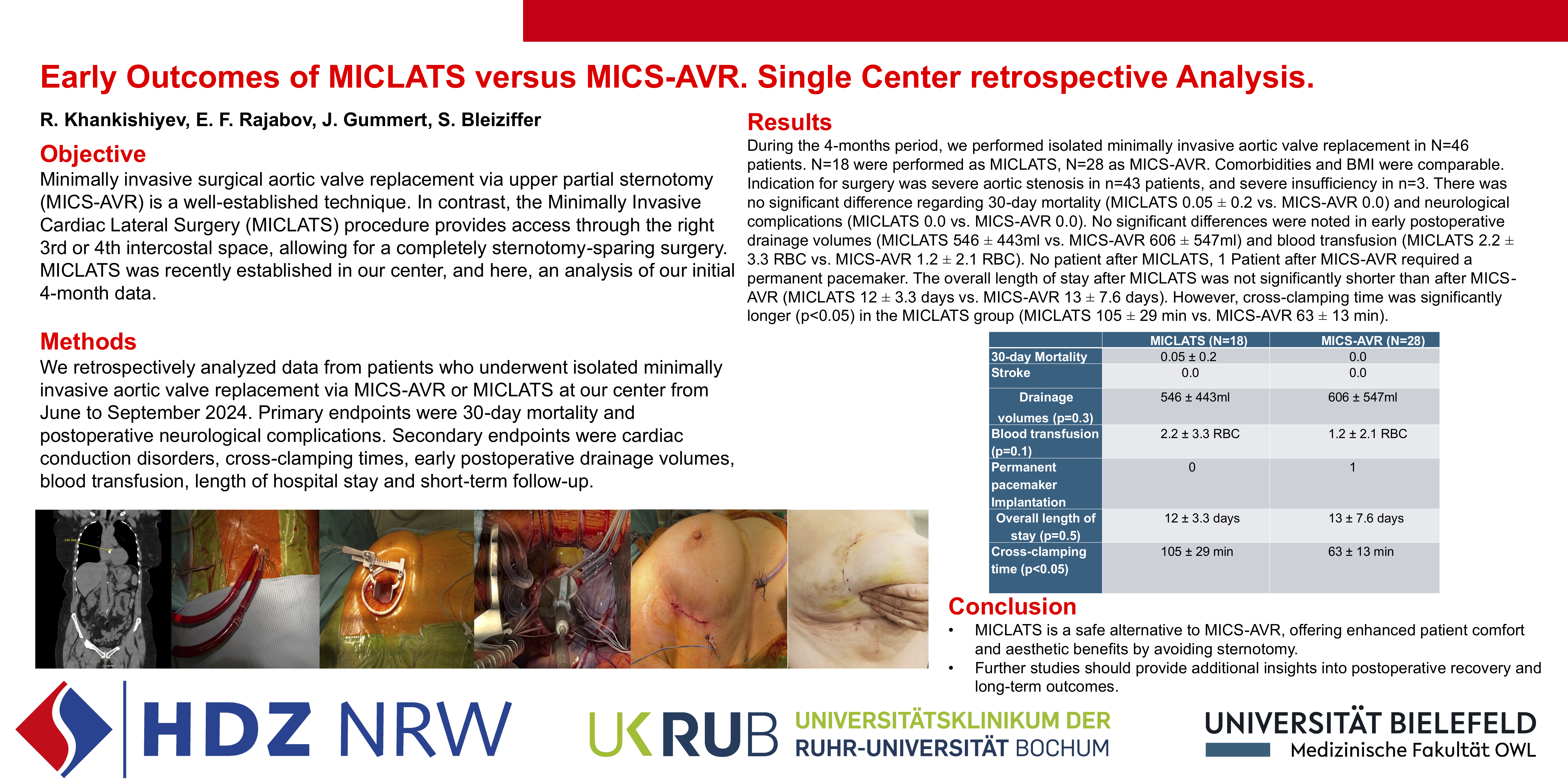
Early Outcomes of MICLATS versus MICS-AVR. Single Center retrospective Analysis.
R. Khankishiyev, E. F. Rajabov, J. Gummert, S. Bleiziffer
Objective: Minimally invasive surgical aortic valve replacement via upper partial sternotomy (MICS-AVR) is a well-established technique. In contrast, the Minimally Invasive Cardiac Lateral Surgery (MICLATS) procedure provides access through the right 3rd or 4th intercostal space, allowing for a completely sternotomy-sparing surgery. MICLATS was recently established in our center, and here, an analysis of our initial 4-month data.
Methods: We retrospectively analyzed data from patients who underwent isolated minimally invasive aortic valve replacement via MICS-AVR or MICLATS at our center from June to September 2024. Primary endpoints were 30-day mortality and postoperative neurological complications. Secondary endpoints were cardiac conduction disorders, cross-clamping times, early postoperative drainage volumes, blood transfusion, length of hospital stay and short-term follow-up.
Results: During the 4-months period, we performed isolated minimally invasive aortic valve replacement in n=46 patients. N=18 were performed as MICLATS, n=28 as MICS-AVR. Comorbidities and BMI were comparable. Indication for surgery was severe aortic stenosis in n=43 patients, and severe insufficiency in n=3. There was no significant difference regarding 30-day mortality (MICLATS 0.05 ± 0.2 vs. MICS-AVR 0.0) and neurological complications (MICLATS 0.0 vs. MICS-AVR 0.0). No significant differences were noted in early postoperative drainage volumes (MICLATS 546 ± 443ml vs. MICS-AVR 606 ± 547ml) and blood transfusion (MICLATS 2.2 ± 3.3 RBC vs. MICS-AVR 1.2 ± 2.1 RBC). No patient after MICLATS, 1 Patient after MICS-AVR required a permanent pacemaker. The overall length of stay after MICLATS was not significantly shorter than after MICS-AVR (MICLATS 12 ± 3.3 days vs. MICS-AVR 13 ± 7.6 days). However, cross-clamping time was significantly longer (p<0.05) in the MICLATS group (MICLATS 105 ± 29 min vs. MICS-AVR 63 ± 13 min).
Conclusions: MICLATS is a safe alternative to MICS-AVR, offering enhanced patient comfort and aesthetic benefits by avoiding sternotomy. Further studies should provide additional insights into postoperative recovery and long-term outcomes.