293 posters, 56 videos, 24 topics, 13 sessions, 658 authors, 215 institutions
ePostersLive by SciGen Technologies S.A. All rights reserved.
ISMICS 2025 Annual Meeting
28 - 31 May, 2025 | Istanbul, Turkey

D70
Endoscopic Mitral Valve Replacement In A Corrected Atrioventricular Septal Defect
Poster Presenter
Authors
Affiliations
Part of Topic
Valve – Surgical Valves
Video
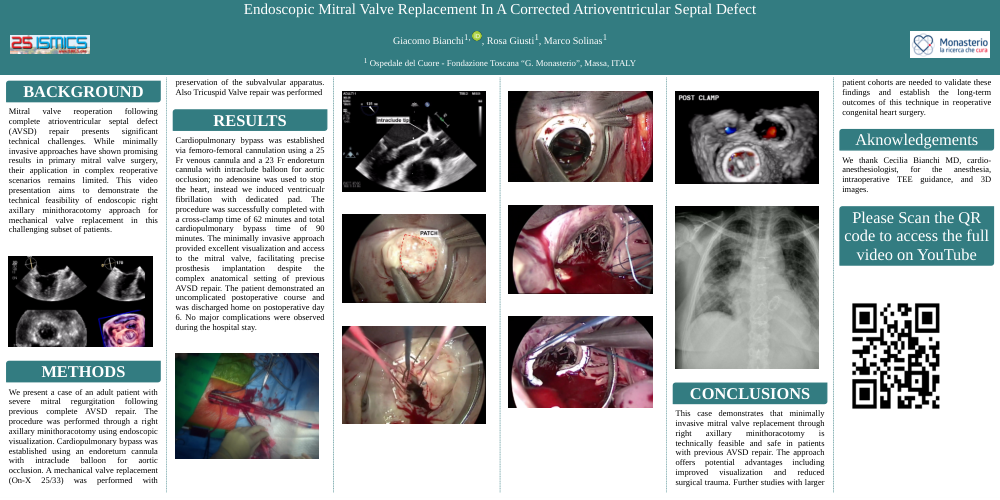
BACKGROUND Mitral valve reoperation following complete atrioventricular septal defect (AVSD) repair presents significant technical challenges. While minimally invasive approaches have shown promising results in primary mitral valve surgery, their application in complex reoperative scenarios remains limited. This video presentation aims to demonstrate the technical feasibility of endoscopic right axillary minithoracotomy approach for mechanical valve replacement in this challenging subset of patients.
METHODS We present a case of an adult patient with severe mitral regurgitation following previous complete AVSD repair. The procedure was performed through a right axillary minithoracotomy using endoscopic visualization. Cardiopulmonary bypass was established using an endoreturn cannula with intraclude balloon for aortic occlusion. A mechanical valve replacement (On-X 25/33) was performed with preservation of the subvalvular apparatus.
RESULTS Cardiopulmonary bypass was established via femoro-femoral cannulation using a 25 Fr venous cannula and a 23 Fr endoreturn cannula with intraclude balloon for aortic occlusion; no adenosine was used to stop the heart, instead we induced ventricualr fibrillation with dedicated pad. The procedure was successfully completed with a cross-clamp time of 62 minutes and total cardiopulmonary bypass time of 90 minutes. The minimally invasive approach provided excellent visualization and access to the mitral valve, facilitating precise prosthesis implantation despite the complex anatomical setting of previous AVSD repair. The patient demonstrated an uncomplicated postoperative course and was discharged home on postoperative day 6. No major complications were observed during the hospital stay.
CONCLUSIONS This case demonstrates that minimally invasive mitral valve replacement through right axillary minithoracotomy is technically feasible and safe in patients with previous AVSD repair. The approach offers potential advantages including improved visualization and reduced surgical trauma. Further studies with larger patient cohorts are needed to validate these findings and establish the long-term outcomes of this technique in reoperative congenital heart surgery.