293 posters, 56 videos, 24 topics, 13 sessions, 658 authors, 215 institutions
ePostersLive by SciGen Technologies S.A. All rights reserved.
ISMICS 2025 Annual Meeting
28 - 31 May, 2025 | Istanbul, Turkey

D67
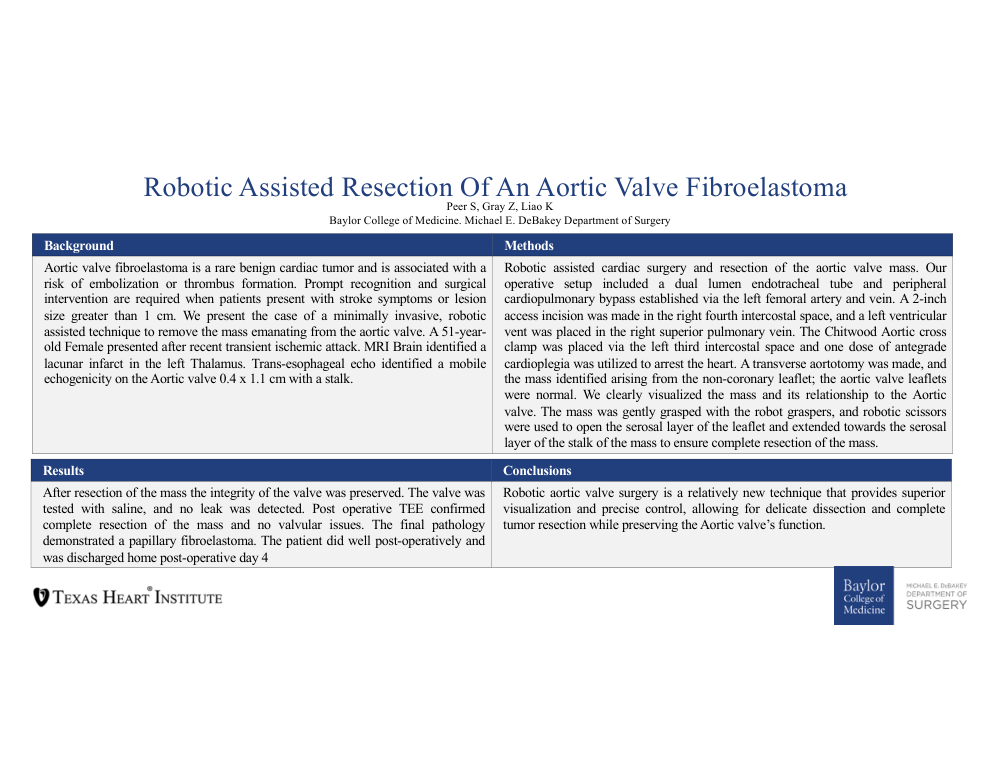
Robotic Assisted Resection Of An Aortic Valve Fibroelastoma
Poster Presenter
Part of Topic
Aortic and Endovascular Therapies
Background:
Aortic valve fibroelastoma is a rare benign cardiac tumor and is associated with a risk of embolization or thrombus formation. Prompt recognition and surgical intervention are required when patients present with stroke symptoms or lesion size greater than 1 cm. We present the case of a minimally invasive, robotic assisted technique to remove the mass emanating from the aortic valve. A 51-year-old Female presented after recent transient ischemic attack. MRI Brain identified a lacunar infarct in the left Thalamus. Trans-esophageal echo identified a mobile echogenicity on the Aortic valve 0.4 x 1.1 cm with a stalk.
Methods:
Robotic assisted cardiac surgery and resection of the aortic valve mass. Our operative setup included a dual lumen endotracheal tube and peripheral cardiopulmonary bypass established via the left femoral artery and vein. A 2-inch access incision was made in the right fourth intercostal space, and a left ventricular vent was placed in the right superior pulmonary vein. The Chitwood Aortic cross clamp was placed via the left third intercostal space and one dose of antegrade cardioplegia was utilized to arrest the heart. A transverse aortotomy was made, and the mass identified arising from the non-coronary leaflet; the aortic valve leaflets were normal. We clearly visualized the mass and its relationship to the Aortic valve. The mass was gently grasped with the robot graspers, and robotic scissors were used to open the serosal layer of the leaflet and extended towards the serosal layer of the stalk of the mass to ensure complete resection of the mass.
Results:
After resection of the mass the integrity of the valve was preserved. The valve was tested with saline, and no leak was detected. Post operative TEE confirmed complete resection of the mass and no valvular issues. The final pathology demonstrated a papillary fibroelastoma. The patient did well post-operatively and was discharged home post-operative day 4.
Conclusion:
Robotic aortic valve surgery is a relatively new technique that provides superior visualization and precise control, allowing for delicate dissection and complete tumor resection while preserving the Aortic valve’s function.