293 posters, 56 videos, 24 topics, 13 sessions, 658 authors, 215 institutions
ePostersLive by SciGen Technologies S.A. All rights reserved.
ISMICS 2025 Annual Meeting
28 - 31 May, 2025 | Istanbul, Turkey

D57
Trends In Implanted Valve Sizes For Minimally Invasive Aortic Valve Replacement At A Veterans Affairs Healthcare System
Poster Presenter
Part of Topic
Valve – Surgical Valves
Trends in Implanted Valve Sizes for Minimally Invasive Aortic Valve Replacement at a Veterans Affairs Healthcare System
Salvador A. Tello¹, Neal Mukherjee¹, Joshua Xian¹, Aditya L. Dwivedi¹, William Carroway MD¹, Axel Gomez MD¹, Shreyas Kiran¹, Marko Boskovski MD¹, Liang Ge PhD¹, Elaine E. Tseng MD¹
¹University of California San Francisco
Introduction
Minimally invasive surgical aortic valve replacement (miSAVR) is a valuable option for patients with isolated aortic valve disease, offering a less invasive surgical alternative while preserving the benefits of direct valve excision and implantation. While transcatheter aortic valve replacement (TAVR) has transformed the management of aortic stenosis, miSAVR remains a critical treatment for select patient populations who may not be ideal TAVR candidates.
This retrospective analysis evaluates the evolution of miSAVR practices and outcomes at the San Francisco VA Healthcare System (SFVAHCS), with a focus on the integration of TAVR-derived imaging modalities—specifically ECG-gated computed tomography angiography (CTA)—into surgical planning and assess key clinical outcomes in the miSAVR patient population.
Objectives
- Evaluate miSAVR Practice Evolution: Analyze procedural characteristics, focusing on surgical approaches, valve types, and ancillary technologies.
- Assess Patient Outcomes: Examine postoperative metrics, including mortality and valve gradients, to determine the impact of procedural changes.
Methods
- Patients: miSAVR patients at SFVAHCS between January 2009 and July 2024.
- RedCap Database: STS-PROM risk calculation variables, outcomes, and surgical techniques.
- Data Collection: Retrospective review of medical records in CPRS inputted in RedCap.
- Data Analysis: Analyze data in R to assess trends and outcomes
Results
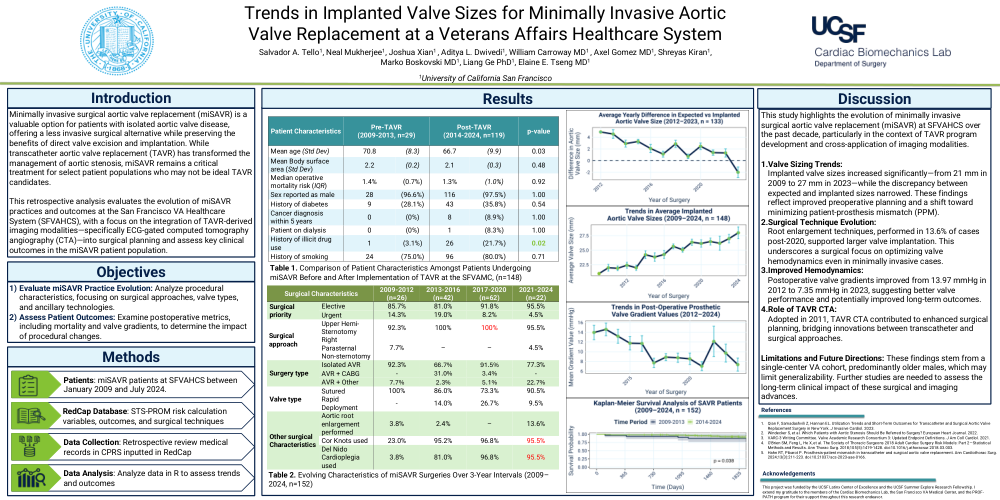
This study highlights the evolution of minimally invasive surgical aortic valve replacement (miSAVR) at SFVAHCS over the past decade, particularly in the context of TAVR program development and cross-application of imaging modalities.
- Valve Sizing Trends:
Implanted valve sizes increased significantly—from 21 mm in 2009 to 27 mm in 2023—while the discrepancy between expected and implanted sizes narrowed. These findings reflect improved preoperative planning and a shift toward minimizing patient-prosthesis mismatch (PPM). - Surgical Technique Evolution:
Root enlargement techniques, performed in 13.6% of cases post-2020, supported larger valve implantation. This underscores a surgical focus on optimizing valve hemodynamics even in minimally invasive cases. - Improved Hemodynamics:
Postoperative valve gradients improved from 13.97 mmHg in 2012 to 7.35 mmHg in 2023, suggesting better valve performance and potentially improved long-term outcomes. - Role of TAVR CTA:
Adopted in 2011, TAVR CTA contributed to enhanced surgical planning, bridging innovations between transcatheter and surgical approaches.
Limitations and Future Directions
These findings stem from a single-center VA cohort, predominantly older males, which may limit generalizability. Further studies are needed to assess the long-term clinical impact of these surgical and imaging advances.
References
- Qian F, Samadashvili Z, Hannan EL. Utilization Trends and Short-Term Outcomes for Transcatheter and Surgical Aortic Valve Replacement Surgery in New York. J Invasive Cardiol. 2023.
- Windecker S, et al. Which Patients with Aortic Stenosis Should Be Referred to Surgery? European Heart Journal. 2022.
- VARC-3 Writing Committee. Valve Academic Research Consortium 3: Updated Endpoint Definitions. J Am Coll Cardiol. 2021.
- O'Brien SM, Feng L, He X, et al. The Society of Thoracic Surgeons 2018 Adult Cardiac Surgery Risk Models: Part 2—Statistical Methods and Results. Ann Thorac Surg. 2018;105(5):1419-1428. doi:10.1016/j.athoracsur.2018.03.003.
- Hahn RT, Pibarot P. Prosthesis-patient mismatch in transcatheter and surgical aortic valve replacement. Ann Cardiothorac Surg. 2024;13(3):211-223. doi:10.21037/acs-2023-aae-0166.
Acknowledgements
This project was funded by the UCSF Latinx Center of Excellence and the UCSF Summer Explore Research Fellowship. I extend my gratitude to the members of the Cardiac Biomechanics Lab, the San Francisco VA Medical Center, and the PROF-PATH program for their support throughout this research endeavor.