293 posters, 56 videos, 24 topics, 13 sessions, 658 authors, 215 institutions
ePostersLive by SciGen Technologies S.A. All rights reserved.
ISMICS 2025 Annual Meeting
28 - 31 May, 2025 | Istanbul, Turkey

D50
Outcomes Of Minimally Invasive Vs Sternotomy Approaches In Aortic Valve Replacement For Infective Endocarditis: A Retrospective Study
Poster Presenter
Authors
Part of Topic
Valve – Surgical Valves
Background
This study aimed to evaluate the outcomes of isolated aortic valve replacement (AVR) for infective endocarditis, comparing traditional full sternotomy with minimally invasive surgical (MIS) approaches. While MIS techniques have gained traction in AVR, their role in endocarditis remains underexplored, with limited evidence on safety and efficacy in this high-risk cohort.
Methods
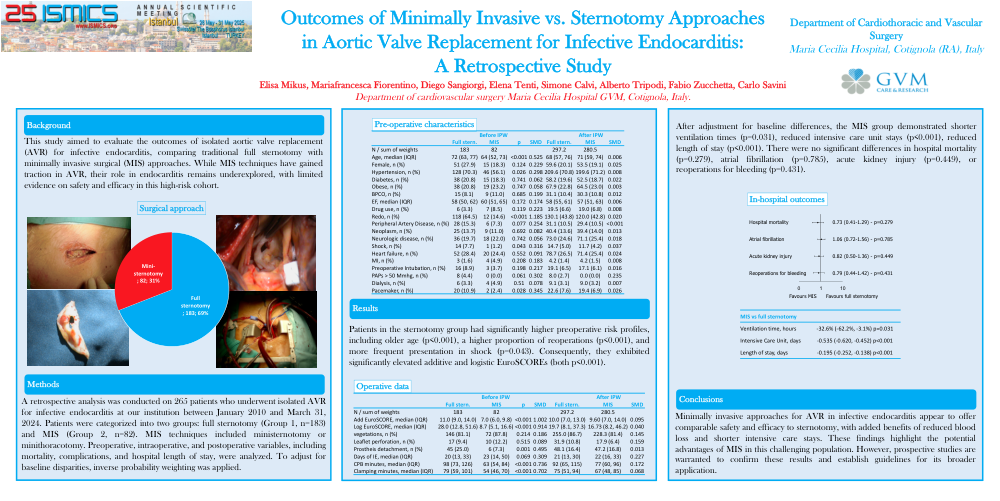
A retrospective analysis was conducted on 265 patients who underwent isolated AVR for infective endocarditis at our institution between January 2010 and March 31, 2024. Patients were categorized into two groups: full sternotomy (Group 1, n=183) and MIS (Group 2, n=82). MIS techniques included ministernotomy or minithoracotomy. Preoperative, intraoperative, and postoperative variables, including mortality, complications, and hospital length of stay, were analyzed. To adjust for baseline disparities, inverse probability weighting was applied.
Results
Patients in the sternotomy group had significantly higher preoperative risk profiles, including older age (p<0.001), a higher proportion of reoperations (p<0.001), and more frequent presentation in shock (p=0.043). Consequently, they exhibited significantly elevated additive and logistic EuroSCOREs (both p<0.001).
After adjustment for baseline differences, the MIS group demonstrated shorter ventilation times (p=0.031), reduced intensive care unit stays (p<0.001), reduced length of stay (p<0.001). There were no significant differences in hospital mortality (p=0.279), atrial fibrillation (p=0.785), acute kidney injury (p=0.449), or reoperations for bleeding (p=0.431).
Conclusions
Minimally invasive approaches for AVR in infective endocarditis appear to offer comparable safety and efficacy to sternotomy, with added benefits of reduced blood loss and shorter intensive care stays. These findings highlight the potential advantages of MIS in this challenging population. However, prospective studies are warranted to confirm these results and establish guidelines for its broader application.