293 posters, 56 videos, 24 topics, 13 sessions, 658 authors, 215 institutions
ePostersLive by SciGen Technologies S.A. All rights reserved.
ISMICS 2025 Annual Meeting
28 - 31 May, 2025 | Istanbul, Turkey

D45
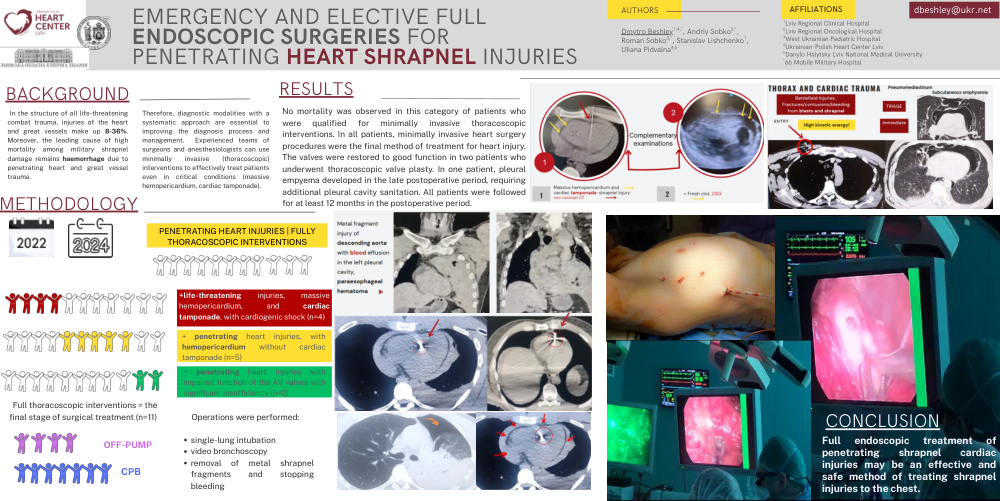
Emergency And Elective Full Endoscoscopic Surgeries For Penetrating Heart Shrapnel Injuries
Part of Topic
Valve – Surgical Valves
Emergency And Elective Full Endoscopic Surgeries For Penetrating Heart Shrapnel Injuries
BACKGROUND
In the structure of all life-threatening combat trauma, injuries of the heart and great vessels make up 8-36%. Moreover, the leading cause of high mortality among military shrapnel damage remains haemorrhage due to penetrating heart and great vessel trauma.
Therefore, diagnostic modalities with a systematic approach are essential to improving the diagnosis process and management. Experienced teams of surgeons and anesthesiologists can use minimally invasive (thoracoscopic) interventions to effectively treat patients even in critical conditions (massive hemopericardium, cardiac tamponade).
Penetrating heart injuries | Fully thoracoscopic Interventions
+life-threatening injuries, massive hemopericardium, and cardiac tamponade, with cardiogenic shock (n=4)
+ penetrating heart injuries, with hemopericardium without cardiac tamponade (n=5)
+ penetrating heart injuries with impaired function of the AV valves with significant insufficiency (n=2)
Operations were performed:
- Single-lung intubation
- Video bronchoscopy
- Removal of metal shrapnel fragments and stopping bleeding
= CPB (n=7); off-pump (n=4)
Full thoracoscopic interventions = the final stage of surgical treatment (n=11)
RESULTS:
No mortality was observed in this category of patients qualified for minimally invasive thoracoscopic interventions. In all patients, minimally invasive heart surgery procedures were the final method of treatment for heart injury. The valves were restored to good function in two patients who underwent thoracoscopic valve plasty. In one patient, pleural empyema developed in the late postoperative period, requiring additional pleural cavity sanitation. All patients were followed for at least 12 months in the postoperative period.
CONCLUSION:
Full endoscopic treatment of penetrating shrapnel cardiac injuries may be an effective and safe method of treating shrapnel injuries to the chest.