293 posters, 56 videos, 24 topics, 13 sessions, 658 authors, 215 institutions
ePostersLive by SciGen Technologies S.A. All rights reserved.
ISMICS 2025 Annual Meeting
28 - 31 May, 2025 | Istanbul, Turkey

D37
Endovascular Repair Of A Symptomatic Kommerell's Aneurysm With Preservation Of Left Subclavian Circulation Using A Branched Thoracic Endograft
Poster Presenter
Authors
Affiliations
Part of Topic
Aortic and Endovascular Therapies
Endovascular Repair Of A Symptomatic Kommerell'sAneurysm With Preservation Of Left Subclavian Circulation Using A Branched Thoracic Endograft
José Francisco Valderrama-Marcos1,2, Alberto Martín-Palanca2, Ignacio Tribes-Caballero1, Julia Fernández-Castañer1, Carmen Ramos-Cantos2, Sergio González-González1.
1Hospital Vithas Málaga, Málaga, Spain | 2Hospital Regional Universitario de Málaga, Málaga, Spain
Background:
An aberrant right subclavian artery with symptomatic dilation of a non-dissecting Kommerell's aneurysm can be potentially life-threatening, associated with a high risk of rupture and dissection. Historically, open surgical repair has been the treatment of choice. However, hybrid and total endovascular approaches, with or without revascularization of the left subclavian artery, have been proposed. In endovascular treatment, coverage of the left subclavian artery without revascularization has been linked to an increased risk of arm ischemia, stroke, and spinal cord injury. To mitigate these complications, hybrid solutions such as carotid-subclavian bypass, or endovascular techniques including chimney, periscope, and custom-made or in-situ fenestrations using Fenestrated Physician-Modified Endovascular Grafts have been proposed.
Methods:
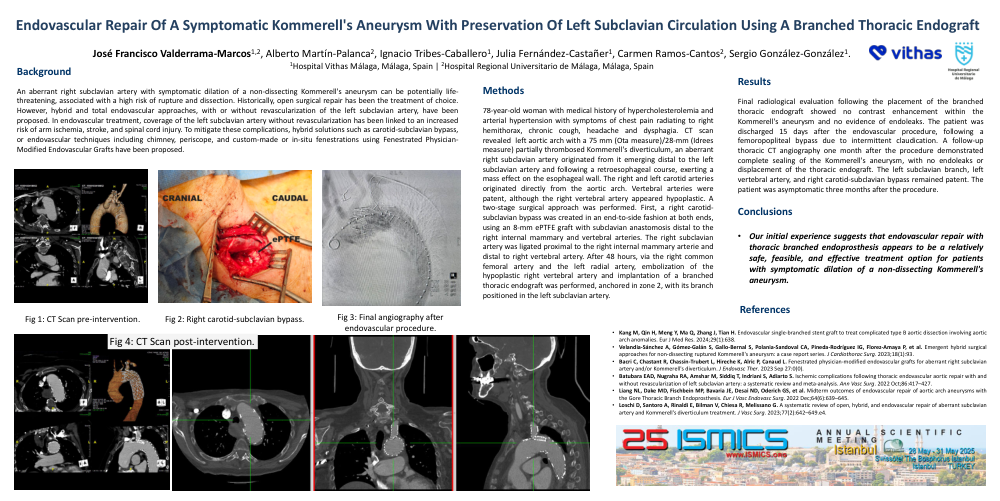
78-year-old woman with medical history of hypercholesterolemia and arterial hypertension with symptoms of chest pain radiating to right hemithorax, chronic cough, headache and dysphagia. CT scan revealed left aortic arch with a 75 mm (Ota measure)/28-mm (Idrees measure) partially thrombosed Kommerell's diverticulum, an aberrant right subclavian artery originated from it emerging distal to the left subclavian artery and following a retroesophageal course, exerting a mass effect on the esophageal wall. The right and left carotid arteries originated directly from the aortic arch. Vertebral arteries were patent, although the right vertebral artery appeared hypoplastic. A two-stage surgical approach was performed. First, a right carotid-subclavian bypass was created in an end-to-side fashion at both ends, using an 8-mm ePTFE graft with subclavian anastomosis distal to the right internal mammary and vertebral arteries. The right subclavian artery was ligated proximal to the right internal mammary arterie and distal to right vertebral artery. After 48 hours, via the right common femoral artery and the left radial artery, embolization of the hypoplastic right vertebral artery and implantation of a branched thoracic endograft was performed, anchored in zone 2, with its branch positioned in the left subclavian artery.
Results:
Final radiological evaluation following the placement of the branched thoracic endograft showed no contrast enhancement within the Kommerell's aneurysm and no evidence of endoleaks. The patient was discharged 15 days after the endovascular procedure, following a femoropopliteal bypass due to intermittent claudication. A follow-up thoracic CT angiography one month after the procedure demonstrated complete sealing of the Kommerell'saneurysm, with no endoleaks or displacement of the thoracic endograft. The left subclavian branch, left vertebral artery, and right carotid-subclavian bypass remained patent. The patient was asymptomatic three months after the procedure.
Conclusions: