293 posters, 56 videos, 24 topics, 13 sessions, 658 authors, 215 institutions
ePostersLive by SciGen Technologies S.A. All rights reserved.
ISMICS 2025 Annual Meeting
28 - 31 May, 2025 | Istanbul, Turkey

D33
Total Endoscopic Minimal Invasive Approach Is Safe Redo Approach For Mitral Valve Surgery (as In First Operation).
Poster Presenter
Authors
Affiliations
Part of Topic
Valve – Surgical Valves
Video
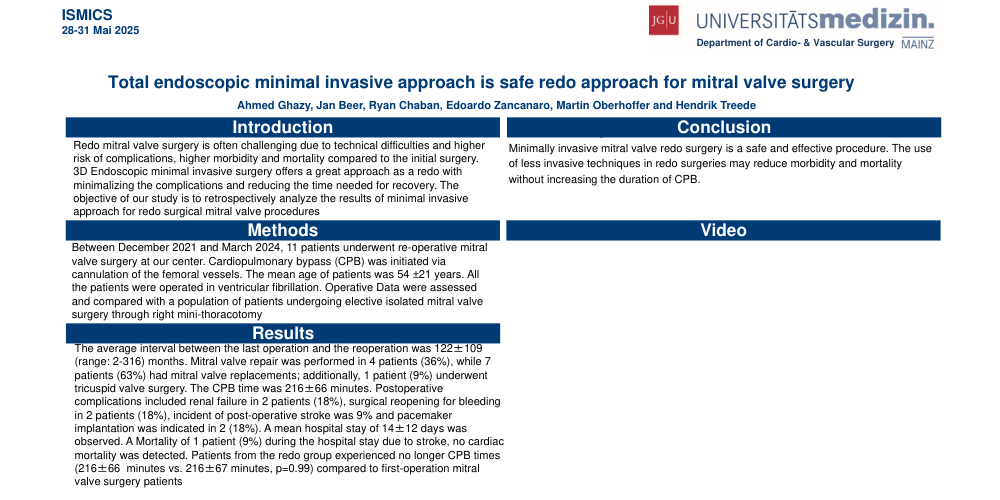
Total endoscopic minimal invasive approach is safe redo approach for mitral valve surgery
Ahmed Ghazy, Jan Beer, Ryan Chaban, Edoardo Zancanaro, Martin Oberhoffer and Hendrik Treede
Introduction:
Redo mitral valve surgery is often challenging due to technical difficulties and higher risk of complications, higher morbidity and mortality compared to the initial surgery. 3D Endoscopic minimal invasive surgery offers a great approach as a redo with minimalizing the complications and reducing the time needed for recovery. The objective of our study is to retrospectively analyze the results of minimal invasive approach for redo surgical mitral valve procedures
Methods:
Between December 2021 and March 2024, 11 patients underwent re-operative mitral valve surgery at our center. Cardiopulmonary bypass (CPB) was initiated via cannulation of the femoral vessels. The mean age of patients was 54 ±21 years. All the patients were operated in ventricular fibrillation. Operative Data were assessed and compared with a population of patients undergoing elective isolated mitral valve surgery through right mini-thoracotomy
Results:
The average interval between the last operation and the reoperation was 122±109 (range: 2-316) months. Mitral valve repair was performed in 4 patients (36%), while 7 patients (63%) had mitral valve replacements; additionally, 1 patient (9%) underwent tricuspid valve surgery. The CPB time was 216±66 minutes. Postoperative complications included renal failure in 2 patients (18%), surgical reopening for bleeding in 2 patients (18%), incident of post-operative stroke was 9% and pacemaker implantation was indicated in 2 (18%). A mean hospital stay of 14±12 days was observed. A Mortality of 1 patient (9%) during the hospital stay due to stroke, no cardiac mortality was detected. Patients from the redo group experienced no longer CPB times (216±66 minutes vs. 216±67 minutes, p=0.99) compared to first-operation mitral valve surgery patients
Conclusion:
Minimally invasive mitral valve redo surgery is a safe and effective procedure. The use of less invasive techniques in redo surgeries may reduce morbidity and mortality without increasing the duration of CPB