293 posters, 56 videos, 24 topics, 13 sessions, 658 authors, 215 institutions
ePostersLive by SciGen Technologies S.A. All rights reserved.
ISMICS 2025 Annual Meeting
28 - 31 May, 2025 | Istanbul, Turkey
D24
Automated Titanium Fastener Use In Minimally Invasive Aortic Valve Replacement: A Propensity Matched Analysis
Poster Presenter
Authors
Mark Lutz, Harry Ramcharran, Shaelyn M. Cavanaugh, Samuel Martin, Karikehalli Dilip, Ahmad Nazem, Anton Cherney, Zhandong Zhou, Kyle Purrman, Jude S. Sauer, Charles Lutz
Affiliations
SUNY Upstate Medical University, St. Joseph's Health Hospital, LSI SOLUTIONS, University of Rochester Medical Center
Part of Topic
Valve – Surgical Valves
Objective:
Less invasive approaches to surgical aortic valve replacement (SAVR) have been demonstrated to provide numerous patient benefits. Using titanium fasteners (TFs) to secure valve suture in minimally invasive SAVR (MIAVR) may further enhance these benefits by making procedures faster and more reliable. Herein we report our center’s experience using TFs in MIAVR by comparing intra- and postoperative results to hand-tied (HT) knots in a retrospective, propensity matched analysis.
Methods:
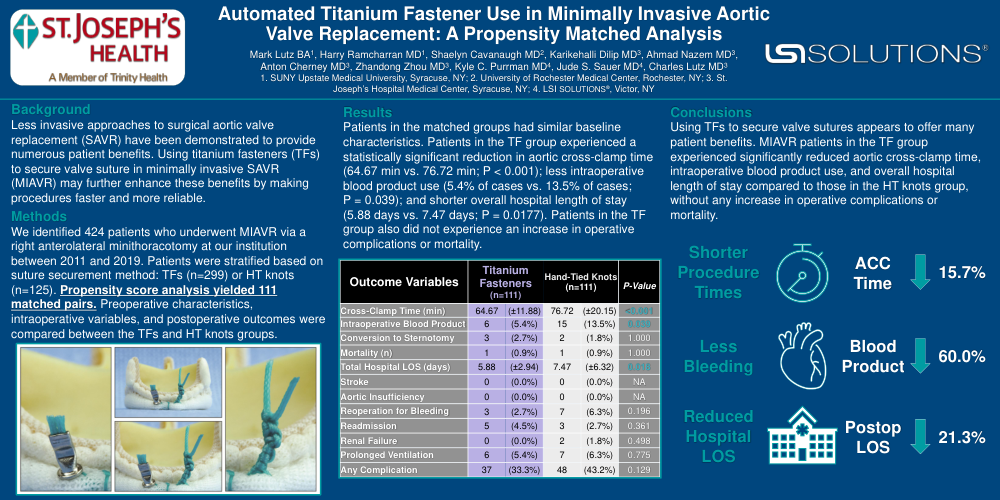
We identified 424 patients who underwent MIAVR via a right anterolateral minithoracotomy at our institution between 2011 and 2019. Patients were stratified based on suture securement method: TFs (n=299) or HT knots (n=125). Propensity score analysis yielded 111 matched pairs. Preoperative characteristics, intraoperative variables, and postoperative outcomes were compared between the TFs and HT knots groups.
Results:
Patients in the matched groups had similar baseline characteristics aside from a small but statistically significant difference in patients undergoing prior cardiovascular interventions (TF = 5 vs. HT = 13; P = 0.049). Patients in the TF group experienced a statistically significant reduction in aortic cross-clamp time (64.67 min vs. 76.72 min; P < 0.001); less intraoperative blood product use (5.4% of cases vs. 13.5% of cases; P = 0.039); and shorter overall hospital length of stay (5.88 days vs. 7.47 days; P = 0.0177). Patients in the TF group also did not experience an increase in operative complications or mortality.
Conclusions:
Using TFs to secure valve sutures appears to offer many patient benefits. MIAVR patients in the TF group experienced significantly reduced aortic cross-clamp time, intraoperative blood product use, and overall hospital length of stay compared to those in the HT knots group, without any increase in operative complications or mortality.