Loading...

293 posters, 56 videos, 24 topics, 13 sessions, 658 authors, 215 institutions

ePostersLive by SciGen Technologies S.A. All rights reserved.

ISMICS 2025 Annual Meeting

28 - 31 May, 2025 | Istanbul, Turkey

ISMICS 2025 Annual Meeting banner

D17

Direct Comparison Of Post-operative Pain Scores After Robotic Versus Conventional Mitral Valve Repair
Part of Topic

Valve – Surgical Valves

DIRECT COMPARISON OF POST-OPERATIVE PAIN SCORES AFTER ROBOTIC VERSUS CONVENTIONAL MITRAL VALVE REPAIR

Ariana Jackson1, Thomas E. Rubino, Jr.1, Martin Winter1, Syed Faaz Ashraf MD1, Keith Dufendach MD1, Nicholas Hess MD1, Rachel Deitz MD, MPH1, Stephen D. Waterford MD1,2, Kathirvel Subramaniam MD3, David Kaczorowski MD1,2, Ibrahim Sultan MD1,2, Johannes Bonatti MD1,2

1Department of Cardiothoracic Surgery, University of Pittsburgh Medical Center, Pittsburgh PA

2Heart and Vascular Institute, University of Pittsburgh Medical Center, Pittsburgh PA

3Department of Anesthesiology and Perioperative Medicine, University of Pittsburgh School of Medicine, Pittsburgh PA


Introduction

-Robotic surgeries are being used as an alternative to conventional mitral valve repairs (MVR).
-Pain outcomes after the first 12 months have been shown to be lower in robotically-assisted MVRs vs those performed with a sternotomy1.
-Other robotic cardiac surgeries (MIDCAB) have been shown to have higher pain score on POD1 and lower pain scores by POD4 compared to traditional sternotomy2.
-Short-term pain outcome differences between the robotically-assisted and traditional MVRs have not been studied.
 
Methodology
 
-Database was created of robotic cardiac surgery cases at UPMC Presbyterian and UPMC Passavant Hospitals since July 19, 2021.
-Matched with patients who underwent mitral valve repair through sternotomy during the same period and from 2015 to June 30, 2024, at UPMC Presbyterian, Passavant, and Shadyside Hospitals in STS cardiac database.
-Excluded: emergent/urgent cases, patients under 18 years, cases performed through partial sternotomy or mini-thoracotomy without the use of a surgical robot and patients with Carpentier’s classification other than class II
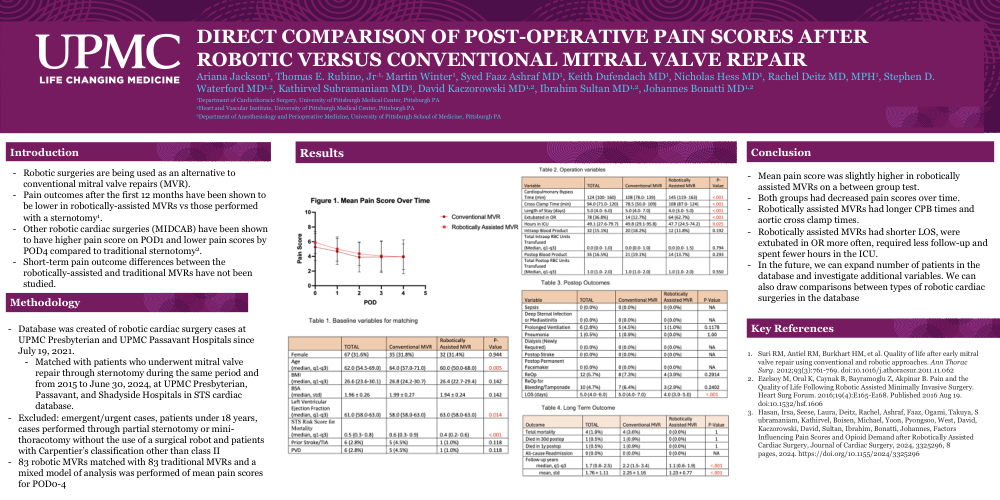
-83 robotic MVRs matched with 83 traditional MVRs and a mixed model of analysis was performed of mean pain scores for POD0-4
 
Results
 
Conclusion
 
-Mean pain score was slightly higher in robotically assisted MVRs on a between group test.
-Both groups had decreased pain scores over time.
-Robotically assisted MVRs had longer CPB times and aortic cross clamp times.
-Robotically assisted MVRs had shorter LOS, were extubated in OR more often, required less follow-up and spent fewer hours in the ICU.
-In the future, we can expand number of patients in the database and investigate additional variables. We can also draw comparisons between types of robotic cardiac surgeries in the database
 
 
Key References
 
1.Suri RM, Antiel RM, Burkhart HM, et al. Quality of life after early mitral valve repair using conventional and robotic approaches. Ann Thorac Surg. 2012;93(3):761-769. doi:10.1016/j.athoracsur.2011.11.062 
 
2.Ezelsoy M, Oral K, Caynak B, Bayramoglu Z, Akpinar B. Pain and the Quality of Life Following Robotic Assisted Minimally Invasive Surgery. Heart Surg Forum. 2016;19(4):E165-E168. Published 2016 Aug 19. doi:10.1532/hsf.1606 
 
3.Hasan, Irsa, Seese, Laura, Deitz, Rachel, Ashraf, Faaz, Ogami, Takuya, Subramaniam, Kathirvel, Boisen, Michael, Yoon, Pyongsoo, West, David, Kaczorowski, David, Sultan, Ibrahim, Bonatti, Johannes, Factors Influencing Pain Scores and Opioid Demand after Robotically Assisted Cardiac Surgery, Journal of Cardiac Surgery, 2024, 3325296, 8 pages, 2024. https://doi.org/10.1155/2024/3325296


ismics2025 banner
Copyright © 2015-2026, ePostersLive® SciGen is a registered trademark of SciGen Technologies S.A. Patent pending.

This website and third-party tools we use rely on cookies for the best user experience. By selecting "I agree", you agree to cookie usage as described in our Privacy Policy.