225 posters, 34 videos, 18 topics, 14 sessions, 251 authors, 55 institutions
ePostersLive by SciGen Technologies S.A. All rights reserved.
ISMICS 2024 Annual Meeting
29 May - 1 June, 2024 | Athens, Greece

PC.58
Results Of Minimally Invasive Thoracic Aortic Surgery In Obese Patients
Poster Presenter
Authors
Affiliations
Part of Topic
Endovascular and Aortic Surgery
Results Of Minimally Invasive Thoracic Aortic Surgery In Obese Patients
Eduard Charchyan, Denis Breshenkov, Yuriy Belov;
Petrovsky National Research Centre of Surgery, Moscow, Russian Federation
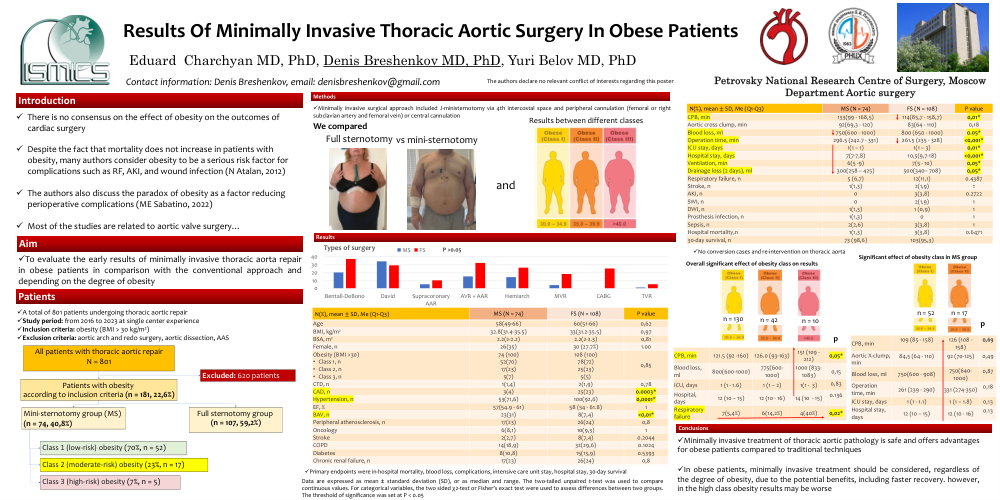
BACKGROUND: In comprehensive studies, it has been shown that minimally invasive aortic valve replacement from a mini-J-sternotomy is safe and beneficial in obese patients. In this study, we assessed the potential benefits of mini-sternotomy in the treatment of thoracic aortic disease in obese patients.
METHODS: We performed a single-center retrospective cohort study of consecutive patients undergoing aortic root, ascending, and arch procedures from full or mini-sternotomy between 2016 and 2023. To determine the benefits of mini-sternotomy, obese patients were divided into full and mini-sternotomy groups. Obesity was defined as an increase in BMI greater than 30 kg/m2. The acute aortic syndrome and repeated interventions were excluded from the study. The primary outcomes were the onset of respiratory failure, wound infection, postoperative length of stay in the ICU and hospital, 30-day mortality, and other complications.
RESULTS: A total of 701 patients were analyzed, of which 292 patients (41.6%) were treated with minimally invasive treatment using a J-shaped mini-sternotomy. The group of obese patients included 182 patients (30.1%) - 74 patients (40.8%) in the mini-sternotomy (MS) group and 108 patients (59.2%) in full sternotomy group. In the MS group, BMI was significantly lower (33.5 ± 3 vs. 36.2 ± 1.8, p <0.05). When analyzing perioperative parameters in the MS group, the cardiopulmonary bypass time (133(99-168,5) min vs. 114 (85-158) min, p = 0.01) was higher then FS group, X-clamp time (92 (69-120) min vs. 83(64-110) min, p = 0.18) was comparable, blood loss (750 (600-1000) ml vs. 800 (650-1000) ml, p =0.05) was lower in MS group. When analyzing postoperative results, MS group had advantages in lower time ventilation (6 (5-9) hours vs. 7(5-10) hours, p = 0.05), ICU stay (1(1) day vs. 1(1-3) days, p <0.01) and hospital stay (7 (7-7.8) days vs. 10.5(9.7-18) days, p <0 .001). While in terms of development of wound complications (1(1.3%) vs. 2(1.9%), respiratory failure (5(6.7%) vs. 7(6.7%) and hospital mortality (1( 1.3%) vs. 2(1.9%) groups were comparable (p>0.05). CONCLUSIONS: Minimally invasive treatment of thoracic aortic pathology is safe and has advantages for obese patients when compared with traditional techniques. In obese patients, minimally invasive surgery should be considered, regardless of the degree of obesity, due to the potential benefits of faster recovery.