225 posters, 34 videos, 18 topics, 14 sessions, 251 authors, 55 institutions
ePostersLive by SciGen Technologies S.A. All rights reserved.
ISMICS 2024 Annual Meeting
29 May - 1 June, 2024 | Athens, Greece

PC.51
Single-stage Total Aortic Replacement After Tevar In Patient With Mega-aortic Syndrome
Poster Presenter
Authors
Affiliations
Part of Topic
Endovascular and Aortic Surgery
Video
Single-stage Total Aortic Replacement After Tevar In Patient With Mega-aortic Syndrome
Eduard Charchyan, Denis Breshenkov, Yuriy Belov;
Petrovsky National Research Centre of Surgery, Moscow, Russian Federation
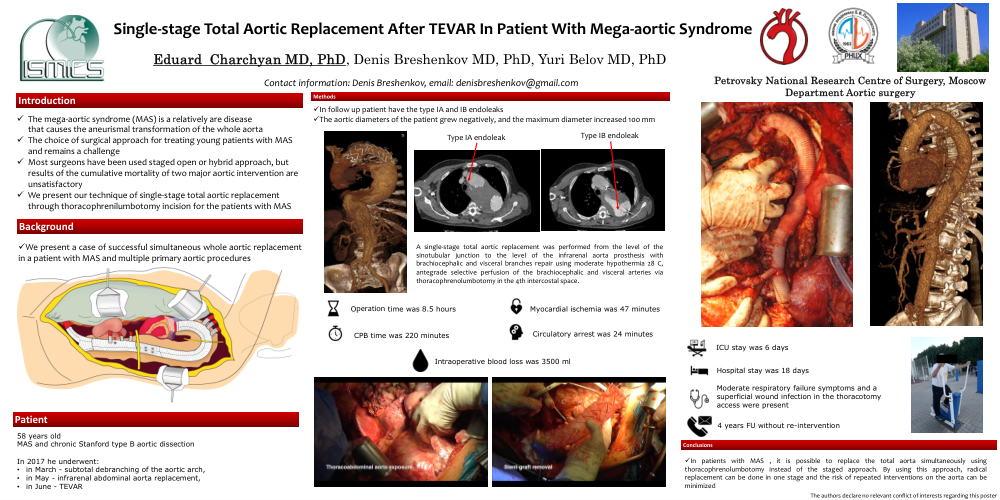
BACKGROUND: We present a case of successful simultaneous whole aortic replacement in a patient with MAS and multiple primary aortic procedures.
METHODS: Mega-aortic syndrome and chronic aortic dissection type B were diagnosed in Patient K, who is 58 years old and has an aneurysm on both the arch and ascending aorta. Initially, the patient at the place of residence in 2017 underwent: in March - subtotal debranching of the branches of the aortic arch, in May - replacement of the infrarenal abdominal aorta, in June - TEVAR with the development of type IA endoleak. The aortic diameters of the patient grew negatively, and the maximum diameter reached 100 mm.
RESULTS: a single-stage total aortic replacement was performed from the level of the sinotubular junction to the level of the infrarenal aorta prosthesis with brachiocephalic and visceral branches repair using moderate hypothermia 28 C, antegrade selective perfusion of the brachiocephalic and visceral arteries via thoracophrenolumbotomy in the 4th intercostal space. The operation time was 8.5 hours, bypass time was 220 minutes, myocardial ischemia time was 47 minutes, circulatory arrest was 24 minutes, aortic clamping time was 67 minutes. Intraoperative blood loss was 3500 ml. Moderate respiratory failure symptoms and a superficial wound infection in the thoracotomy access were present during the postoperative period. On the 28th day, the patient was discharged with satisfactory condition. The patient has been completely rehabilitated and there have been no re-interventions or complications since the operation two years ago.
CONCLUSIONS: In patients with megaaortic syndrome, it is possible to replace the entire aorta simultaneously using thoracophrenolumbotomy instead of the staged approach. By using this approach, radical replacement can be done in one stage and the risk of repeated interventions on the aorta can be minimized.Introduction. The mega-aortic syndrome (MAS) is a rare disease with poor prognosis after conservative treatment, and it is associated with aneurysmal lesions in all segments of the aorta. Despite the current preference for the staged approach, non-radical open replacement and endovascular treatment both have high rates of delayed re-intervention due to disease progression, which undoubtedly worsens the long-term prognosis.