225 posters, 34 videos, 18 topics, 14 sessions, 251 authors, 55 institutions
ePostersLive by SciGen Technologies S.A. All rights reserved.
ISMICS 2024 Annual Meeting
29 May - 1 June, 2024 | Athens, Greece

D.142
Minimally Invasive Avr Via Anterior Right Thoracotomy (art) - A Safe And Effective Approach
Poster Presenter
Authors
Part of Topic
Valve - Surgical Valves
OBJECTIVE: Minimally invasive approach has evolved into a safe, well-tolerated and effective surgical
option for aortic valve replacement in recent years. Four different approaches are used for minimally
invasive aortic valve replacement. These include right parasternal, transverse sternotomy, right anterior
minithoracotomy and upper J or T shaped hemisternotomy. In this study right anterior minithoracotomy via
2nd intercostal space with peripheral cannulation (femorofemoral CPB) was our preferred approach. We
compared postoperative outcomes with this technique to median complete sternotomy (MCS) in
conventional AVR.
METHODS: From Dec 2020 – Jan 2022, 32 patients underwent aortic valve replacement. We divided
these patients in two groups. Group A MIAVR included 16 patients and Group B conventional AVR
included 16 patients. Patient data was collected and analyzed using IBM SPSS statistic 21 and chi squared
test was applied to assess the variables. We presented variables under study as numbers, percentages and
interquartile range.
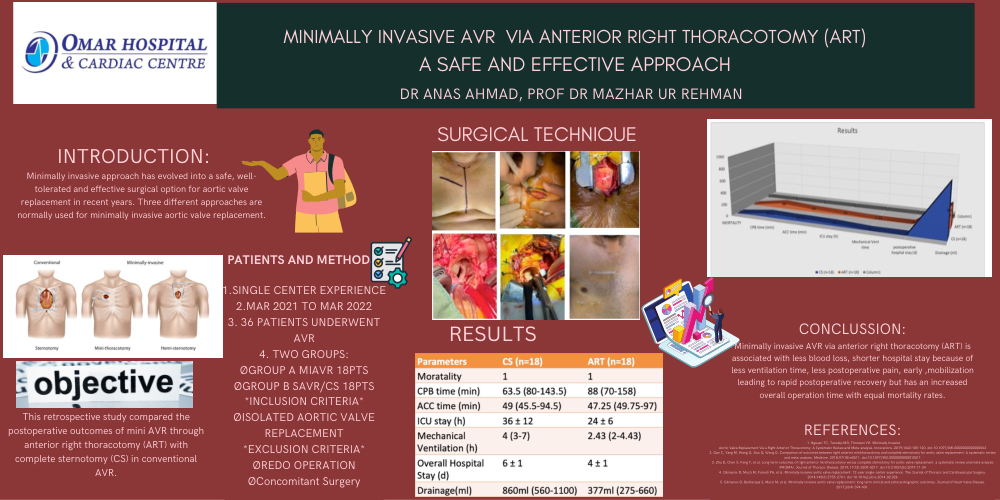
RESULTS: In group A right anterior mini thoracotomy through 2nd intercostal space was used while in
group B median complete sternotomy was done. Mortality and morbidity rates were similar in both groups.
Incidence of stroke was similar in both groups. MIAVR was associated with longer CPB time (88 (70-158)
vs 63.5 (80-143.5) mins with almost comparable Aortic cross clamp time (47.25(49.75-97) vs 49(45.5-94.5)
min. MIAVR was associated with less bleeding therefore decreased blood product requirement 31.2% in
group A vs 62.5% in group B. MIAVR group had less ventilation time (2.43(2-4.43) vs 4( 3-7)hours and
shorter ICU stay (1.25 (1.65 – 2.875) vs 3( 2-5) days. Overall hospital stay was also reduced in MIAVR i.e 4
days vs 7 days in group B. chest drain removal ( mean 1.5 vs 3 days). Early mobilization owing to better
sternal and thoracic stability alongwith less postoperative pain contributes to faster recovery. Improved
cosmesis associated with smaller incision remains an unquestionable benefit of MIAVR.
CONCLUSSION: MIAVR is associated with less transfusion requirement, shorter hospital stay because of
less ventilation time, early mobilization, less postoperative pain leading to rapid postoperative recovery but
has an increased overall operation time.