225 posters, 34 videos, 18 topics, 14 sessions, 251 authors, 55 institutions
ePostersLive by SciGen Technologies S.A. All rights reserved.
ISMICS 2024 Annual Meeting
29 May - 1 June, 2024 | Athens, Greece

D.134
Title Case: Minimally Invasive Resection Of Heart Valve Papillary Fibroelastoma: Two Case Reports And Review Of The Literature
Poster Presenter
Authors
Part of Topic
Valve - Surgical Valves
Minimally invasive resection of heart valve papillary fibroelastoma: two case reports and review of the literature
Phan Quang Thuan a, Pham Tran Viet Chuong a, Dang Nguyen b ,Nguyen Hoang Dinh a
a Department of Adult Cardiovascular Surgery, University Medical Center, Ho Chi Minh City, Vietnam
b Massachusetts General Hospital, Corrigan Minehan Heart Center, Harvard Medical School, Boston, USA
E-mail: phanquangthuan.md@gmail.com
CASE:
Background: The recognition of papillary fibroelastoma (PFE) is increasing due to the widespread use of cardiovascular imaging; however, the optimal management remains varied.
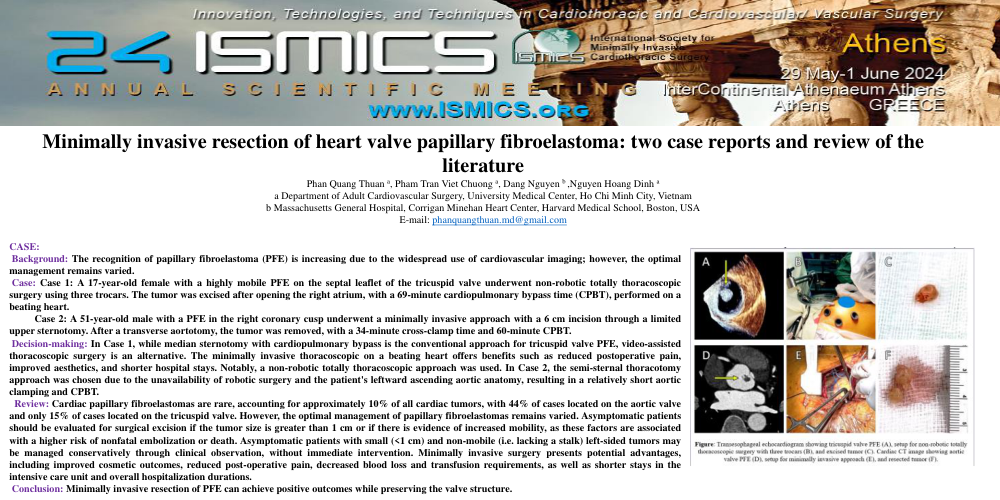
Case: Case 1: A 17-year-old female with a highly mobile PFE on the septal leaflet of the tricuspid valve underwent non-robotic totally thoracoscopic surgery using three trocars. The tumor was excised after opening the right atrium, with a 69-minute cardiopulmonary bypass time (CPBT), performed on a beating heart.
Case 2: A 51-year-old male with a PFE in the right coronary cusp underwent a minimally invasive approach with a 6 cm incision through a limited upper sternotomy. After a transverse aortotomy, the tumor was removed, with a 34-minute cross-clamp time and 60-minute CPBT.
Decision-making: In Case 1, while median sternotomy with cardiopulmonary bypass is the conventional approach for tricuspid valve PFE, video-assisted thoracoscopic surgery is an alternative. The minimally invasive thoracoscopic on a beating heart offers benefits such as reduced postoperative pain, improved aesthetics, and shorter hospital stays. Notably, a non-robotic totally thoracoscopic approach was used. In Case 2, the semi-sternal thoracotomy approach was chosen due to the unavailability of robotic surgery and the patient's leftward ascending aortic anatomy, resulting in a relatively short aortic clamping and CPBT.
Review: Cardiac papillary fibroelastomas are rare, accounting for approximately 10% of all cardiac tumors, with 44% of cases located on the aortic valve and only 15% of cases located on the tricuspid valve. However, the optimal management of papillary fibroelastomas remains varied. Asymptomatic patients should be evaluated for surgical excision if the tumor size is greater than 1 cm or if there is evidence of increased mobility, as these factors are associated with a higher risk of nonfatal embolization or death. Asymptomatic patients with small (<1 cm) and non-mobile (i.e. lacking a stalk) left-sided tumors may be managed conservatively through clinical observation, without immediate intervention. Minimally invasive surgery presents potential advantages, including improved cosmetic outcomes, reduced post-operative pain, decreased blood loss and transfusion requirements, as well as shorter stays in the intensive care unit and overall hospitalization durations.
Conclusion: Minimally invasive resection of PFE can achieve positive outcomes while preserving the valve structure.