225 posters, 34 videos, 18 topics, 14 sessions, 251 authors, 55 institutions
ePostersLive by SciGen Technologies S.A. All rights reserved.
ISMICS 2024 Annual Meeting
29 May - 1 June, 2024 | Athens, Greece

D.127
The Rviat In Cardiac Surgery Assessing Postoperative Pulmonary Function Compared To Conventional Incision
Poster Presenter
Authors
Affiliations
Part of Topic
Valve - Surgical Valves
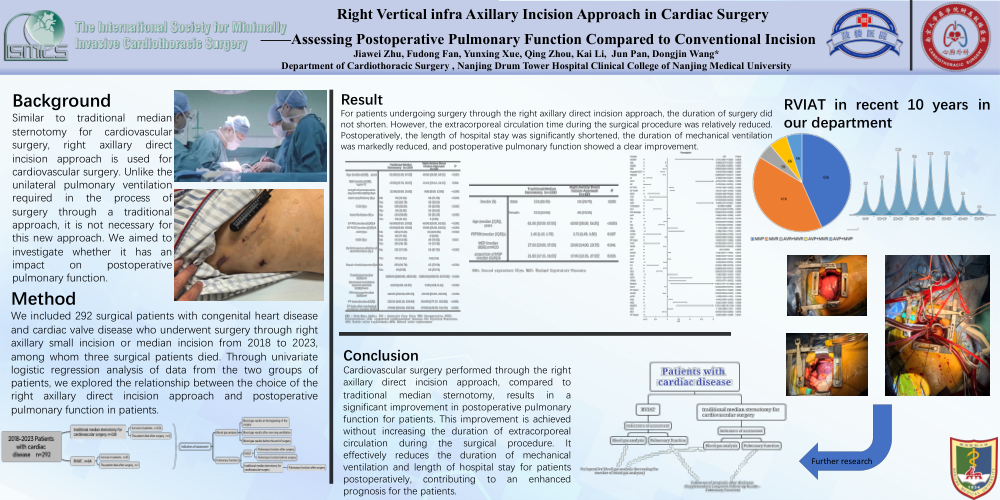
Right Vertical infra Axillary Incision Approach in Cardiac Surgery: Assessing Postoperative Pulmonary Function Compared to Conventional Incision
Background
Similar to traditional median sternotomy for cardiovascular surgery, right axillary direct incision approach is used for cardiovascular surgery. Unlike the unilateral pulmonary ventilation required in the process of surgery through a traditional approach, it is not necessary for this new approach. We aimed to investigate whether it has an impact on postoperative pulmonary function.
Method
We included 292 surgical patients with congenital heart disease and cardiac valve disease who underwent surgery through right axillary small incision or median incision from 2018 to 2023, among whom three surgical patients died. Through univariate logistic regression analysis of data from the two groups of patients, we explored the relationship between the choice of the right axillary direct incision approach and postoperative pulmonary function in patients.
Result
We included 292 patients with congenital heart disease and cardiac valve disease who underwent surgical procedures at our center. Among them, 228 patients underwent surgery through the traditional median sternotomy approach (2 patients died postoperatively), and 64 patients underwent surgery through the right axillary direct incision approach (1 patient died postoperatively). For patients undergoing surgery through the right axillary direct incision approach, compared to those with the traditional median sternotomy approach, the duration of surgery did not shorten(Right Vertical infra Axillary Incision Approach VS. Conventional Incision: 275.00 [237.50, 330.00] VS 285.00 [232.50, 350.00],P=0.536). However, the extracorporeal circulation time during the surgical procedure was relatively reduced(Right Vertical infra Axillary Incision Approach VS. Conventional Incision: 149.00 [123.00, 195.00]VS 141.50 [100.00, 184.50] ,P=0.058). Postoperatively, the length of hospital stay was significantly shortened(Right Vertical infra Axillary Incision Approach VS. Conventional Incision:12.00 [10.00, 15.00]VS 9.00 [8.00, 12.00],P<0.001), the duration of mechanical ventilation was markedly reduced(Right Vertical infra Axillary Incision Approach VS. Conventional Incision:10.00 [6.00, 16.50] VS 5.00 [3.88, 9.12],P<0.001), and postoperative pulmonary function showed a clear improvement(P/F: Right Vertical infra Axillary Incision Approach VS. Conventional Incision: 233.34 [146.18, 334.94]VS 354.99 [277.27, 422.88],P<0.001).
Conclusion
Cardiovascular surgery performed through the right axillary direct incision approach, compared to traditional median sternotomy, results in a significant improvement in postoperative pulmonary function for patients. This improvement is achieved without increasing the duration of extracorporeal circulation during the surgical procedure. It effectively reduces the duration of mechanical ventilation and length of hospital stay for patients postoperatively, contributing to an enhanced prognosis for the patients.