225 posters, 34 videos, 18 topics, 14 sessions, 251 authors, 55 institutions
ePostersLive by SciGen Technologies S.A. All rights reserved.
ISMICS 2024 Annual Meeting
29 May - 1 June, 2024 | Athens, Greece

D.121
3-d Endoscopic Mitral Valve Replacement & Tricuspid Valve Repair Under Hvfa In A Patient With Two Previous Heart Surgeries
Poster Presenter
Authors
Part of Topic
Valve - Surgical Valves
Video
3-D Endoscopic Mitral Valve Replacement and Tricuspid Valve Repair Under HVFA in a Patient with Two Previous Heart Surgeries
SUDHIR RAJBHANDARI1*, MD, MS, PhD; Sheng Wang1, MD, PhD
1Fuwai Central China Cardiovascular Hospital (Central China Fuwai Hospital of Zhengzhou University), Zhengzhou, China
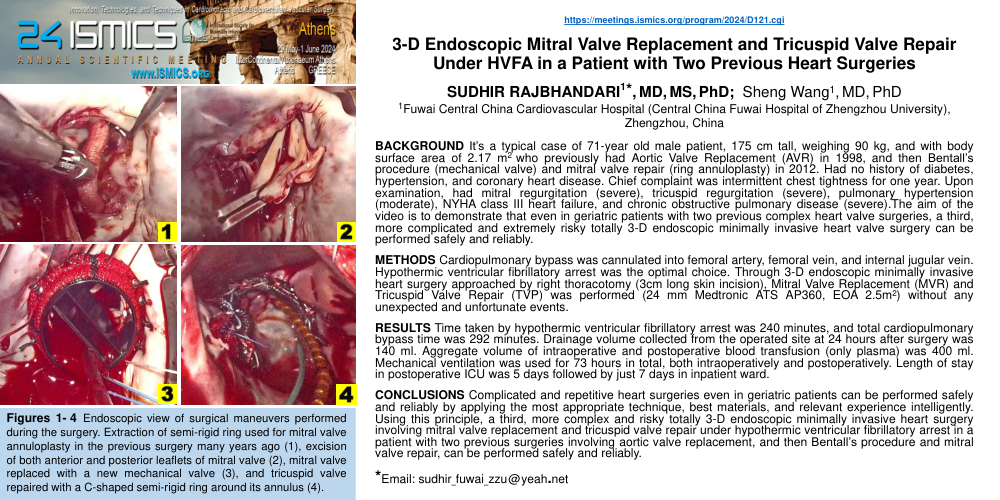
BACKGROUND It’s a typical case of 71-year old male patient, 175 cm tall, weighing 90 kg, and with body surface area of 2.17 m2 who previously had Aortic Valve Replacement (AVR) in 1998, and then Bentall’s procedure (mechanical valve) and mitral valve repair (ring annuloplasty) in 2012. Had no history of diabetes, hypertension, and coronary heart disease. Chief complaint was intermittent chest tightness for one year. Upon examination, had mitral regurgitation (severe), tricuspid regurgitation (severe), pulmonary hypertension (moderate), NYHA class III heart failure, and chronic obstructive pulmonary disease (severe).The aim of the video is to demonstrate that even in geriatric patients with two previous complex heart valve surgeries, a third, more complicated and extremely risky totally 3-D endoscopic minimally invasive heart valve surgery can be performed safely and reliably.
METHODS Cardiopulmonary bypass was cannulated into femoral artery, femoral vein, and internal jugular vein. Hypothermic ventricular fibrillatory arrest was the optimal choice. Through 3-D endoscopic minimally invasive heart surgery approached by right thoracotomy (3cm long skin incision), Mitral Valve Replacement (MVR) and Tricuspid Valve Repair (TVP) was performed (24 mm Medtronic ATS AP360, EOA 2.5m2) without any unexpected and unfortunate events.
RESULTS Time taken by hypothermic ventricular fibrillatory arrest was 240 minutes, and total cardiopulmonary bypass time was 292 minutes. Drainage volume collected from the operated site at 24 hours after surgery was 140 ml. Aggregate volume of intraoperative and postoperative blood transfusion (only plasma) was 400 ml. Mechanical ventilation was used for 73 hours in total, both intraoperatively and postoperatively. Length of stay in postoperative ICU was 5 days followed by just 7 days in inpatient ward.
CONCLUSIONS Complicated and repetitive heart surgeries even in geriatric patients can be performed safely and reliably by applying the most appropriate technique, best materials, and relevant experience intelligently. Using this principle, a third, more complex and risky totally 3-D endoscopic minimally invasive heart surgery involving mitral valve replacement and tricuspid valve repair under hypothermic ventricular fibrillatory arrest in a patient with two previous surgeries involving aortic valve replacement, and then Bentall’s procedure and mitral valve repair, can be performed safely and reliably.
*Email for correspondence: sudhir_fuwai_zzu @ yeah.net