225 posters, 34 videos, 18 topics, 14 sessions, 251 authors, 55 institutions
ePostersLive by SciGen Technologies S.A. All rights reserved.
ISMICS 2024 Annual Meeting
29 May - 1 June, 2024 | Athens, Greece

D.114
Minimally Invasive Approach Is Feasible For Mitral Repair For Infective Endocarditis
Poster Presenter
Authors
Part of Topic
Valve - Surgical Valves
Minimally Invasive Approach Is Feasible For Mitral Repair For Infective Endocarditis
Author: Iakovos Ttofi, Andrea D'Alessio, Jasmina Ttofi, Quentin Ainsworth, Charles Chan, Xy Jin, Jyothi Nair, Estelle Eaglestone, Robert Wylie, Rana Sayeed, Vivek Srivastava.
Department of Cardiac Surgery, Oxford University Hospitals NHS Foundation Trust, Oxford, United Kingdom.
BACKGROUND: 29-year-old man presented with culture negative infective endocarditis. Echo showed severe eccentric mitral regurgitation in A1-P1 commissure area. He was treated medically for 6 weeks, and mitral valve surgery was planned electively.
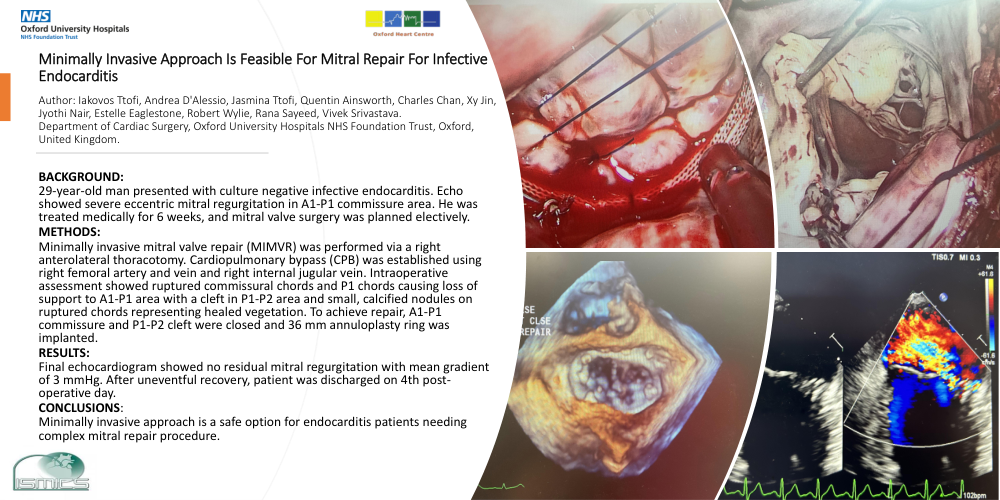
METHODS: Minimally invasive mitral valve repair (MIMVR) was performed via a right anterolateral thoracotomy. Cardiopulmonary bypass (CPB) was established using right femoral artery and vein and right internal jugular vein. Intraoperative assessment showed ruptured commissural chords and P1 chords causing loss of support to A1-P1 area with a cleft in P1-P2 area and small, calcified nodules on ruptured chords representing healed vegetation. To achieve repair, A1-P1 commissure and P1-P2 cleft were closed and 36 mm annuloplasty ring was implanted.
RESULTS: Final echocardiogram showed no residual mitral regurgitation with mean gradient of 3 mmHg. After uneventful recovery, patient was discharged on 4th post-operative day.
CONCLUSIONS: Minimally invasive approach is a safe option for endocarditis patients needing complex mitral repair procedure.