225 posters, 34 videos, 18 topics, 14 sessions, 251 authors, 55 institutions
ePostersLive by SciGen Technologies S.A. All rights reserved.
ISMICS 2024 Annual Meeting
29 May - 1 June, 2024 | Athens, Greece

PC.136
Safety Comparision Of Primary Versus Redo Robotic Assisted Valve Surgery: Insights From A Single Center Study
Poster Presenter
Authors
Part of Topic
Global
BACKGROUND: In the late 1990s, robotic cardiac surgery emerged as a groundbreaking advancement in the field of cardiac surgery. The US FDA-approved daVinci Surgical System for intra-cardiac surgery has been in use in our institution’s robotic cardiac surgery program since 20xx. Given recent reports that redo-robotic interventions are relatively contraindicated in patients with previous sternotomy, we sought to retrospectively compare clinical outcomes of patients who underwent primary vs redo interventions in our institution.
METHODS: A retrospective study of adult patients who underwentintra cardiac robotic assisted valve surgery between February 2019 and November 2023 at a cardiac center in Saudi Arabia.
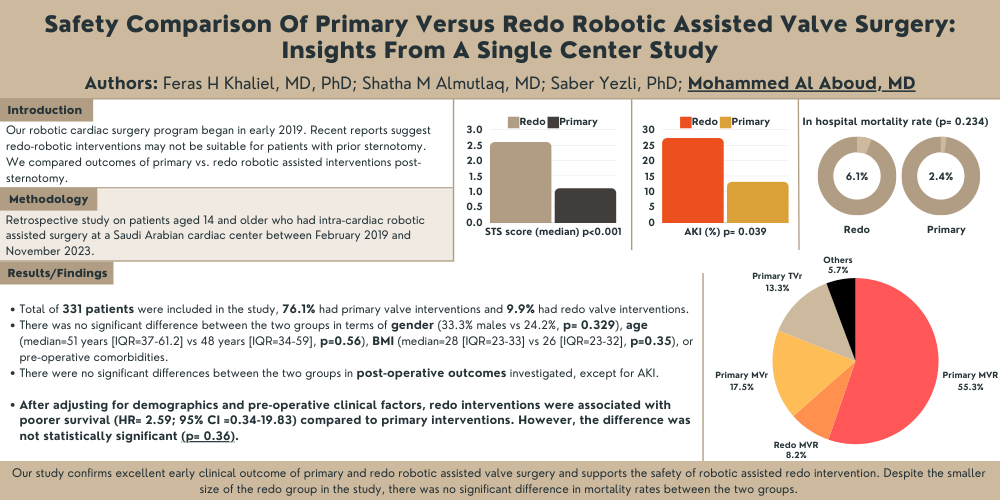
RESULTS: 331 patients were included in the study, 76.1% hadprimary valve interventions and 9.9% had redo valve interventions.There was no significant difference between the two groups in terms of gender (33.3% males vs 24.2%, p= 0.329), age (median=51 years [IQR=37-61.2] vs 48 years [IQR=34-59], p=0.56), BMI (median=28 [IQR=23-33] vs 26 [IQR=23-32], p=0.35), follow up time (median= 519.5 days [IQR=106.25-1041] vs =519 days [IQR=105-1064], p=0.74) or pre-operative comorbidities. However, patients who underwent primary interventions had significantly lower STS scores(median=1.1 [IQR=0.7-2.4] vs =2.6 [IQR=1.5-4], p<0.001). There were no significant differences between the two groups in post-operative outcomes investigated with the exception of acute kidney injury, where the rate was higher among the redo cohort (13.1% vs 27.3%, p= 0.039). Rates of in-hospital mortality (2.4% vs 6.1%, p= 0.234) and post-discharge mortality (0.4% vs 3.0%, p=0.219) were not significantly different between the two groups. After adjusting for demographics and pre-operative clinical factors, redo interventions were associated with poorer survival (HR= 2.59; 95% CI =0.34-19.83) compared to primary interventions. However, the difference was not statistically significant (p= 0.36).
CONCLUSIONS: Our study confirms excellent early clinical outcome of primary and redo robotic assisted valve surgery at our institution and supports the safety of robotic assisted redo intervention. Despite the smaller size of the redo group in the study, there was no significant difference in survival rates between the two groups. Further long-term studies with larger sample sizes are warranted to corroborate our findings.