225 posters, 34 videos, 18 topics, 14 sessions, 251 authors, 55 institutions
ePostersLive by SciGen Technologies S.A. All rights reserved.
ISMICS 2024 Annual Meeting
29 May - 1 June, 2024 | Athens, Greece

PC.129
Totally Endoscopic Atrial Septal Defect Repair On Beating Heart: Clinical Outcomes And Single Surgeon's Learning Curve Experience
Poster Presenter
Authors
Affiliations
Part of Topic
Global
Video
Totally Endoscopic Atrial Septal Defect Repair on Beating Heart: Clinical Outcome and Single-Surgeon Learning Curve Experience
Huy Q. Dang1, Huu C. Nguyen2, and Thanh N. Le2
1 Vinmec Times City International Hospital, Hanoi, Vietnam; 2 E hospital, Hanoi, Vietnam
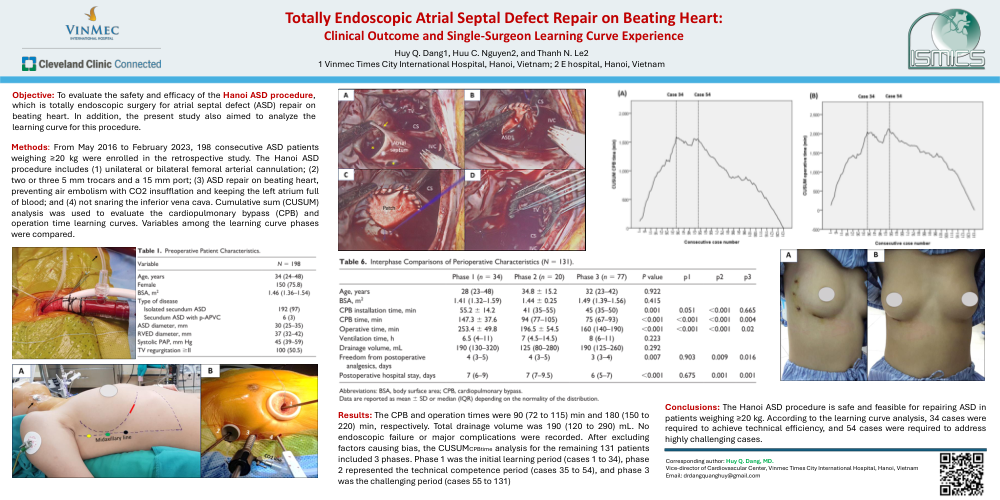
Objective: To evaluate the safety and efficacy of the Hanoi ASD procedure, which is totally endoscopic surgery for atrial septal defect (ASD) repair on beating heart. In addition, the present study also aimed to analyze the learning curve for this procedure. Methods: From May 2016 to February 2023, 198 consecutive ASD patients weighing ≥20 kg were enrolled in the retrospective study. The Hanoi ASD procedure includes (1) unilateral or bilateral femoral arterial cannulation; (2) two or three 5 mm trocars and a 15 mm port; (3) ASD repair on beating heart, preventing air embolism with CO2 insufflation and keeping the left atrium full of blood; and (4) not snaring the inferior vena cava. Cumulative sum (CUSUM) analysis was used to evaluate the cardiopulmonary bypass (CPB) and operation time learning curves. Variables among the learning curve phases were compared. Results: The CPB and operation times were 90 (72 to 115) min and 180 (150 to 220) min, respectively. Total drainage volume was 190 (120 to 290) mL. No endoscopic failure or major complications were recorded. After excluding factors causing bias, the CUSUMCPBtime analysis for the remaining 131 patients included 3 phases. Phase 1 was the initial learning period (cases 1 to 34), phase 2 represented the technical competence period (cases 35 to 54), and phase 3 was the challenging period (cases 55 to 131). Conclusions: The Hanoi ASD procedure is safe and feasible for repairing ASD in patients weighing ≥20 kg. According to the learning curve analysis, 34 cases were required to achieve technical efficiency, and 54 cases were required to address highly challenging cases.