225 posters, 34 videos, 18 topics, 14 sessions, 251 authors, 55 institutions
ePostersLive by SciGen Technologies S.A. All rights reserved.
ISMICS 2024 Annual Meeting
29 May - 1 June, 2024 | Athens, Greece

PC.127
Computed Tomography Sizing For Sutureless Aortic Valve Replacement: Proof Of Concept
Poster Presenter
Authors
Part of Topic
Global
Computed tomography sizing for sutureless aortic valve replacement: proof of concept
Alfredo Giuseppe Cerillo, Giulio Pellegrini, Anna Laganà, Anna Rita Manca, Paolo Ballestracci, Gabriele Giunti, and Pierluigi Stefano
Objective: It has been shown that wrong sizing of sutureless aortic bioprostheses is associated with increased gradients and possibly with thrombosis and early failure. The intraoperative sizing policy of sutureless valves has changed over the years to avoid excessive oversizing. Cardiac CT sizing of the aortic annulus with the “Virtual basal ring” (VBR) method is highly effective, and it has been widely and successfully used for thousands of TAVI patients.
The aim of this study is to describe our experience with CT based sizing of sutureless valves.
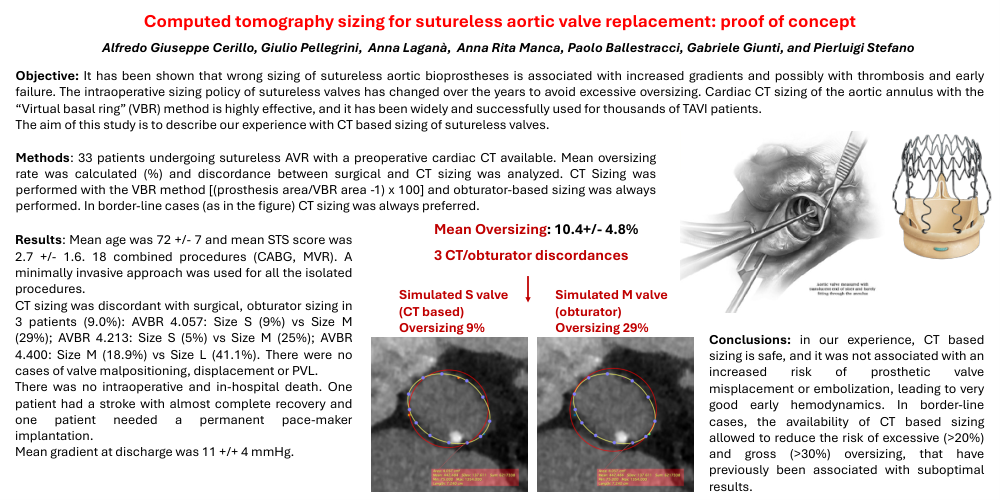
Methods: 33 patients undergoing sutureless AVR with a preoperative cardiac CT available. Mean oversizing rate was calculated (%) and discordance between surgical and CT sizing was analyzed. CT Sizing was performed with the VBR method [(prosthesis area/VBR area -1) x 100] and obturator-based sizing was always performed. In border-line cases (as in the figure) CT sizing was always preferred.
Results: Mean age was 72 +/- 7 and mean STS score was 2.7 +/- 1.6. 18 combined procedures (CABG, MVR). A minimally invasive approach was used for all the isolated procedures.
CT sizing was discordant with surgical, obturator sizing in 3 patients (9.0%): AVBR 4.057: Size S (9%) vs Size M (29%); AVBR 4.213: Size S (5%) vs Size M (25%); AVBR 4.400: Size M (18.9%) vs Size L (41.1%). There were no cases of valve malpositioning, displacement or PVL. There was no intraoperative and in-hospital death. One patient had a stroke with almost complete recovery and one patient needed a permanent pace-maker implantation.
Mean gradient at discharge was 11 +/+ 4 mmHg.
Conclusions: in our experience, CT based sizing is safe, and it was not associated with an increased risk of prosthetic valve misplacement or embolization, leading to very good early hemodynamics. In border-line cases, the availability of CT based sizing allowed to reduce the risk of excessive (>20%) and gross (>30%) oversizing, that have previously been associated with suboptimal results.