225 posters, 34 videos, 18 topics, 14 sessions, 251 authors, 55 institutions
ePostersLive by SciGen Technologies S.A. All rights reserved.
ISMICS 2024 Annual Meeting
29 May - 1 June, 2024 | Athens, Greece

PC.135
Transcarotid Vs Transfemoral Tavr: A Propensity Matched Analysis
Part of Topic
Global
Video
Transcarotid Versus Transfemoral TAVR under local anesthesia : A propensity matched analysis
Objective
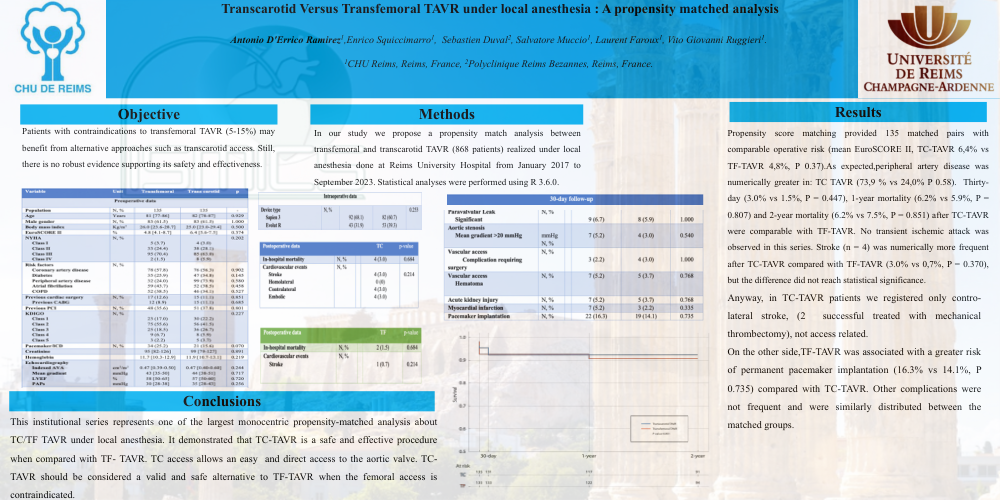
Patients with contraindications to transfemoral TAVR (5-15%) may benefit from alternative approaches such as transcarotid access. Still, there is no robust evidence supporting its safety and effectiveness.
Methods
In our study we propose a propensity match analysis between transfemoral and transcarotid TAVR (868 patients) realized under local anesthesia done at Reims University Hospital from January 2017 to September 2023. Statistical analyses were performed using R 3.6.0.
Results
Propensity score matching provided 135 matched pairs with comparable operative risk (mean EuroSCORE II, TC-TAVR 6,4% vs TF-TAVR 4,8%, P 0.37).As expected,peripheral artery disease was numerically greater in: TC TAVR (73,9 % vs 24,0% P 0.58). Thirty- day (3.0% vs 1.5%, P = 0.447), 1-year mortality (6.2% vs 5.9%, P = 0.807) and 2-year mortality (6.2% vs 7.5%, P = 0.851) after TC-TAVR were comparable with TF-TAVR. No transient ischemic attack was observed in this series. Stroke (n = 4) was numerically more frequent after TC-TAVR compared with TF-TAVR (3.0% vs 0,7%, P = 0.370), but the difference did not reach statistical significance.
Anyway, in TC-TAVR patients we registered only contro- lateral stroke, (2 successful treated with mechanical thrombectomy), not access related.
On the other side,TF-TAVR was associated with a greater risk of permanent pacemaker implantation (16.3% vs 14.1%, P 0.735) compared with TC-TAVR. Other complications were not frequent and were similarly distributed between the matched groups.
Conclusions
This institutional series represents one of the largest monocentric propensity-matched analysis about TC/TF TAVR under local anesthesia. It demonstrated that TC-TAVR is a safe and effective procedure when compared with TF- TAVR. TC access allows an easy and direct access to the aortic valve. TC- TAVR should be considered a valid and safe alternative to TF-TAVR when the femoral access is controindicated.