225 posters, 34 videos, 18 topics, 14 sessions, 251 authors, 55 institutions
ePostersLive by SciGen Technologies S.A. All rights reserved.
ISMICS 2024 Annual Meeting
29 May - 1 June, 2024 | Athens, Greece

PC.134
Cost Analysis Of Robot-assisted Vs On-pump And Off-pump Coronary Artery Bypass Grafting: Single-center Surgical And 30-day Outcomes Comparison
Poster Presenter
Authors
Affiliations
Part of Topic
Global
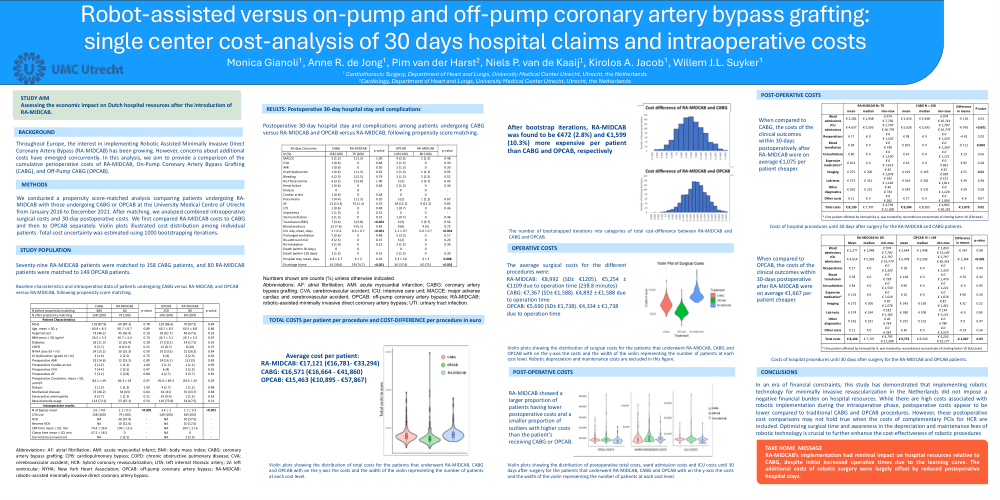
Robot-assisted versus on-pump and off-pump coronary artery bypass grafting: single center cost-analysis of 30 days hospitalclaims and intraoperative costs
Monica Gianoli1, Anne R. de Jong1, Pim van der Harst2, Niels P. van de Kaaij1, Kirolos A. Jacob1, Willem J.L. Suyker1
1 Cardiothoracic Surgery, Department of Heart and Lungs, University Medical Center Utrecht, Utrecht, the Netherlands
2Cardiology, Department of Heart and Lungs, University Medical Center Utrecht, Utrecht, the Netherlands
STUDY AIM
Assessing the economic impact on Dutch hospital resources after the introduction of RA-MIDCAB.
BACKGROUND
Throughout Europe, the interest in implementing Robotic Assisted Minimally Invasive Direct Coronary Artery Bypass (RA-MIDCAB) has been growing. However, concerns about additional costs have emerged concurrently. In this analysis, we aim to provide a comparison of the cumulative perioperative costs of RA-MIDCAB, On-Pump Coronary Artery Bypass Grafting (CABG), and Off-Pump CABG (OPCAB).
METHODS
We conducted a propensity score-matched analysis comparing patients undergoing RA-MIDCAB with those undergoing CABG or OPCAB at the University Medical Centre of Utrecht from January 2016 to December 2021. After matching, we analyzed combined intraoperative surgical costs and 30-day postoperative costs. We first compared RA-MIDCAB costs to CABG and then to OPCAB separately. Violin plots illustrated cost distribution among individual patients. Total cost uncertainty was estimated using 1000 bootstrapping iterations.
STUDY POPULATION
Seventy-nine RA-MIDCAB patients were matched to 158 CABG patients, and 80 RA-MIDCAB patients were matched to 149 OPCAB patients.