225 posters, 34 videos, 18 topics, 14 sessions, 251 authors, 55 institutions
ePostersLive by SciGen Technologies S.A. All rights reserved.
ISMICS 2024 Annual Meeting
29 May - 1 June, 2024 | Athens, Greece

PC.133
Is There A Role For Routine Dexterity And Visuospatial Ability Testing To Guide Training Of Residents In Minimally Invasive Cardiothoracic Surgery?
Poster Presenter
Authors
Part of Topic
Global
The Role For Routine Dexterity And Visuospatial Ability Testing To Guide Training Of Residents In Minimally Invasive Cardiothoracic Surgery
Background
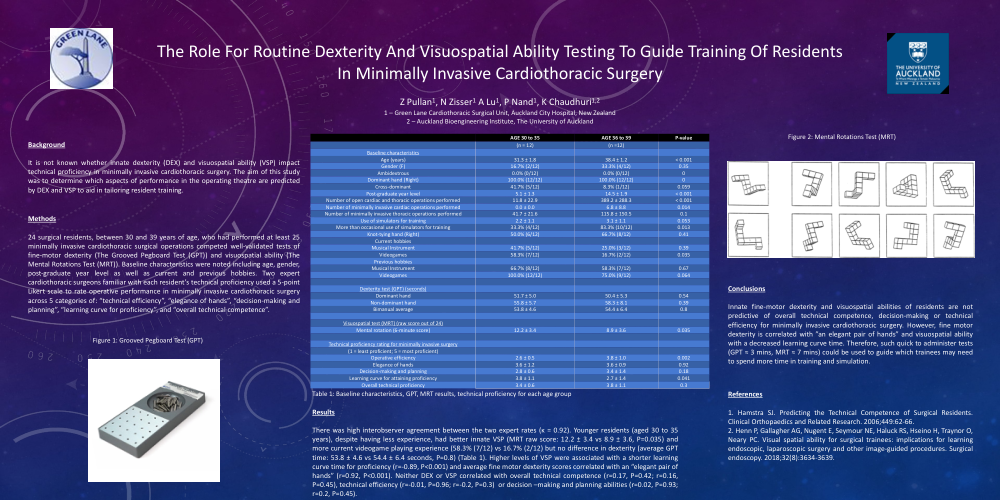
It is not known whether innate dexterity (DEX) and visuospatial ability (VSP) impact technical proficiency in minimally invasive cardiothoracic surgery. The aim of this study was to determine which aspects of performance in the operating theatre are predicted by DEX and VSP to aid in tailoring resident training.
Methods
24 surgical residents, between 30 to 39 years of age, who had performed at least 25 minimally invasive cardiothoracic surgical operations completed well-validated tests of fine-motor dexterity (The Grooved Pegboard Test (GPT)) and visuospatial ability (The Mental Rotations Test (MRT)). Baseline characteristics were noted including age, gender, post-graduate year level as well as current and previous hobbies. Two expert cardiothoracic surgeons familiar with each resident’s technical proficiency used a 5-point Likert scale to rate operative performance in minimally invasive cardiothoracic surgery across 5 categories of: “technical efficiency”, “elegance of hands”, “decision-making and planning”, “learning curve for proficiency”, and “overall technical competence”.
Results
There was high interobserver agreement between the two expert raters (κ = 0.92). Younger residents (aged 30 to 35 years), despite having less experience, had better innate VSP (MRT raw score: 12.2 ± 3.4 vs 8.9 ± 3.6, P=0.035) and more current videogame playing experience (58.3% (7/12) vs 16.7% (2/12) but no difference in dexterity (average GPT time: 53.8 ± 4.6 vs 54.4 ± 6.4 seconds, P=0.8) (Table 1). Higher levels of VSP were associated with a shorter learning curve time for proficiency (r=-0.89, P<0.001) and average fine motor dexterity scores correlated with an “elegant pair of hands” (r=0.92, P<0.001). One such resident was a concert-level pianist. Neither DEX or VSP correlated with overall technical competence (r=0.17, P=0.42; r=0.16, P=0.45), technical efficiency (r=-0.01, P=0.96; r=-0.2, P=0.3) or decision-making and planning abilities (r=0.02, P=0.93; r=0.2, P=0.45).
Conclusions
Innate fine-motor dexterity and visuospatial abilities of residents are not predictive of overall technical competence, decision-making or technical efficiency for minimally invasive cardiothoracic surgery. However, fine motor dexterity is correlated with “an elegant pair of hands” and visuospatial ability with a decreased learning curve time. Therefore, such quick to administer tests (GPT ≈ 3 mins, MRT ≈ 7 mins) could be used to guide which trainees may need to spend more time in training and simulation.