225 posters, 34 videos, 18 topics, 14 sessions, 251 authors, 55 institutions
ePostersLive by SciGen Technologies S.A. All rights reserved.
ISMICS 2024 Annual Meeting
29 May - 1 June, 2024 | Athens, Greece
PC.113
Intraoperative Mild Hypothermia Makes MICS Safer
Poster Presenter
Authors
Affiliations
Part of Topic
Valve - Surgical Valves
Intraoperative Mild Hypothermia Makes MICS Safer
(Background)
Minimally invasive cardiac surgery (MICS) has increased in recent years due to its perioperative minimally invasion for patient compared to conventional cardiac surgery, and while MICS has the advantage of being free of mediastinitis after surgery compared to median incision cardiac surgery, it also has its own complications, one of which is pulmonary edema.
Once pulmonary edema occurs, it strongly affects postoperative mortality and mobility.
(Objective.)
We conducted a prospective (follow-up) study of the effect of intraoperative mild hypothermia on postoperative pulmonary edema.
(Methods.)
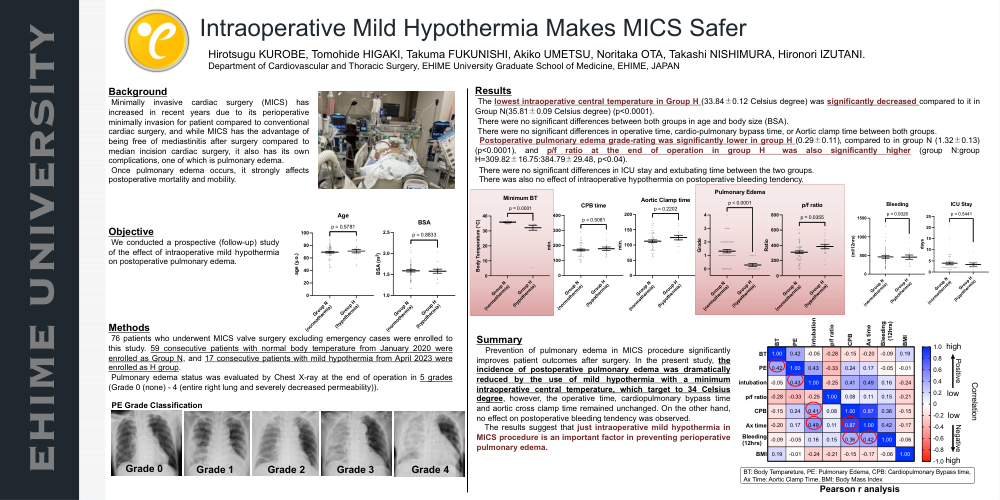
76 patients who underwent MICS valve surgery excluding emergency cases were enrolled to this study. 59 consecutive patients with normal body temperature from January 2020 were enrolled as Group N, and 17 consecutive patients with mild hypothermia from April 2023 were enrolled as H group. Pulmonary edema status was evaluated by Chest X-ray at the end of operation in 5 grades (Grade 0 (none) - 4 (entire right lung and severely decreased permeability)).
(Results)
The lowest intraoperative central temperature in Group H (33.84±0.12 Celsius degree) was significantly decreased compared to it in Group N(35.81±0.09 Celsius degree) (p<0.0001). There were no significant differences between both groups in age and body size (BSA).
There were no significant differences in operative time, cardio-pulmonary bypass time, or Aortic clamp time between both groups.
Postoperative pulmonary edema grade-rating was significantly lower in group H (0.29±0.11), compared to in group N (1.32±0.13) (p<0.0001), and p/f ratio at admission was also significantly higher (group N:group H=309.82±16.75:384.79±29.48, p<0.04).
There were no significant differences in ICU stay and extubating time between the two groups.
There was also no effect of intraoperative hypothermia on postoperative bleeding tendency.
(Summary).
Prevention of pulmonary edema in MICS procedure significantly improves patient outcomes after surgery. In the present study, the incidence of postoperative pulmonary edema was dramatically reduced by the use of mild hypothermia with a minimum intraoperative central temperature, which target to 34 Celsius degree, however, the operative time, cardiopulmonary bypass time and aortic cross clamp time remained unchanged. On the other hand, no effect on postoperative bleeding tendency was observed.
The results suggest that just intraoperative mild hypothermia in MICS procedure is an important factor in preventing perioperative pulmonary edema.