225 posters, 34 videos, 18 topics, 14 sessions, 251 authors, 55 institutions
ePostersLive by SciGen Technologies S.A. All rights reserved.
ISMICS 2024 Annual Meeting
29 May - 1 June, 2024 | Athens, Greece
PC.112
Enhanced Recovery After Minimally Invasive Valve Surgery In Older Adults
Poster Presenter
Authors
Part of Topic
Valve - Surgical Valves
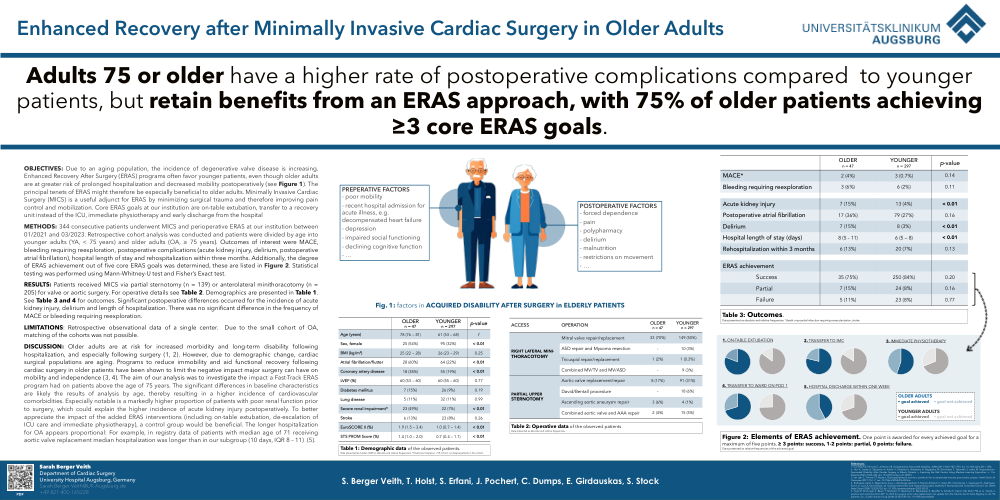
TITLE: Enhanced Recovery after Minimally Invasive Cardiac Surgery in Older Adults
OBJECTIVES: Due to an aging population, the incidence of degenerative valve disease is increasing. Enhanced Recovery After Surgery (ERAS) programs often favor younger patients, even though older adults are at greater risk of prolonged hospitalization and decreased mobility postoperatively (see Figure 1). The principal tenets of ERAS might therefore be especially beneficial to older adults. Minimally Invasive Cardiac Surgery (MICS) is a useful adjunct for ERAS by minimizing surgical trauma and therefore improving pain control and mobilization. Core ERAS goals at our institution are on-table extubation, transfer to a recovery unit instead of the ICU, immediate physiotherapy and early discharge from the hospital
METHODS: 344 consecutive patients underwent MICS and perioperative ERAS at our institution between 01/2021 and 03/2023. Retrospective cohort analysis was conducted and patients were divided by age into younger adults (YA, < 75 years) and older adults (OA, ≥ 75 years). Outcomes of interest were MACE, bleeding requiring reexploration, postoperative complications (acute kidney injury, delirium, postoperative atrial fibrillation), hospital length of stay and rehospitalization within three months. Additionally, the degree of ERAS achievement out of five core ERAS goals was determined, these are listed in Figure 2. Statistical testing was performed using Mann-Whitney-U test and Fisher’s Exact test.
RESULTS: Patients received MICS via partial sternotomy (n = 139) or anterolateral minithoracotomy (n = 205) for valve or aortic surgery. For operative details see Table 2. Demographics are presented in Table 1. See Table 3 and 4 for outcomes. Significant postoperative differences occurred for the incidence of acute kidney injury, delirium and length of hospitalization. There was no significant difference in the frequency of MACE or bleeding requiring reexploration.
LIMITATIONS: Retrospective observational data of a single center. Due to the small cohort of OA, matching of the cohorts was not possible.
DISCUSSION: Older adults are at risk for increased morbidity and long-term disability following hospitalization, and especially following surgery (1, 2). However, due to demographic change, cardiac surgical populations are aging. Programs to reduce immobility and aid functional recovery following cardiac surgery in older patients have been shown to limit the negative impact major surgery can have on mobility and independence (3, 4). The aim of our analysis was to investigate the impact a Fast-Track ERAS program had on patients above the age of 75 years. The significant differences in baseline characteristics are likely the results of analysis by age, thereby resulting in a higher incidence of cardiovascular comorbidities. Especially notable is a markedly higher proportion of patients with poor renal function prior to surgery, which could explain the higher incidence of acute kidney injury postoperatively. To better appreciate the impact of the added ERAS interventions (including on-table extubation, de-escalation of ICU care and immediate physiotherapy), a control group would be beneficial. The longer hospitalization for OA appears proportional: For example, in registry data of patients with median age of 71 receiving aortic valve replacement median hospitalization was longer than in our subgroup (10 days, IQR 8 – 11) (5).
CONCLUSION: Adults 75 or older have a higher rate of postoperative complications compared to younger patients, but retain benefits from an ERAS approach, with 75% of older patients achieving ≥3 core ERAS goals.
REFERENCES:
1. Covinsky KE, Pierluissi E, Johnston CB. Hospitalization-Associated Disability. JAMA (2011) 306:1782–1793. doi: 10.1001/jama.2011.1556
2. Hori K, Usuba K, Sakuyama A, Adachi Y, Hirakawa K, Nakayama A, Nagayama M, Shimokawa T, Takanashi S, Isobe M. Hospitalization- Associated Disability After Cardiac Surgery in Elderly Patients ― Exploring the Risk Factors Using Machine Learning Algorithms ―. Circ Reports (2021) 3:423–430. doi: 10.1253/circrep.cr-21-00573.
3. van Laar C, Timman ST, Noyez L. Decreased physical activity is a predictor for a complicated recovery post cardiac surgery. Health Qual Life Outcomes (2017) 15:1–7. doi: 10.1186/s12955-016-0576-6
4. Rodriguez-Lopez C, Mayordomo-Cava J, Zarralanga-Lasobras T, Romero-Estarlich V, Vidan MT, Ortiz-Alonso J, Valenzuela PL, Rodriguez- Romo G, Lucia A, Serra-Rexach JA. Exercise Intervention and Hospital-Associated Disability A Nonrandomized Controlled Clinical Trial. JAMA Netw Open (2024) 7:E2355103. doi: 10.1001/jamanetworkopen.2023.55103
5. Fujita B, Ensminger S, Bauer T, Möllmann H, Beckmann A, Bekeredjian R, Bleiziffer S, Schäfer E, Hamm CW, Mohr FW, et al. Trends in practice and outcomes from 2011 to 2015 for surgical aortic valve replacement: An update from the German Aortic Valve Registry on 42 776 patients. Eur J Cardio-thoracic Surg (2018) 53:552–559. doi: 10.1093/ejcts/ezx408