225 posters, 34 videos, 18 topics, 14 sessions, 251 authors, 55 institutions
ePostersLive by SciGen Technologies S.A. All rights reserved.
ISMICS 2024 Annual Meeting
29 May - 1 June, 2024 | Athens, Greece

PC.110
Endoscopic Minimally Invasive Approach Versus Median Sternotomy For Multiple Valve Surgery
Part of Topic
Valve - Surgical Valves
Background.
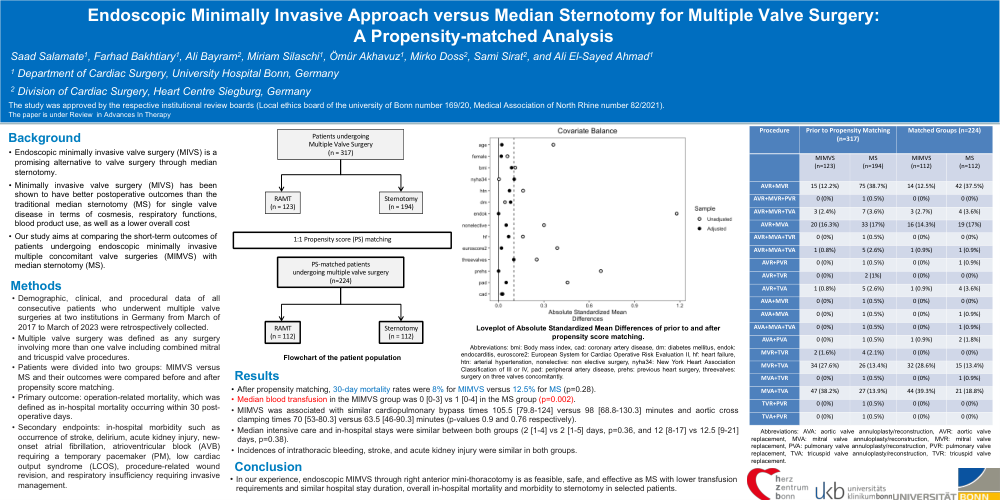
•Endoscopic minimally invasive valve surgery (MIVS) is a promising alternative to valve surgery through median sternotomy.
•Minimally invasive valve surgery (MIVS) has been shown to have better postoperative outcomes than the traditional median sternotomy (MS) for single valve disease in terms of cosmesis, respiratory functions, blood product use, as well as a lower overall cost
•Our study aims at comparing the short-term outcomes of patients undergoing endoscopic minimally invasive multiple concomitant valve surgeries (MIMVS) with median sternotomy (MS).
Methods.
•Demographic, clinical, and procedural data of all consecutive patients who underwent multiple valve surgeries at two institutions in Germany from March of 2017 to March of 2023 were retrospectively collected.
•Multiple valve surgery was defined as any surgery involving more than one valve including combined mitral and tricuspid valve procedures.
•Patients were divided into two groups: MIMVS versus MS and their outcomes were compared before and after propensity score matching.
•Primary outcome: operation-related mortality, which was defined as in-hospital mortality occurring within 30 post-operative days.
•Secondary endpoints: in-hospital morbidity such as occurrence of stroke, delirium, acute kidney injury, new-onset atrial fibrillation, atrioventricular block (AVB) requiring a temporary pacemaker (PM), low cardiac output syndrome (LCOS), procedure-related wound revision, and respiratory insufficiency requiring invasive management.
Results.
•After propensity matching, 30-day mortality rates were 8% for MIMVS versus 12.5% for MS (p=0.28).
•Median blood transfusion in the MIMVS group was 0 [0-3] vs 1 [0-4] in the MS group (p=0.002).
•MIMVS was associated with similar cardiopulmonary bypass times 105.5 [79.8-124] versus 98 [68.8-130.3] minutes and aortic cross clamping times 70 [53-80.3] versus 63.5 [46-90.3] minutes (p-values 0.9 and 0.76 respectively).
•Median intensive care and in-hospital stays were similar between both groups (2 [1-4] vs 2 [1-5] days, p=0.36, and 12 [8-17] vs 12.5 [9-21] days, p=0.38).
•Incidences of intrathoracic bleeding, stroke, and acute kidney injury were similar in both groups.
Conclusions.
•In our experience, endoscopic MIMVS through right anterior mini-thoracotomy is as feasible, safe, and effective as MS with lower transfusion requirements and similar hospital stay duration, overall in-hospital mortality and morbidity to sternotomy in selected patients.