167 posters, 28 videos, 9 topics, 12 sessions, 337 authors, 160 institutions
ePostersLive by SciGen Technologies S.A. All rights reserved.
ISMICS 2023 Annual Meeting
31 May - 3 June, 2023 | Boston, MA

PC19
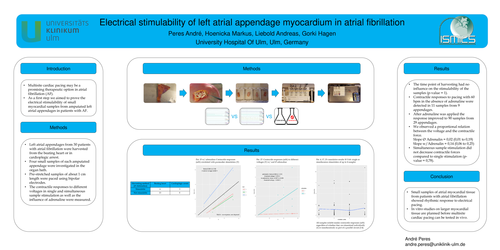
Electrical Stimulability Of Left Atrial Appendage Myocardium In Atrial Fibrillation
Poster Presenter
Authors
Affiliations
Part of Topic
Arrhythmia Surgery & Interventions
Electrical stimulability of left atrial appendage myocardium in atrial fibrillation
Peres André, Hoenicka Markus, Liebold Andreas, Gorki Hagen
University Hospital Of Ulm, Ulm, Germany
Introduction
Multisite cardiac pacing may be a promising therapeutic option in atrial fibrillation (AF).
As a first step we aimed to prove the electrical stimulability of small myocardial samples from amputated left atrial appendages in patients with AF.
Methods
Left atrial appendages from 30 patients with atrial fibrillation were harvested from the beating heart or in cardioplegic arrest.
Four small samples of each amputated appendage were investigated in the organ bath.
Pre-stretched samples of about 1 cm length were paced using bipolar electrodes.
The contractile responses to different voltages in single and simultaneous sample stimulation as well as the influence of adrenaline were measured.
Results
The time point of harvesting had no influence on the stimulability of the samples (p-value = 1). Contractile responses to pacing with 60 bpm in the absence of adrenaline were detected in 11 samples from 9 appendages.
After adrenaline was applied the response improved to 90 samples from 29 appendages.
We observed a proportional relation between the voltage and the contractile force.
Slope Ø Adrenalin = 0,02 (0,01 to 0,19) Slope w/Adrenalin = 0,14 (0,06 to 0,25)
Simultaneous sample stimulation did not decrease contractile forces compared to single stimulation (p-value = 0,78).
Conclusion
Small samples of atrial myocardial tissue from patients with atrial fibrillation showed rhythmic response to electrical pacing.
In vitro studies on larger myocardial tissue are planned before multisite cardiac pacing can be tested in vivo.