Loading...

167 posters, 28 videos, 9 topics, 12 sessions, 337 authors, 160 institutions

ePostersLive by SciGen Technologies S.A. All rights reserved.

ISMICS 2023 Annual Meeting

31 May - 3 June, 2023 | Boston, MA

ISMICS 2023 Annual Meeting banner

D18

Effectiveness Of Thoracoscopic Ablation Of Persistent And Long-standing Atrial Fibrillation
Part of Topic

Arrhythmia Surgery & Interventions

Introduction. 

üThe prevalence of Atrial Fibrillation (AF) will continue to increase 1, 2
üAF is associated with high risks of thromboembolic events (12-31% of all ischemic strokes) 3
üOf particular interest are non-paroxysmal AF, which accounts for up to 70% of all forms of AF
 
Actual
üThe effectiveness of Cox-Maze IV is 96% 5, 6
üEfficacy of catheter ablations for persistent AF is extremely low - 54% 6
In 2006, Wolf et al. described a video-assisted thoracoscopic surgical ablation (TSA), the effectiveness of TSA is close to Cox-Maze procedure – 65-96% 

Video-assisted thoracoscopic ablation (TSA) of AF is an alternative surgical treatment for lone AF on the off-pump (beating heart)

Currently, TSA can include: pulmonary vein isolation, posterior left atrial wall isolation, additional linear ablations, Marshall's ligament dissection and left atrial appendage exclusion.


But the effectiveness of TSA varies considerably from 26% to 86% due to the variation in patients, surgical technique and follow-up period 8, 9, 10

Objective

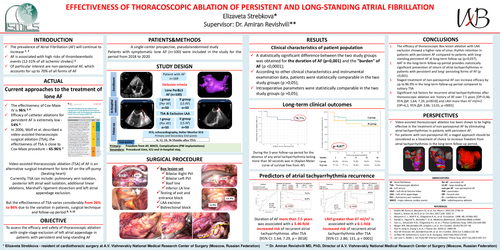
To assess the efficacy and safety of thoracoscopic ablation with single-stage exclusion of left atrial appendage in patients with persistent and long-standing AF

PATIENTS&METHODS

A single-center prospective, pseudorandomised study

Patients with symptomatic lone AF (n=100) were included in the study for the period from 2018 to 2020

SURGICAL PROCEDURE

üBox lesion set
üBibolar Right PVI
üBibolar Left PVI
üRoof line
üInferior LA line
üTesting of exit and entrance block
üLAA excision
üBidirectional block
 

RESULTS

üA statistically significant difference between the two study groups was obtained for the duration of AF (p=0,001) and the "burden" of AF (p <0,0001);
üAccording to other clinical characteristics and instrumental examination data, patients were statistically comparable in the two study groups (p >0,05);
üIntraoperative parameters were statistically comparable in the two study groups (p >0,05);
 

Long-term clinical outcomes

During the 3-year follow–up period for the absence of any atrial tachyarrhythmia lasting more than 30 seconds was in (Kaplan-Meier curve of survival free from AF

Predictors of atrial tachyarrhythmia recurrence

Duration of AF more than 7.5 years was associated with a 3.46-fold increased risk of recurrent atrial tachyarrhythmias  after TSA

[95% CI: 1.64; 7.29, p = 0018]

LAVI greater than 47 ml/m2 is associated with a 6.1-fold increased risk of recurrent atrial tachyarrhythmia after TSA

[95% CI: 2.86; 131, p < 0001]

CONCLUSIONS

1.The efficacy of thoracoscopic Box lesion ablation with LAA exclusion showed a higher rate of sinus rhythm retention in patients with persistent AF compared to patients with long-standing persistent AF at long-term follow-up (p=0,037);
2.AAT in the long-term follow-up period provides statistically significant prevention of return of atrial tachyarrhythmias in patients with persistent and long- persisting forms of AF (p <0,001)
3.Staged treatment of non-paroxysmal AF can increase efficacy by up to 86.9% in the long-term follow-up period compared to solitary TSA
4.Significant risk factors for recurrent atrial tachyarrhythmias after thoracoscopic ablation are: history of AF over 7.5 years [ОР=3,46; 95% ДИ: 1,64; 7,29, p=0018] and LAVI more than 47 ml/m2 [ОР=6,1; 95% ДИ: 2,86; 13,01, p <0001]
 

PERSPECTIVES

üVideo-assisted thoracoscopic ablation has been shown to be highly effective in the treatment of non-paroxysmal AF by eliminating atrial tachyarrhythmias in patients with persistent AF;
üFor patients with non-paroxysmal AF, a staged approach should be considered as a treatment of choice to increase freedom from atrial tachyarrhythmias in the long-term follow-up period.


ISMICS 2023 Annual Meeting » banner
Copyright © 2015-2026, ePostersLive® SciGen is a registered trademark of SciGen Technologies S.A. Patent pending.

This website and third-party tools we use rely on cookies for the best user experience. By selecting "I agree", you agree to cookie usage as described in our Privacy Policy.