167 posters, 28 videos, 9 topics, 12 sessions, 337 authors, 160 institutions
ePostersLive by SciGen Technologies S.A. All rights reserved.
ISMICS 2023 Annual Meeting
31 May - 3 June, 2023 | Boston, MA

PC15
Surgical And Percutaneous Left Atrial Appendage Intervention: Silent Cerebral Embolism Considerations
Poster Presenter
Part of Topic
Arrhythmia Surgery & Interventions
Surgical and Percutaneous Left Atrial Appendage Intervention:Silent Cerebral Embolism Considerations
Kexin Wanga, MD; Zidun Wanga, MD; Mingfang Lia, MD; Weizhu Jua, MD; Buqing Nib, MD; Yongfeng Shaob, MD; Minglong Chena, MD
aDivision of Cardiology, The First Affiliated Hospital of Nanjing Medical University, Nanjing, China; bDivision of Cardiovascular Surgery, The First Affiliated Hospital of Nanjing Medical University, Nanjing, China.
Background: Left atrial appendage intervention is an alternative to oral anticoagulation for thromboprophylaxis in atrial fibrillation. The aim of our study was to compare the incidence of silent cerebral embolisms after surgical and percutaneous intervention and to identify the risk factors for procedure-related silent cerebral embolisms after intervention.
Methods: This prospective observational study included consecutive atrial fibrillation patients from 2 independent cohorts (left atrial appendage excision cohort and left atrial appendage occlusion cohort) between September 2018 and December 2020. All patients underwent cerebral magnetic resonance imaging before and after the procedure. Silent cerebral embolism was defined as new focal hyperintense lesions detected only on postprocedural sequence.
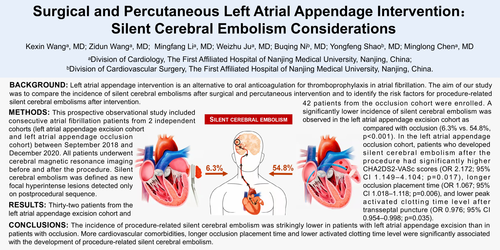
Results: Thirty-two patients from the left atrial appendage excision cohort and 42 patients from the occlusion cohort were enrolled. A significantly lower incidence of silent cerebral embolism was observed in the left atrial appendage excision cohort as compared with occlusion (6.3% vs. 54.8%, p<0.001). In the left atrial appendage occlusion cohort, patients who developed silent cerebral embolism after the procedure had significantly higher CHA2DS2-VASc scores (OR 2.172; 95% CI 1.149–4.104; p=0.017), longer occlusion placement time (OR 1.067; 95% CI 1.018–1.118; p=0.006), and lower peak activated clotting time level after transseptal puncture (OR 0.976; 95% CI 0.954–0.998; p=0.035).
Conclusions: The incidence of procedure-related silent cerebral embolism was strikingly lower in patients with left atrial appendage excision than in patients with occlusion. More cardiovascular comorbidities, longer occlusion placement time and lower activated clotting time level were significantly associated with the development of procedure-related silent cerebral embolism.