477 posters, 14 topics, 2,065 authors, 1,055 institutions
ePostersLive by SciGen Technologies S.A. All rights reserved.
The Joint EBJIS-MSIS 2026 Conference
17 - 19 September, 2026 | Porto, Portugal

PP39
Clinical Characteristics and Outcomes of Brucellar Spondylitis in a Non-endemic Region of Southern China
Part of Topic
Osteomyelitis/ Spondylitis
Clinical Characteristics and Outcomes of Brucellar Spondylitis in a Non-endemic Region of Southern China
Zhuoang Lin, Jiajun Tang, Liang Wang
Division of Spine Surgery, Department of Orthopedics, The Third Affiliated Hospital, Southern Medical University, Guangzhou, China
BACKGROUND AND OBJECTIVE
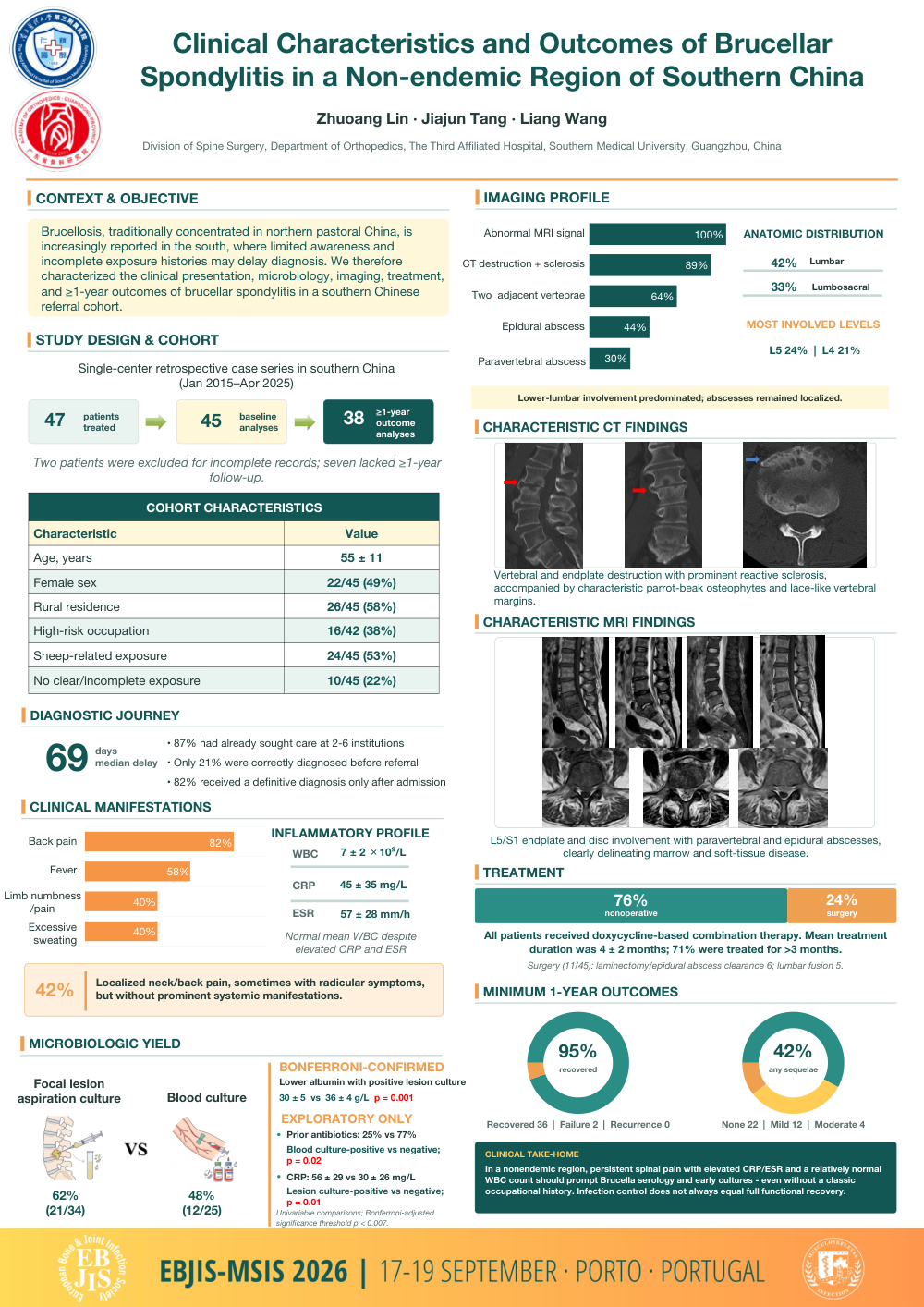
Brucellosis is increasingly reported in southern China, where limited awareness and incomplete exposure histories may delay diagnosis. This study characterized the clinical presentation, microbiology, imaging features, treatment, and minimum 1-year outcomes of brucellar spondylitis in a southern Chinese referral cohort.
METHODS
This single-center retrospective case series included patients treated between January 2015 and April 2025. Diagnosis required compatible CT or MRI findings plus a positive Brucella culture or standard agglutination test titer ≥1:100. Of 47 treated patients, 45 were included in baseline analyses and 38 in outcome analyses. Fisher’s exact and independent-samples t tests were used, with a Bonferroni-adjusted significance threshold of p<0.007.
RESULTS
The mean age was 55 ± 11 years, 49% were women, and 58% lived in rural areas. High-risk occupations were reported in 38%, sheep-related exposure in 53%, and no clear or complete exposure history in 22%. The median diagnostic delay was 69 days. Before referral, 87% had sought care elsewhere, but only 21% were correctly diagnosed.
The most common manifestations were back pain (82%), fever (58%), limb numbness or pain (40%), and excessive sweating (40%). Forty-two percent presented mainly with localized neck or back pain, sometimes with radicular symptoms, but without prominent systemic manifestations. The mean WBC count was relatively normal despite elevated CRP and ESR levels.
Observed culture yields were 62% (21/34) for focal lesion aspiration and 48% (12/25) for blood culture. Lower albumin was associated with positive focal lesion culture after Bonferroni correction (30 ± 5 versus 36 ± 4 g/L; p=0.001). Associations involving prior antibiotic exposure and CRP were exploratory.
MRI demonstrated abnormal vertebral signal in all evaluated patients (43/43). CT showed vertebral destruction with reactive sclerosis in 89% (40/45). Epidural and paravertebral abscesses were identified in 44% (19/43) and 30% (13/43), respectively. The lumbar spine and lumbosacral junction were the most commonly involved regions.
All patients received doxycycline-based combination antimicrobial therapy for a mean of 4 ± 2 months. Thirty-four patients (76%) were treated nonoperatively, while 11 (24%) underwent surgery.
At a minimum 1-year follow-up, 95% (36/38) recovered, 5% (2/38) experienced treatment failure, and no recurrence was observed. However, 42% (16/38) had mild or moderate sequelae. Clinical outcomes and sequelae were assessed separately.
CONCLUSION
In non-endemic regions, persistent spinal pain with elevated CRP or ESR and a relatively normal WBC count should prompt early Brucella serology and microbiologic sampling, even without a classic occupational or exposure history. Successful infection control does not always indicate complete functional recovery.
Keywords: brucellosis; brucellar spondylitis; spinal infection; non-endemic region; focal lesion aspiration; clinical outcomes