477 posters, 14 topics, 2,065 authors, 1,055 institutions
ePostersLive by SciGen Technologies S.A. All rights reserved.
The Joint EBJIS-MSIS 2026 Conference
17 - 19 September, 2026 | Porto, Portugal

PP38
To Amputate or Not Amputate? A Retrospective Cohort Study Evaluating Complications following Amputation for Chronic Tibial and Fibular Osteomyelitis
Poster Presenter
Authors
Kelan Queenan, Hannah Dieterle, Sophia Caputo, Paddy Ssentongo, Edward Fox, Jana Davis, Meredith Schade
Affiliations
Penn State College Of Medicine, Hershey, United States, Department of Internal Medicine, Penn State Milton S. Hershey Medical Center, Hershey, United States, Department of Orthopaedic Surgery, Penn State Milton S. Hershey Medical Center, Hershey, United States, Department of Infectious Disease, Penn State Milton S. Hershey Medical Center, Hershey, United States, Penn State College Of Medicine
Part of Topic
Osteomyelitis/ Spondylitis
Introduction
• Chronic tibial and fibular osteomyelitis can be difficult to treat and may ultimately require amputation.
• Limited data exist comparing postoperative complications and long-term outcomes between patients managed with limb preservation versus amputation.
• Aim: To compare postoperative complications and fiveyear outcomes among patients with chronic tibial or fibular osteomyelitis who underwent amputation versus limb preservation.
Methods
• Retrospective cohort study using a multicenter, deidentified database.
• Patients with chronic tibial or fibular osteomyelitis between March 2006 and March 2026 were identified and stratified by amputation status.
• 1:1 propensity score matching was performed to control for comorbidities and lower extremity fractures.
• Five-year outcomes were assessed using risk differences, risk ratios, and Kaplan-Meier survival analyses.
Results
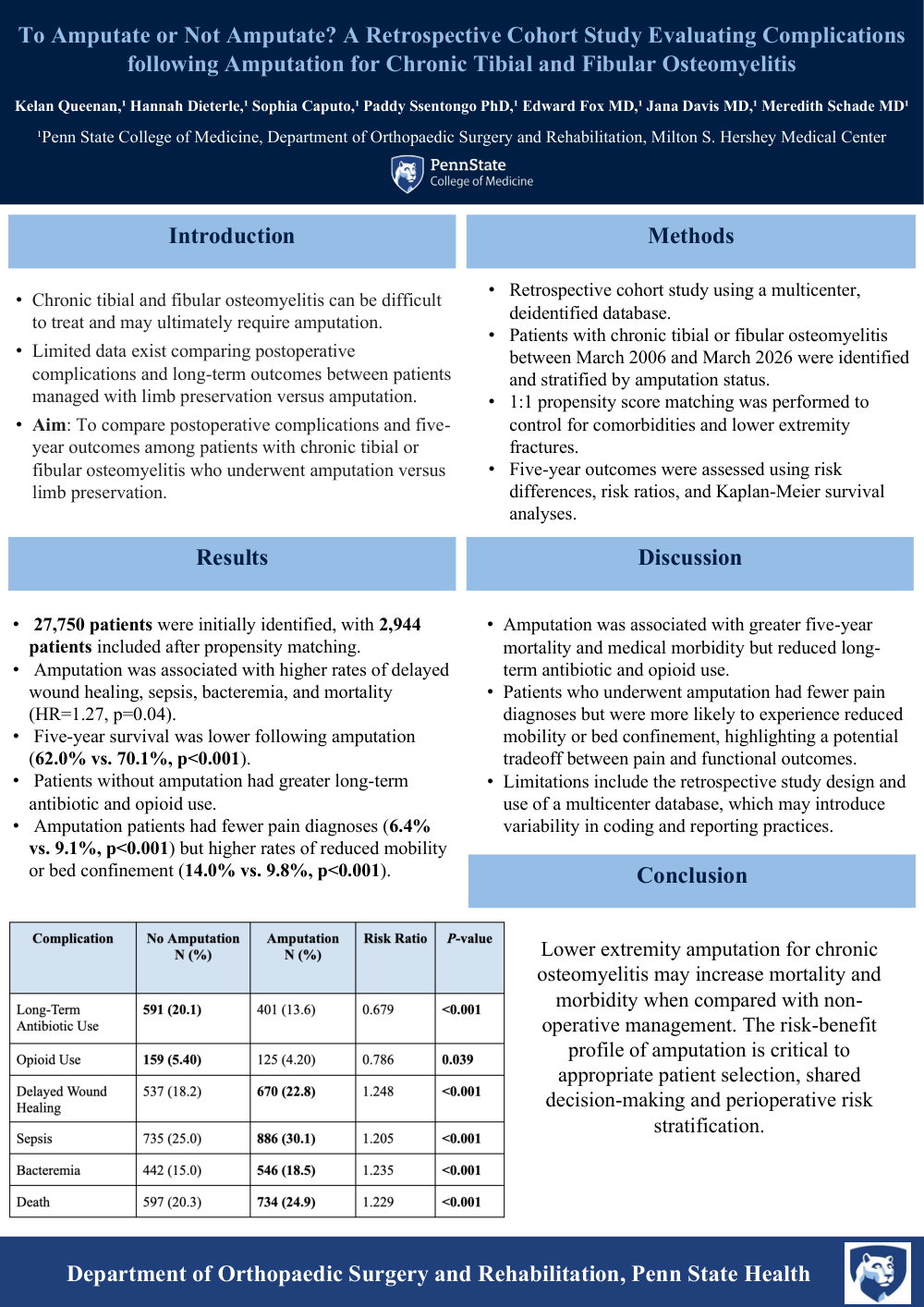
• 27,750 patients were initially identified, with 2,944 patients included after propensity matching.
• Amputation was associated with higher rates of delayed wound healing, sepsis, bacteremia, and mortality (HR=1.27, p=0.04).
• Five-year survival was lower following amputation (62.0% vs. 70.1%, p<0.001).
• Patients without amputation had greater long-term antibiotic and opioid use.
• Amputation patients had fewer pain diagnoses (6.4% vs. 9.1%, p<0.001) but higher rates of reduced mobility or bed confinement (14.0% vs. 9.8%, p<0.001).
Discussion
• Amputation was associated with greater five-year mortality and medical morbidity but reduced longterm antibiotic and opioid use.
• Patients who underwent amputation had fewer pain diagnoses but were more likely to experience reduced mobility or bed confinement, highlighting a potential tradeoff between pain and functional outcomes.
• Limitations include the retrospective study design and use of a multicenter database, which may introduce variability in coding and reporting practices.
Conclusion
Lower extremity amputation for chronic osteomyelitis may increase mortality and morbidity when compared with nonoperative management. The risk-benefit profile of amputation is critical to appropriate patient selection, shared decision-making and perioperative risk stratification.