477 posters, 14 topics, 2,052 authors, 1,056 institutions
ePostersLive by SciGen Technologies S.A. All rights reserved.
The Joint EBJIS-MSIS 2026 Conference
17 - 19 September, 2026 | Porto, Portugal
PP35
A multi-timepoint evaluation of health-related quality of life in bone and joint infection using the EQ-5D-5L instrument
Part of Topic
Miscellaneous
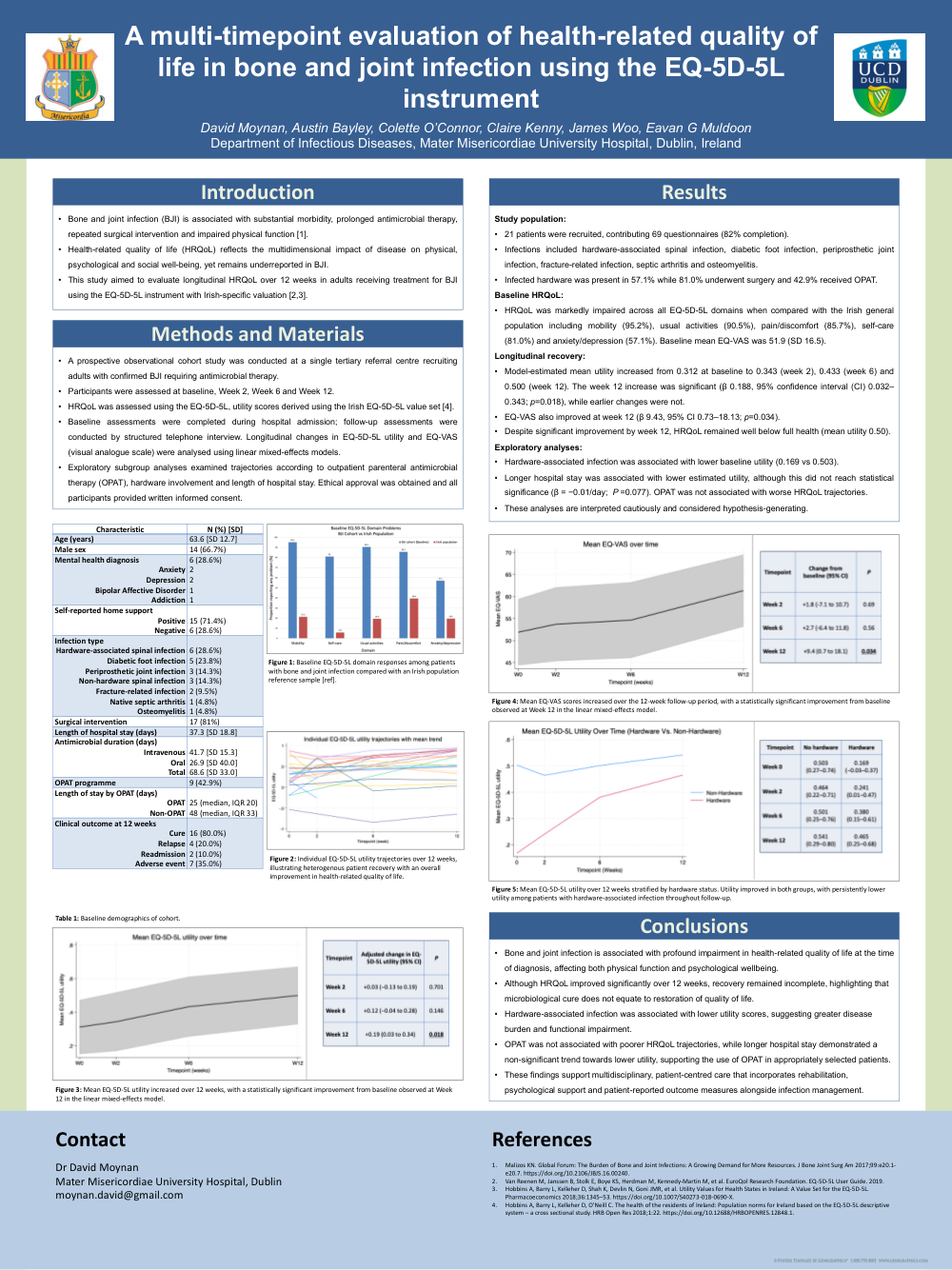
A multi-timepoint evaluation of health-related quality of life in bone and joint infection using the EQ-5D-5L instrument
•Bone and joint infection (BJI) is associated with substantial morbidity, prolonged antimicrobial therapy, repeated surgical intervention and impaired physical function [1].
•Health-related quality of life (HRQoL) reflects the multidimensional impact of disease on physical, psychological and social well-being, yet remains underreported in BJI.
•This study aimed to evaluate longitudinal HRQoL over 12 weeks in adults receiving treatment for BJI using the EQ-5D-5L instrument with Irish-specific valuation [2,3].
•A prospective observational cohort study was conducted at a single tertiary referral centre recruiting adults with confirmed BJI requiring antimicrobial therapy.
•Participants were assessed at baseline, Week 2, Week 6 and Week 12.
•HRQoL was assessed using the EQ-5D-5L, utility scores derived using the Irish EQ-5D-5L value set [4].
•Baseline assessments were completed during hospital admission; follow-up assessments were conducted by structured telephone interview. Longitudinal changes in EQ-5D-5L utility and EQ-VAS (visual analogue scale) were analysed using linear mixed-effects models.
•Exploratory subgroup analyses examined trajectories according to outpatient parenteral antimicrobial therapy (OPAT), hardware involvement and length of hospital stay. Ethical approval was obtained and all participants provided written informed consent.
Study population:
•21 patients were recruited, contributing 69 questionnaires (82% completion).
•Infections included hardware-associated spinal infection, diabetic foot infection, periprosthetic joint infection, fracture-related infection, septic arthritis and osteomyelitis.
•Infected hardware was present in 57.1% while 81.0% underwent surgery and 42.9% received OPAT.
Baseline HRQoL:
•HRQoL was markedly impaired across all EQ-5D-5L domains when compared with the Irish general population including mobility (95.2%), usual activities (90.5%), pain/discomfort (85.7%), self-care (81.0%) and anxiety/depression (57.1%). Baseline mean EQ-VAS was 51.9 (SD 16.5).
Longitudinal recovery:
•Model-estimated mean utility increased from 0.312 at baseline to 0.343 (week 2), 0.433 (week 6) and 0.500 (week 12). The week 12 increase was significant (β 0.188, 95% confidence interval (CI) 0.032–0.343; p=0.018), while earlier changes were not.
•EQ-VAS also improved at week 12 (β 9.43, 95% CI 0.73–18.13; p=0.034).
•Despite significant improvement by week 12, HRQoL remained well below full health (mean utility 0.50).
Exploratory analyses:
•Hardware-associated infection was associated with lower baseline utility (0.169 vs 0.503).
•Longer hospital stay was associated with lower estimated utility, although this did not reach statistical significance (β = −0.01/day; P =0.077). OPAT was not associated with worse HRQoL trajectories.
•These analyses are interpreted cautiously and considered hypothesis-generating.
•Bone and joint infection is associated with profound impairment in health-related quality of life at the time of diagnosis, affecting both physical function and psychological wellbeing.
•Although HRQoL improved significantly over 12 weeks, recovery remained incomplete, highlighting that microbiological cure does not equate to restoration of quality of life.
•Hardware-associated infection was associated with lower utility scores, suggesting greater disease burden and functional impairment.
•OPAT was not associated with poorer HRQoL trajectories, while longer hospital stay demonstrated a non-significant trend towards lower utility, supporting the use of OPAT in appropriately selected patients.
•These findings support multidisciplinary, patient-centred care that incorporates rehabilitation, psychological support and patient-reported outcome measures alongside infection management.