477 posters, 14 topics, 2,052 authors, 1,056 institutions
ePostersLive by SciGen Technologies S.A. All rights reserved.
The Joint EBJIS-MSIS 2026 Conference
17 - 19 September, 2026 | Porto, Portugal
PP17
Incidence rate of Fracture-Related Infections after Internal Fixation: Insights from civilian patients with war-related and civilian trauma in Afghanistan
Poster Presenter
Authors
Juan Carlos Perdomo Lizarraga, Giacomo Fiorio, Marcello Zavatta
Affiliations
Orthopedics Department, Don Benito�Villanueva de la Serena Hospital, Don Benito, Spain, Orthopedics Department, Don Benito�Villanueva de la Serena Hospital, EMERGENCY Surgical Centre for War Victims, Lashkargah,, Afghanistan
Part of Topic
Fracture-Related Infections
Introduction & Aim: Fracture-related infection (FRI) rates range from 1–2% in closed fractures to up to 30% in severe open injuries; however, these estimates are largely based on civilian trauma (CT) data. Evidence of war-related trauma (WRT) injuries primarily comes from military sources, despite the fact that civilians may account for up to 87% of casualties in modern conflicts, depending on the context. This study aimed to determine the incidence rate of FRI after internal fixation in fractures caused by WRT and CT in a Non-Governmental Organization (NGO) hospital in Afghanistan.
Methods: This retrospective study reviewed medical records of civilian patients treated with internal fixation, either as primary fixation or following initial external fixation, between January 2020 and December 2023. Patients treated exclusively with external fixation were excluded. Reoperations for FRI within 12 months after fracture fixation were recorded and analyzed. Diagnosis followed the 2018 International Consensus Definition, relying on clinical signs, radiography, and suggestive biomarkers (elevated ESR/WBC) due to laboratory constraints. Infections were classified as early, delayed, or late based on the Willenegger and Roth criteria.
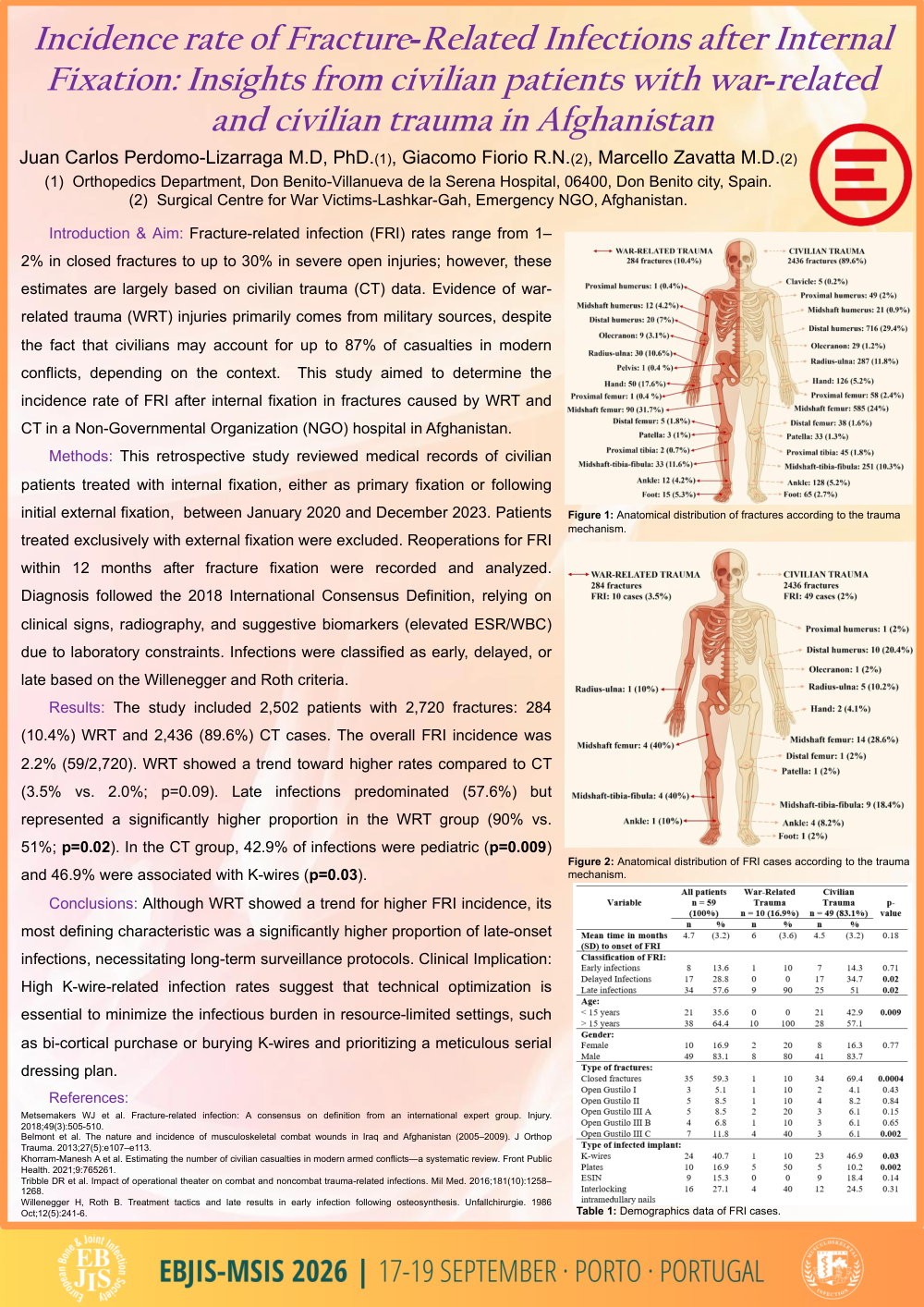
Results: The study included 2,502 patients with 2,720 fractures: 284 (10.4%) WRT and 2,436 (89.6%) CT cases. The overall FRI incidence was 2.2% (59/2,720). WRT showed a trend toward higher rates compared to CT (3.5% vs. 2.0%; p=0.09). Late infections predominated (57.6%) but represented a significantly higher proportion in the WRT group (90% vs. 51%; p=0.02). In the CT group, 42.9% of infections were pediatric (p=0.009) and 46.9% were associated with K-wires (p=0.03).
Conclusions: Although WRT showed a trend for higher FRI incidence, its most defining characteristic was a significantly higher proportion of late-onset infections, necessitating long-term surveillance protocols. Clinical Implication: High K-wire-related infection rates suggest that technical optimization is essential to minimize the infectious burden in resource-limited settings, such as bi-cortical purchase or burying K-wires and prioritizing a meticulous serial dressing plan.
References:
Metsemakers WJ et al. Fracture-related infection: A consensus on definition from an international expert group. Injury. 2018;49(3):505-510.
Belmont et al. The nature and incidence of musculoskeletal combat wounds in Iraq and Afghanistan (2005–2009). J Orthop Trauma. 2013;27(5):e107–e113.
Khorram-Manesh A et al. Estimating the number of civilian casualties in modern armed conflicts—a systematic review. Front Public Health. 2021;9:765261.
Tribble DR et al. Impact of operational theater on combat and noncombat trauma-related infections. Mil Med. 2016;181(10):1258–1268.
Willenegger H, Roth B. Treatment tactics and late results in early infection following osteosynthesis. Unfallchirurgie. 1986 Oct;12(5):241-6.