477 posters, 14 topics, 2,065 authors, 1,055 institutions
ePostersLive by SciGen Technologies S.A. All rights reserved.
The Joint EBJIS-MSIS 2026 Conference
17 - 19 September, 2026 | Porto, Portugal

EP109
Retrograde Tibial Intramedullary Nailing in Complex Fracture-Related Infection
Poster Presenter
Part of Topic
Fracture-Related Infections
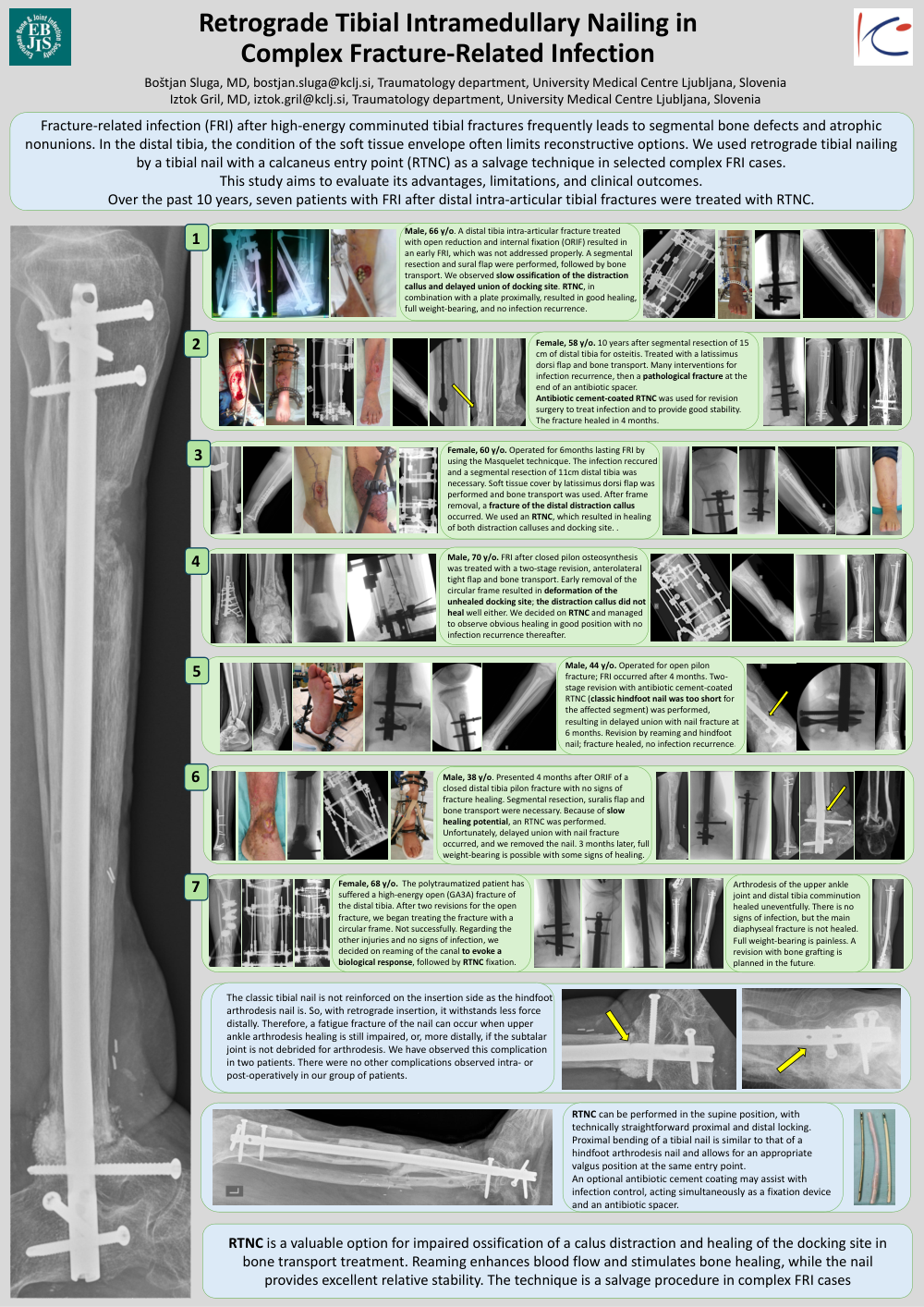
Fracture-related infection (FRI) after high-energy comminuted tibial fractures frequently leads to segmental bone defects and atrophic nonunions. In the distal tibia, the condition of the soft tissue envelope often limits reconstructive options. We used retrograde tibial nailing by a tibial nail with a calcaneus entry point (RTNC) as a salvage technique in selected complex FRI cases.
This study aims to evaluate its advantages, limitations, and clinical outcomes.
Over the past 10 years, seven patients with FRI after distal intra-articular tibial fractures were treated with RTNC.
The classic tibial nail is not reinforced on the insertion side as the hindfoot arthrodesis nail is. So, with retrograde insertion, it withstands less force distally. Therefore, a fatigue fracture of the nail can occur when upper ankle arthrodesis healing is still impaired, or, more distally, if the subtalar joint is not debrided for arthrodesis. We have observed this complication in two patients. There were no other complications observed intra- or post-operatively in our group of patients.
RTNC can be performed in the supine position, with technically straightforward proximal and distal locking. Proximal bending of a tibial nail is similar to that of a hindfoot arthrodesis nail and allows for an appropriate valgus position at the same entry point.
An optional antibiotic cement coating may assist with infection control, acting simultaneously as a fixation device and an antibiotic spacer.
RTNC is a valuable option for impaired ossification of a calus distraction and healing of the docking site in bone transport treatment. Reaming enhances blood flow and stimulates bone healing, while the nail provides excellent relative stability. The technique is a salvage procedure in complex FRI cases