477 posters, 14 topics, 2,065 authors, 1,055 institutions
ePostersLive by SciGen Technologies S.A. All rights reserved.
The Joint EBJIS-MSIS 2026 Conference
17 - 19 September, 2026 | Porto, Portugal

EP230
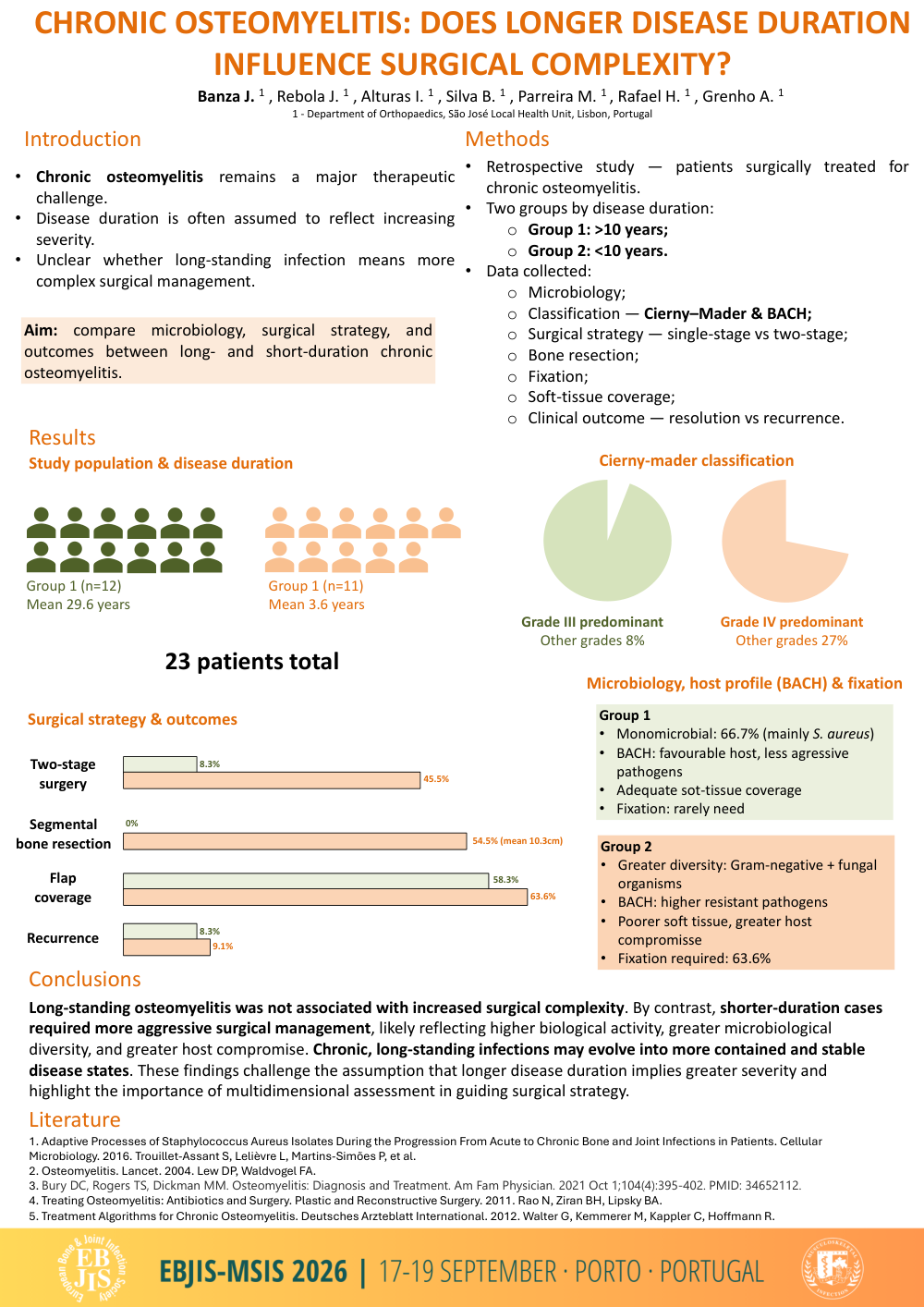
Chronic Osteomyelitis: Does Longer Disease Duration Influence Surgical Complexity?
Poster Presenter
Part of Topic
Osteomyelitis/ Spondylitis
Introduction
Chronic osteomyelitis remains a major therapeutic challenge. • Disease duration is often assumed to reflect increasing severity. • Unclear whether long-standing infection means more complex surgical management.
Aim: compare microbiology, surgical strategy, and outcomes between long- and short-duration chronic osteomyelitis.
Methods
Retrospective study — patients surgically treated for chronic osteomyelitis. • Two groups by disease duration: o Group 1: >10 years; o Group 2: <10 years. • Data collected: o Microbiology; o Classification — Cierny–Mader & BACH; o Surgical strategy — single-stage vs two-stage; o Bone resection; o Fixation; o Soft-tissue coverage; o Clinical outcome — resolution vs recurrence.
Results
Study population & disease duration
Group 1 (n=12) Mean 29.6 years
Group 1 (n=11) Mean 3.6 years
23 patients total
Surgical strategy & outcomes: Two-stage surgery; Segmental bone resection; Flap coverage; Recurrence
Microbiology, host profile (BACH) & fixation
Group 1 • Monomicrobial: 66.7% (mainly S. aureus) • BACH: favourable host, less agressive pathogens • Adequate sot-tissue coverage • Fixation: rarely need Group 2 • Greater diversity: Gram-negative + fungal organisms • BACH: higher resistant pathogens • Poorer soft tissue, greater host compromisse • Fixation required: 63.6%
Conclusions
Long-standing osteomyelitis was not associated with increased surgical complexity. By contrast, shorter-duration cases required more aggressive surgical management, likely reflecting higher biological activity, greater microbiological diversity, and greater host compromise. Chronic, long-standing infections may evolve into more contained and stable disease states. These findings challenge the assumption that longer disease duration implies greater severity and highlight the importance of multidimensional assessment in guiding surgical strategy.