477 posters, 14 topics, 2,065 authors, 1,055 institutions
ePostersLive by SciGen Technologies S.A. All rights reserved.
The Joint EBJIS-MSIS 2026 Conference
17 - 19 September, 2026 | Porto, Portugal

EP221
Pressure-ulcer associated pelvic and hip osteomyelitis: healthcare burden, microbiology, reconstruction and longitudinal quality of life outcomes
Poster Presenter
Authors
Alistair Reed, Andrew Hotchen, Vicky Pullinger, David Stubbs, Antony Palmer, Jamie Ferguson, Martin McNally, Alex Ramsden
Affiliations
University Of Oxford, Oxford University Hospitals, Oxford, United Kingdom; University of Oxford, Oxford, United Kingdom, Oxford University Hospitals, Oxford, United Kingdom
Part of Topic
Osteomyelitis/ Spondylitis
Aim
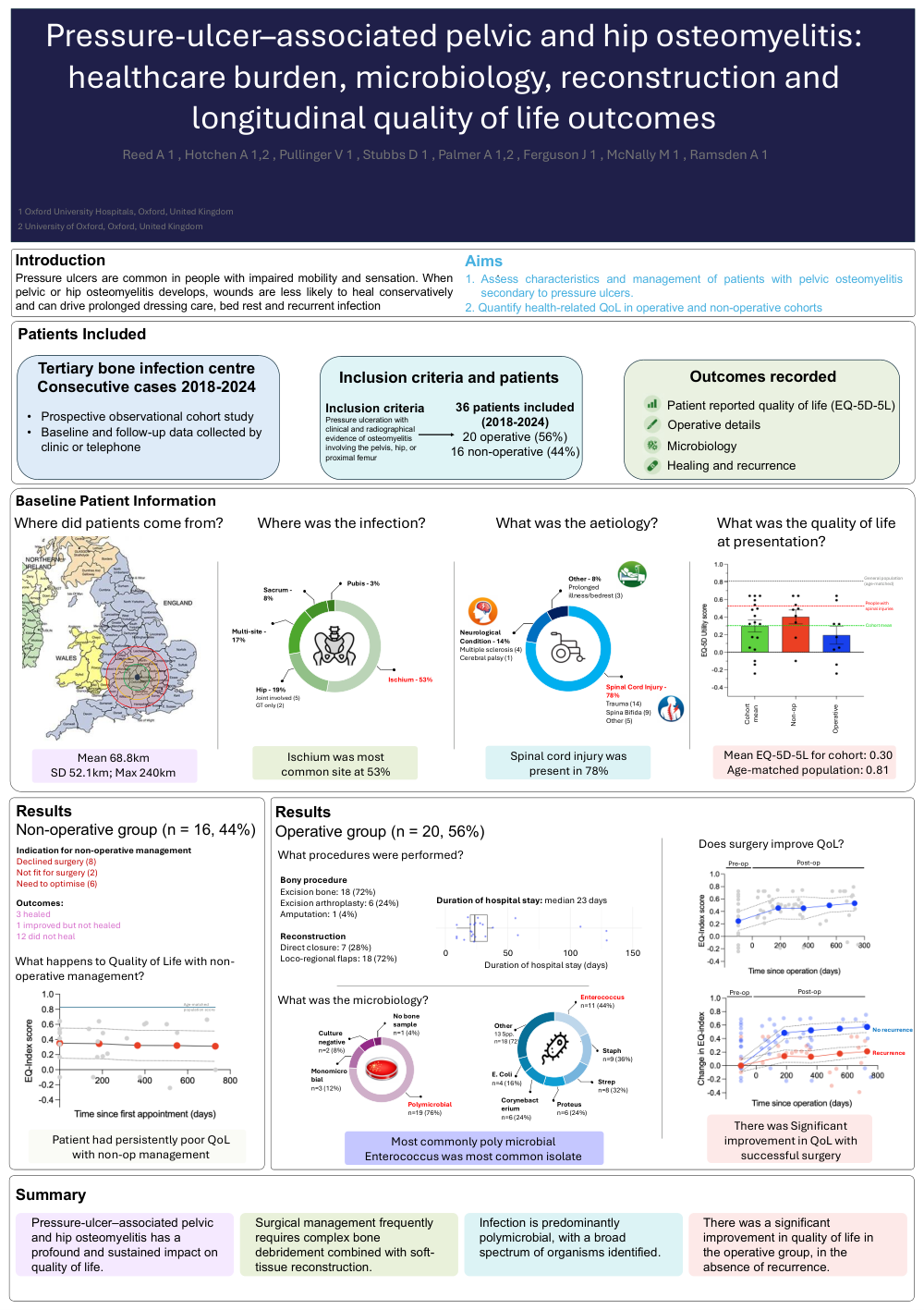
To characterise patients with pressure-ulcer associated osteomyelitis involving the pelvis, hip or proximal femur, and to quantify longitudinal health-related quality of life (QoL) in operative and non-operative cohorts.
Methods
Prospective observational cohort study at a tertiary bone infection centre from 2018–2024. Patients had pressure ulceration with clinical and radiological evidence of osteomyelitis involving the pelvis, hip or proximal femur. Operative management was offered according to a multidisciplinary protocol which included patients able to optimise factors required for ulcer healing, including nutrition, anaemia correction, and pressure relief measures. Baseline and follow-up QoL were measured using the EuroQol EQ-5D index scores in clinic or by telephone. Longitudinal QoL was assessed using time-weighted area-under-the-curve (AUC) analysis. Operative details, microbiology, reconstruction, healing and recurrence were recorded.
Results
Thirty-six patients were included; 24 were male (67%) and mean age was 53.2 years (SD 13.6; range 27–84). Patients represented a large geographical spread, travelling a mean of 68.8km (SD 52.1km; maximum 240km). Twenty patients underwent operative management, involving 25 procedures. 16 were managed non-operatively. Most ulcers followed spinal cord injury (28/36, 78%). Ulcer sites were ischial in 19 patients (53%), hip/proximal femur in 7 (19%), multi-site in 6 (17%), sacral in 3 (8%) and pubic in 1 (3%).
Non-operative management was associated with persistently impaired QoL, with EQ-5D scores of 0.352±0.200 at baseline, 0.320±0.200 at one year and 0.310±0.200 at two years. Healing occurred in 3/16 non-operative pressure sores, with 1/16 improving and 12/16 not healed.
Operative procedures comprised bone excision in 18/25 (72%), excision arthroplasty in 6/25 (24%) and amputation in 1/25 (4%). Reconstruction was by direct closure in 7/25 (28%) and flap coverage in 18/25 (72%). Microbiology was predominantly polymicrobial (19/25, 76%) and Enterococcus faecalis was most frequently isolated (11/25, 44%). Eighteen of 25 operative pressure sores healed, including three patients who later developed a new pressure sore elsewhere. Eleven of 25 procedures were complicated by recurrence, at a mean of 1.4 years (SD 1.2). In operative cases without recurrence, there was significant improvement in the QoL from baseline (+0.574±0.080 at two years, p<0.001). However, there was limited improvement in the cohort who had recurrence (+0.211±0.097 at two years, p=0.657).
Conclusions
Pressure-ulcer–associated pelvic and hip osteomyelitis causes profound and sustained QoL impairment. Operative treatment often requires complex bone and soft tissue reconstruction. Successful surgery is associated with substantial QoL improvement, however, patients who have recurrent ulceration continue to report poor QoL.