477 posters, 14 topics, 2,065 authors, 1,055 institutions
ePostersLive by SciGen Technologies S.A. All rights reserved.
The Joint EBJIS-MSIS 2026 Conference
17 - 19 September, 2026 | Porto, Portugal

EP220
Use of a chimeric ALT flap to treat a type III Cierny-Mader osteitis of the lower limb: a case report.
Poster Presenter
Authors
Affiliations
Part of Topic
Osteomyelitis/ Spondylitis
Use of a chimeric ALT flap to treat a type III Cierny-Mader osteitis of the lower limb: a case reported.
Introduction
Type III osteomyelitis consists of infected bone cavities, and the first-line treatment involves surgical debridement, cavity filling, and targeted antibiotic therapy. Unfortunately, the filling tools are either dead bone or foreign bodies such as cement, which then limits healing against the infection.
method
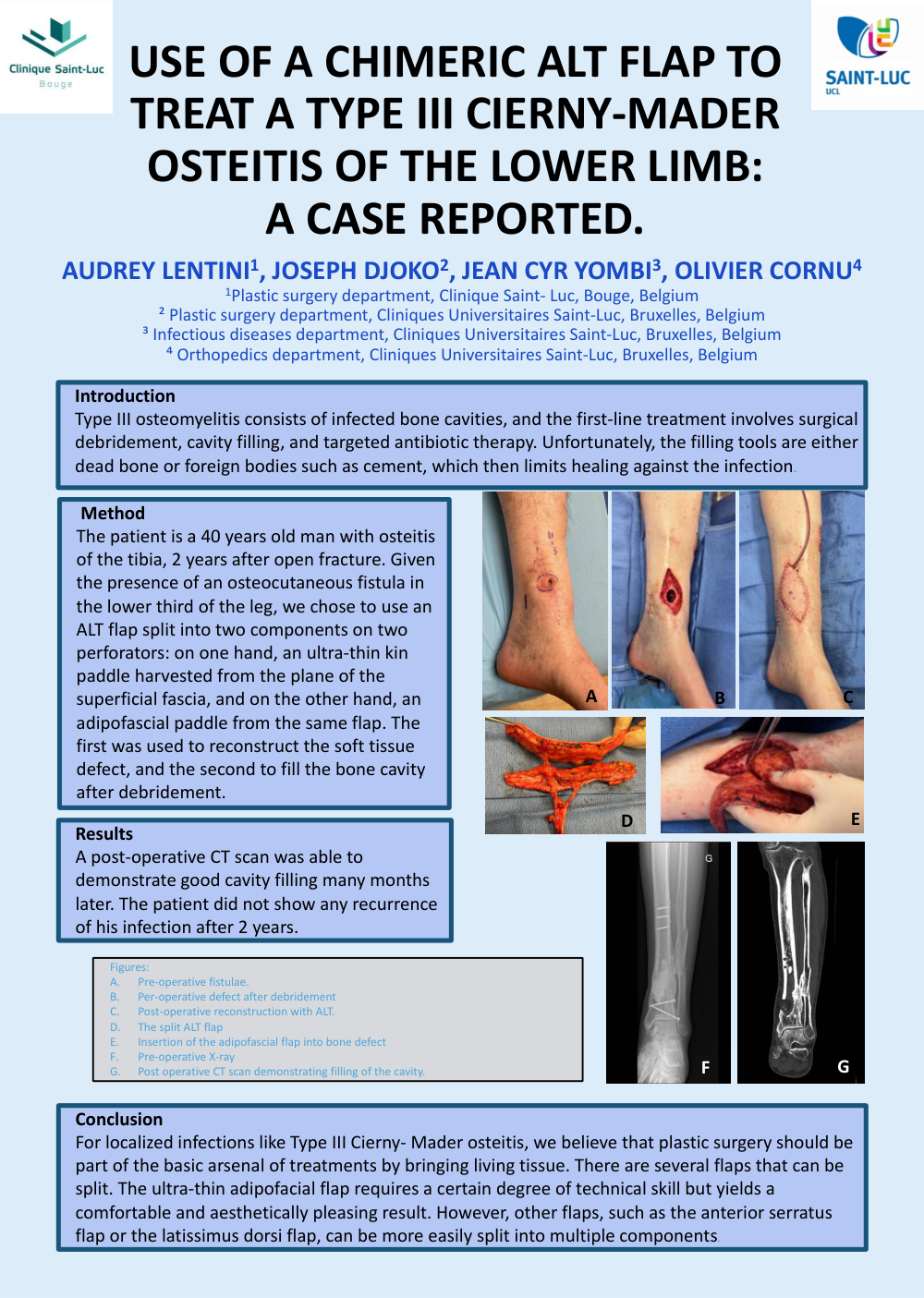
The patient is a 40 years old man with osteitis of the tibia, 2 years after open fracture. Given the presence of an osteocutaneous fistula in the lower third of the leg, we chose to use an ALT flap split into two components on two perforators: on one hand, an ultra-thin skin paddle harvested from the plane of the superficial fascia, and on the other hand, an adipofascial paddle from the same flap. The first was used to reconstruct the soft tissue defect, and the second to fill the bone cavity after debridement.
Results
A post-operative CT scan was able to demonstrate good cavity filling many month later. The patient did not show any recurrence of his infection after 2 years.
Conclusion
For localized infections like Type III Cierny- Mader osteitis, we believe that plastic surgery should be part of the basic arsenal of treatments by bringing living tissue. There are several flaps that can be split. The ultra-thin adipofacial flap requires a certain degree of technical skill but yields a comfortable and aesthetically pleasing result. However, other flaps, such as the anterior serratus flap or the latissimus dorsi flap, can be more easily split into multiple components.