477 posters, 14 topics, 2,065 authors, 1,055 institutions
ePostersLive by SciGen Technologies S.A. All rights reserved.
The Joint EBJIS-MSIS 2026 Conference
17 - 19 September, 2026 | Porto, Portugal

EP215
Chronic Osteomyelitis of Long Bones: A 25-Case Retrospective Study
Poster Presenter
Authors
Mohamed ben jemaa, Jawhar Ben Dhief, Achref lajmi, Mohamed ali Rekik, khaled keskes, hedi Chaabouni, Moez Trigui, zoubaier Ellouz, hassib Keskes
Affiliations
The Orthopedics and Traumatology Department, Habib Bourguiba University Hospital, Sfax, The Orthopedics and Traumatology Department, Habib Bourguiba University Hospital, Tunisia
Part of Topic
Osteomyelitis/ Spondylitis
Background : Chronic osteomyelitis (COM) of long bones remains a challenging and often disabling condition, typically resulting from inadequately treated acute infections. It is associated with significant morbidity, recurrent infections, functional impairment, and socio-professional consequences, particularly in low-resource settings.
Objectives: To identify risk factors associated with progression to chronic osteomyelitis of long bones and to describe its clinical, radiological, microbiological, and therapeutic characteristics.
Materials and Methods : Retrospective descriptive study of patients treated for chronic osteomyelitis of long bones in the Department of Orthopedic Surgery and Traumatology at CHU Habib Bourguiba, Sfax, over a 26-year period (1995–2021). Epidemiological, clinical, radiological, microbiological, therapeutic, and outcome data were systematically analyzed.
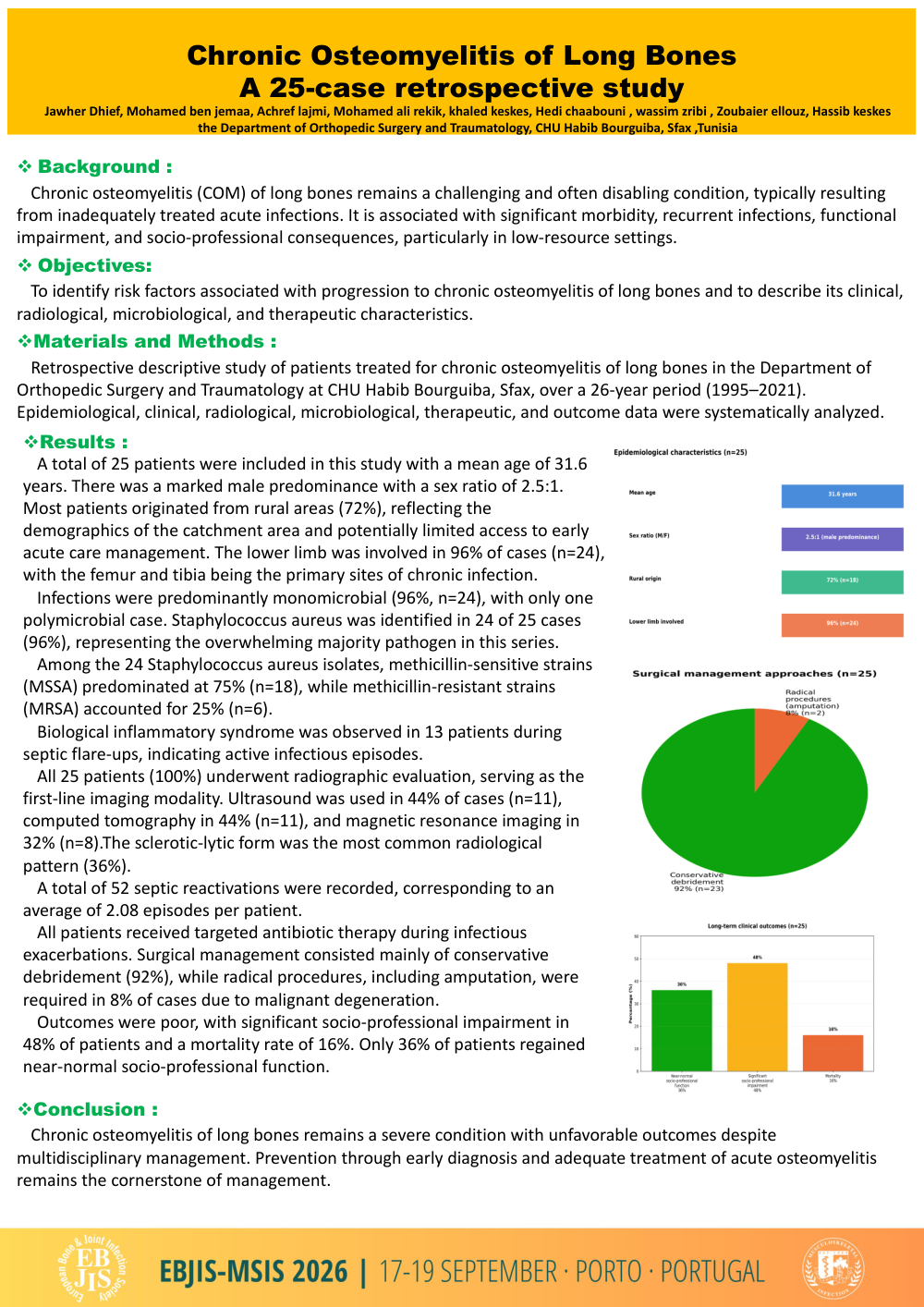
Results : A total of 25 patients were included in this study with a mean age of 31.6 years. There was a marked male predominance with a sex ratio of 2.5:1. Most patients originated from rural areas (72%), reflecting the demographics of the catchment area and potentially limited access to early acute care management. The lower limb was involved in 96% of cases (n=24), with the femur and tibia being the primary sites of chronic infection. Infections were predominantly monomicrobial (96%, n=24), with only one polymicrobial case. Staphylococcus aureus was identified in 24 of 25 cases (96%), representing the overwhelming majority pathogen in this series. Among the 24 Staphylococcus aureus isolates, methicillin-sensitive strains (MSSA) predominated at 75% (n=18), while methicillin-resistant strains (MRSA) accounted for 25% (n=6). Biological inflammatory syndrome was observed in 13 patients during septic flare-ups, indicating active infectious episodes. All 25 patients (100%) underwent radiographic evaluation, serving as the first-line imaging modality. Ultrasound was used in 44% of cases (n=11), computed tomography in 44% (n=11), and magnetic resonance imaging in 32% (n=8).The sclerotic-lytic form was the most common radiological pattern (36%). A total of 52 septic reactivations were recorded, corresponding to an average of 2.08 episodes per patient. All patients received targeted antibiotic therapy during infectious exacerbations. Surgical management consisted mainly of conservative debridement (92%), while radical procedures, including amputation, were required in 8% of cases due to malignant degeneration. Outcomes were poor, with significant socio-professional impairment in 48% of patients and a mortality rate of 16%. Only 36% of patients regained near-normal socio-professional function.
Conclusion : Chronic osteomyelitis of long bones remains a severe condition with unfavorable outcomes despite multidisciplinary management. Prevention through early diagnosis and adequate treatment of acute osteomyelitis remains the cornerstone of management.